A shipment looks simple until the vehicle can’t be replaced, can’t be late, and can’t arrive with a mark on it. That’s usually the moment a business owner realises they’re not buying ordinary transport. They’re buying risk control.
Think about the situations that trigger that change. A prototype has to reach a launch event under confidentiality. A competition car needs to move on a fixed timetable with support equipment and no room for handling damage. An EV import has to clear the border with the right declarations and battery information in place. An agricultural machine has to cross jurisdictions without turning into a paperwork problem at the first inspection point.
In those cases, price still matters, but it stops being the first question. The right questions become more practical. Who is handling the loading? Who owns the visibility from collection to delivery? Who is responsible when the shipment changes mode, lane, or customs status? Those are specialist vehicle logistics questions.
This isn’t a niche side issue in the UK. The UK automotive industry exported over 793,000 vehicles in 2023, valued at £39.6 billion, according to SMMT data cited by IMARC. At that scale, vehicle logistics isn’t just a transport function. It’s part of how manufacturers, importers, and distributors protect revenue, delivery commitments, and customer trust.
Beyond the Standard Shipment An Introduction
A standard freight move is built around capacity and route. A specialist vehicle move is built around asset sensitivity, handling discipline, compliance exposure, and timing risk.
That distinction matters because a vehicle isn’t just another unit of cargo. It may have a VIN that needs to be tracked at every handover. It may have strict loading angles, battery state constraints, confidentiality rules, or specific customs treatment. In practice, the transport plan has to reflect the vehicle’s commercial value and operational role.
A missed delivery window can create problems that don’t show up on a basic freight quote. A prototype that misses a test slot can disrupt internal programmes. A high-value import held for paperwork can tie up capital. A damaged collector vehicle can become a dispute nobody wanted, especially when liability, condition reports, and loading records weren’t managed properly from the start.
Specialist vehicle logistics starts where general haulage stops being enough.
The businesses that handle this well tend to make one important shift early. They stop asking, “How do we ship this vehicle?” and start asking, “What could go wrong with this movement, and how do we design around it?”
That changes the transport decision completely. The mode might stay on the road. It might become multimodal. The shortest route might not be the safest route. The cheapest option might become the most expensive once delay exposure, customs friction, rehandling, or claims risk are taken seriously.
For a business owner, that’s the practical definition of specialist vehicle logistics. It’s the planning, handling, visibility, and compliance discipline needed to move a vehicle where the consequences of error are high.
Defining What Makes a Vehicle Shipment Specialist
The word “specialist” gets overused in logistics. In vehicle movements, it has a clear meaning. A shipment is specialist when standard equipment, standard paperwork, or standard operating assumptions create avoidable risk.

That can apply to far more than supercars.
Typical specialist vehicle categories
High-value vehicles such as collector cars, luxury models, restored classics, and premium EVs.
Regulated vehicles such as EVs with battery documentation requirements or machinery subject to inspection and cleanliness controls.
Prototype and pre-production units where secrecy, restricted access, and exact timing matter as much as physical protection.
Oversized or non-standard equipment such as agricultural, construction, or mining vehicles that need route checks, permits, or specialist trailers.
High value changes the transport logic
High-value vehicles often need enclosed transport, controlled loading, stricter driver procedures, and better evidence of condition at collection and delivery. The issue isn’t only theft or weather exposure. It’s also vibration, ramp angle, ground clearance, and preventable cosmetic damage.
A normal carrier might say, “We move vehicles every day.” That’s not the same as saying they know how to handle a low-clearance classic with delicate trim, or a premium EV where handling mistakes can create operational and warranty headaches.
Regulation makes paperwork part of the physical move
Some shipments become specialist because the compliance burden is inseparable from the movement itself. EVs are the obvious example. The vehicle isn’t only being transported. Its battery status, declarations, and the chosen mode all affect what can be done and how.
Agricultural and related machinery can create another kind of problem. If a unit crosses borders with contamination concerns or inspection requirements, transport planning has to include cleaning, documentation, and timing discipline. If those steps are treated as admin afterthoughts, the border becomes the place where the shipment stalls.
Prototypes need control, not just protection
Prototype and pre-series vehicles create a different operating environment. Security, discretion, controlled access, and driver briefing matter as much as physical carriage. The shipment may also involve unusual collection points, testing schedules, or restricted destination procedures.
That means the provider needs more than trucks. They need process control. Who can see the vehicle, who can touch it, what data is visible, and how deviations are escalated all need to be defined before collection.
If a shipment would trigger a difficult internal post-mortem after a delay, inspection issue, or loading incident, treat it as specialist from day one.
Core Transport and Handling Methods
Choosing the right method starts with a blunt question. What are you optimising for: cost, security, speed, or handling control? You usually can’t maximise all four at once.
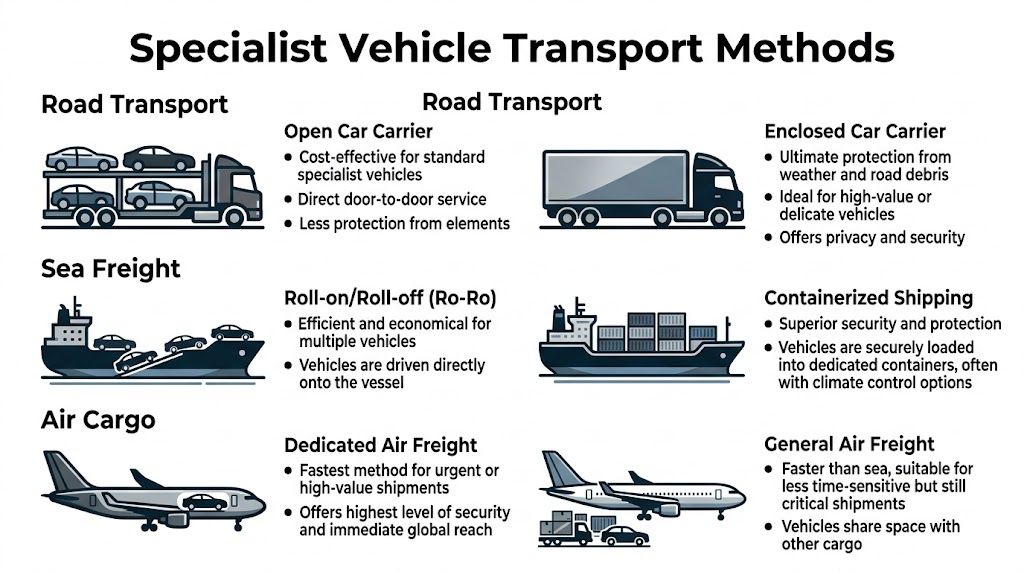
Road transport options
On UK and near-Europe lanes, road is often the core method because it offers direct collection and delivery with fewer handovers. That matters when every handover creates another chance for delay, damage, or reporting inconsistency.
The decision on road isn’t just open versus enclosed. It’s about the full handling profile.
| Method | Best fit | Main advantage | Main trade-off |
|---|---|---|---|
| Open car carrier | Routine movements where exposure risk is acceptable | Efficient and practical for many flows | Less protection from weather, debris, and visibility |
| Enclosed carrier | High-value, delicate, confidential, or presentation-critical vehicles | Better protection, privacy, and handling control | Higher cost and tighter equipment availability |
| Low-loader or specialist trailer | Oversized, low-clearance, or non-standard vehicles | Safer loading geometry and better fit for unusual dimensions | Requires more route planning and operational coordination |
Top-tier operators use advanced closed truck configurations and invest in specialised driver training on precise loading protocols, which directly reduces damage risk for irreplaceable assets such as prototypes and homologation vehicles, as described by CEVA’s specialist vehicle transport overview.
That point is often underestimated by buyers. They focus on the trailer type and ignore the loading method. In practice, loading discipline is where many problems start. Poor ramp choice, rushed wheel placement, or incorrect securement can create damage before the vehicle has travelled any meaningful distance.
Sea freight options
Sea freight usually enters the conversation for international moves, larger programmes, or when road-only routing isn’t realistic. The two main choices are RoRo and containerised shipping, and they solve different problems.
RoRo works well for drivable vehicles moving on established trade lanes. It’s operationally efficient and often suits volume programmes. If your shipment fits that profile, it’s worth understanding how roll-on/roll-off shipping works in practice.
Container shipping is often the stronger fit for higher-control moves. It suits non-running vehicles, confidential units, shipments with parts or support equipment, and movements where sealed handling and tighter isolation matter.
Air freight when the clock matters more than the budget
Air freight is the premium answer to a narrow but important set of problems. It makes sense when delay costs more than the transport premium, when a launch or race calendar leaves no slack, or when recovering programme time is commercially justified.
That doesn’t mean air is automatically the safest choice. It’s the fastest. Safety still depends on correct preparation, acceptance requirements, loading plans, and the provider’s experience with vehicle shipments in airport cargo environments.
Practical rule: Choose the mode based on the consequence of failure, not the headline transit time.
Loading and securement decide whether the plan survives contact with reality
Mode selection gets most of the attention. Securement should get more.
For specialist vehicle logistics, loading needs to account for:
- Ground clearance and approach angle so ramps, deck heights, and loading positions don’t create contact damage.
- Weight distribution so the vehicle sits correctly during carriage and doesn’t create instability or pressure issues.
- Securement method so tie-down points, tyre straps, wheel chocks, and chassis-related considerations match the vehicle’s design.
- Power and battery status so the vehicle can be moved, monitored, and handed over without improvised fixes.
- Condition recording so disputes can be resolved with evidence, not opinion.
Some operators are excellent at moving standard units but weak at exceptions. That’s where things go wrong. A non-runner requires one loading plan. A low-clearance collector vehicle requires another. A race car with splitters, wide track, and event deadlines requires another again.
What works and what usually fails
The strongest specialist operations tend to follow a few habits consistently.
- Pre-move technical review: They ask for dimensions, running condition, clearance issues, restrictions, battery status, and handover rules before they assign equipment.
- Equipment matched to the vehicle: They don’t force an awkward fit because a cheaper trailer is available.
- Driver briefing with asset-specific instructions: The movement is treated as a controlled job, not a generic collection.
- Condition and handover evidence: Photos, notes, and exception logging are built into the process.
What doesn’t work is equally clear.
- Late changes to mode or equipment: These usually create rushed loading and poor communication.
- Assuming all enclosed transport is equal: Trailer type matters, but operator discipline matters more.
- Separating paperwork from operations: If customs or acceptance requirements are unresolved, the movement isn’t really ready.
- Buying only on price: The cheapest quote often assumes the smoothest version of the job.
That’s why transport method and handling method should be chosen together. A technically correct route can still fail if the loading plan is weak.
Navigating Customs and Regulatory Compliance
Specialist vehicle shipments often fail on paperwork long before they fail on transport. The truck turns up. The vessel space is booked. The customer expects delivery. Then a customs query, inspection trigger, or missing document turns a clean plan into delay storage and phone calls.
For UK businesses, this is still one of the biggest practical pressure points. Post-Brexit, UK importers face up to 25% higher customs delay risks than EU peers, and agri-food exporters have seen a 15% rise in veterinary and customs inspection backlogs since Q1 2025, according to industry analysis on current finished vehicle logistics trends.
Customs problems usually start before departure
Most customs disruption comes from one of three failures. The documentation is incomplete. The data is inconsistent across parties. Or the shipment was booked before someone checked whether the declared movement matched the actual commercial and regulatory reality.
That sounds obvious, but it happens constantly. A vehicle can be described correctly in commercial terms and still be wrong for customs or carrier acceptance. Prototype status, temporary movement, return flows, battery-related information, proof of origin, and supporting documents all need to align.
If you’re trading on UK-EU routes, it helps to stay close to border process updates such as the France customs clearance changes from 1 September 2025 and their logistics impact. The rulebook isn’t static, and specialist traffic suffers first when process changes are missed.
The compliance checklist that matters
For most specialist vehicle movements, the useful question isn’t “What document do we usually need?” It’s “What evidence will the border, carrier, and consignee expect for this exact vehicle and lane?”
A practical review should include:
- Movement purpose: Sale, temporary export, return, event use, testing, repair, or internal transfer.
- Vehicle identity: VIN, status, and any differences between physical asset details and commercial paperwork.
- Origin evidence: Especially where preference, duty treatment, or proof of origin may affect clearance.
- Mode-specific requirements: Sea, road, and air each have their own acceptance expectations.
- Inspection exposure: Whether the shipment could draw customs, veterinary, or related checks.
- Delivery sequence: Whether the consignee can accept immediately, or whether storage and controlled release are needed.
Compliance isn’t a document pack. It’s an agreement between the physical shipment, the declared movement, and the border process.
Vehicle-specific regulation changes the routing decision
EVs are a good example. Businesses sometimes treat battery-related requirements as a technical matter for the warehouse or airline. That’s too narrow. Battery information can affect routing, timing, handling, and mode choice.
The same applies to machinery or specialist vehicles that may trigger cleanliness or inspection concerns. If a shipment could be examined for contamination or related compliance issues, build that into the schedule. Don’t plan to the perfect transit time and ignore this border risk.
What business owners should insist on
If you’re shipping specialist vehicles regularly, ask your logistics provider to confirm four things before collection:
- Who owns the customs file. One party should be clearly accountable for document completeness and submission coordination.
- How discrepancies are escalated. You need a named process for mismatched data, late documents, or inspection holds.
- What mode-specific checks were completed. Especially for EVs, prototypes, and temporary movements.
- What happens if the shipment is stopped. The answer should include communication flow, document retrieval, and next-step control.
Businesses that do this well don’t eliminate friction. They reduce avoidable friction. That’s the difference that protects delivery dates and margin.
Integrating Strategy and Risk Management
Specialist vehicle logistics becomes easier to manage when you stop treating transport, insurance, and tracking as separate purchases. They work better as one risk system.
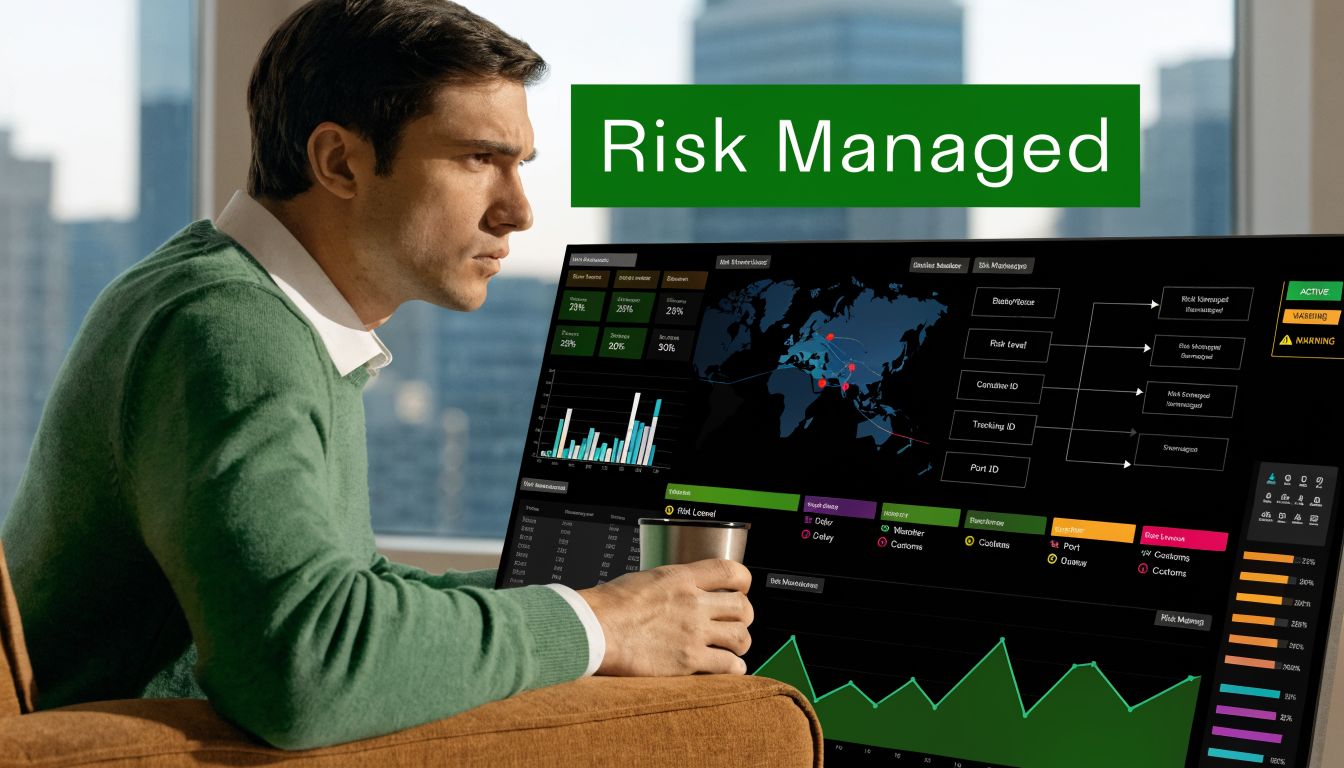
That matters because most failures don’t come from a single dramatic event. They come from small gaps between functions. The route was fine, but handover control was weak. Insurance existed, but the declared value or exclusions didn’t match the actual exposure. Tracking was available, but nobody had a clear response process when the ETA slipped or a handover event didn’t register properly.
Multimodal planning only works when the handovers are designed
A multimodal route can be the smartest option for balancing timing, budget, and access. It can also be the easiest way to lose control if the handovers aren’t planned in detail.
Every transfer point raises practical questions. Who inspects the vehicle? Who confirms condition? Who validates identity, keys, documents, and release authority? What happens if the arriving data conflicts with the yard record or carrier manifest?
Those questions sound operational, but they’re strategic because they control claims exposure and recovery speed. If your provider can’t explain the handover process clearly, the route may be theoretically good and operationally fragile.
Visibility should shorten decisions, not just generate updates
The best tracking set-up doesn’t merely show dots on a map. It helps people intervene early enough to matter.
According to Identec’s analysis of reliable vehicle logistics flows, VIN-level tracking and event-based visibility such as dynamic ETAs and proactive alerts can shorten reaction times from hours to minutes, while process controls at handovers reduce variability by 30% to 50%.
That’s valuable because specialist vehicles don’t tolerate ambiguity well. If a handover event is late, contradictory, or missing, the team loses confidence fast. Then everyone starts chasing by phone and email, which usually means the process was underdesigned from the start.
Insurance should follow the real consequence of loss
Many businesses assume carrier liability equals adequate protection. Often it doesn’t.
For specialist vehicle logistics, insurance should reflect the commercial reality of the shipment. Consider:
- The true value of the asset, not just its invoice treatment.
- The consequence of delay, especially for launches, events, testing, or contractual delivery commitments.
- The difficulty of replacement, which can be more important than market value for prototypes or restored vehicles.
- The points of highest exposure, such as loading, transhipment, storage, and border holds.
A provider doesn’t need to promise perfection. They need to identify where the exposure sits and make the coverage conversation concrete before the move starts.
Good risk management is specific. It names the failure points, the owner of each control, and the response if that control breaks.
A practical operating model for business owners
If you’re managing recurring specialist movements, build your review around these four controls:
| Control area | What to ask | Why it matters |
|---|---|---|
| Routing | Is the route chosen for convenience or for controlled handovers and realistic timing? | A fast route on paper can create more risk than a steadier one |
| Visibility | Will I get VIN-level milestones, exceptions, and proactive alerts? | Updates are only useful if they trigger action |
| Liability and insurance | What is covered, where are the exclusions, and what value is declared? | Claims disputes usually expose assumptions made too late |
| Exception management | Who acts when the shipment deviates, and how quickly? | Delays become expensive when nobody owns the response |
Experienced operators separate themselves from basic carriers. They don’t just move the vehicle. They build a movement that can survive normal disruption without collapsing into confusion.
Evaluating Costs and Selecting Your Logistics Partner
The first quote rarely tells you the actual cost of a specialist vehicle move. It tells you the carrier’s opening position.
That’s why procurement decisions go wrong when they compare only line-haul price. In specialist vehicle logistics, the final cost is shaped by handling complexity, equipment fit, customs exposure, insurance needs, timing pressure, and the amount of management the provider has to do when something changes.
What actually drives the quote
Some cost drivers are obvious. Distance, mode, and urgency always matter. Others are less visible and often more decisive.
- Vehicle characteristics: A non-runner, low-clearance car, prototype, or oversized unit is harder to plan than a routine drivable vehicle.
- Equipment requirement: Enclosed transport, low-loaders, specialist trailers, or controlled storage all affect price.
- Route complexity: Border activity, transhipment points, difficult collection sites, and restricted delivery windows all add operational cost.
- Compliance burden: Customs support, inspections, declarations, and document management consume real time.
- Risk allocation: Better condition reporting, tighter visibility, and stronger exception management don’t happen for free.
That doesn’t mean buyers should accept opaque pricing. It means they should ask what the quote assumes. If a low price depends on flexible timing, minimal reporting, generic equipment, or outsourced customs support, compare that with the actual needs of the shipment.
The better partner selection test
The UK fleet vehicle market provides a useful service benchmark. The British Vehicle Rental and Leasing Association notes that logistics for fleet vehicles alone exceeds 1.5 million units annually, supported by 24/7 operations and GPS telematics achieving 99.5% on-time delivery rates, as cited in Fortune Business Insights’ finished vehicle logistics market review.
That doesn’t mean every specialist shipment should be judged by fleet logic. It does show what strong service discipline looks like. Availability, visibility, and operational consistency are measurable capabilities, not marketing phrases.
Questions worth asking before you appoint anyone
A useful tender conversation should test capability, not just enthusiasm. Ask questions like these:
Do you operate your own equipment or rely mainly on subcontracted capacity?
This affects control, consistency, and response speed when plans change.Who handles customs and document coordination?
If the answer is fragmented, expect more chasing and more risk at the border.How do you manage exceptions after hours?
Specialist traffic often runs outside office-friendly windows.What is your process for condition reporting and handover control?
You want a repeatable method, not “our drivers know what to do”.Have you moved this type of vehicle before?
Relevant experience matters more than broad claims about moving vehicles generally.What visibility will I receive during the movement?
A portal alone isn’t enough if exception ownership is unclear.
If you’re comparing providers for broader cross-border movements as well, it helps to understand what a full-service operator should cover in international freight forwarding services. Specialist vehicle logistics works best when road, sea, air, customs, and warehousing can be coordinated as one commercial decision.
The cheapest provider is often the one asking you to absorb the most hidden risk.
What tends to work in practice
The strongest partner is usually the one who asks difficult questions early. They’ll want to know the exact asset, route constraints, compliance profile, timing sensitivity, and handover conditions before they commit. That can feel slower at quotation stage. It’s usually a sign they know where specialist jobs fail.
The weakest partner often sounds easiest to buy. Fast quote. Minimal questions. Broad assurances. Those jobs become expensive when the first exception appears.
Your Strategic Partner in Specialist Logistics
Specialist vehicle logistics isn’t a premium version of standard transport. It’s a different discipline with different consequences when it goes wrong.
The right approach starts with accurately classifying the shipment. A high-value classic, a confidential prototype, an EV crossing borders, and an oversized machine may all be “vehicles”, but they don’t need the same routing, equipment, handling, or compliance treatment. Once that’s clear, the practical decisions get sharper. You can choose the mode based on real exposure, build loading and handover controls around the asset, and make customs part of the movement plan rather than an afterthought.
That’s also why the strongest operators think in systems. They connect transport mode, loading method, insurance, documentation, and visibility into one operating model. When those elements are coordinated, delays are easier to absorb, exceptions are easier to resolve, and claims are less likely to become arguments.
For business owners, that changes the buying decision. You’re not merely selecting a carrier. You’re selecting the team that will protect the value of the vehicle, the timetable around it, and the commercial relationship behind the shipment.
If the movement is routine, the market gives you many options. If the movement is sensitive, regulated, high-value, or time-critical, partner quality becomes the deciding factor. That’s where specialist vehicle logistics earns its name.
If you need a logistics partner that can coordinate specialist vehicle movements across road, sea and air, handle customs in-house, and keep complex cross-border shipments visible and controlled, speak with Multica Group. Their team supports end-to-end multimodal transport for businesses moving high-value, regulated, and time-critical cargo across Europe, Asia and the United States.