If you're sourcing stock, components, samples, or finished goods from the United States, you're probably juggling three questions at once. How do I get it here without delays, what will it really cost me, and who is carrying the risk at each stage?
That’s the shape of an import from usa to uk project. It isn’t just a customs task and it isn’t just a freight booking. The businesses that handle this well don’t focus only on the shipping quote. They line up mode choice, Incoterms, customs data, and compliance before the cargo moves. That’s what protects margin.
A cheap freight rate can still produce an expensive shipment if the commodity code is wrong, the supplier invoices under the wrong term, or the cargo needs a licence nobody spotted until arrival. A more expensive route can still be the better commercial decision if it cuts stockout risk, reduces handling, or gives you tighter control over customs clearance. That’s the lens worth using throughout this process.
The Growing Importance of USA to UK Imports
The USA matters more to UK importers than many buying teams assumed even a short time ago. In October 2025, the United States became the United Kingdom's largest import partner, accounting for 13% of total goods imports, and annual UK imports from the US totalled US$114.27 billion in 2025, up 24% from 2024, driven by categories such as machinery and mineral fuels, according to the UK overseas trade in goods statistics commentary for October 2025.
That matters for practical reasons, not just macroeconomic ones. If you're buying machinery, industrial inputs, specialist parts, consumer goods, or regulated products from US suppliers, you're now operating on a lane that has become strategically important to UK trade. More volume usually brings more opportunity, but it also brings more pressure on booking capacity, customs precision, and inland coordination.
Why this trade lane needs a different mindset
A USA to UK shipment usually crosses several operational boundaries. Export handling in the US. Main carriage by air or sea. UK customs entry. Port or airport handling. Final inland delivery. If one handoff goes wrong, the whole chain slows down.
For that reason, the right question isn't “what's the shipping rate?” It’s “what is my total landed cost, and what setup gives me the best control over it?”
Practical rule: Treat transatlantic imports as a margin-management exercise. Freight is one line in the cost stack, not the whole stack.
What importers are getting wrong
A lot of businesses still buy from the US in a reactive way. They approve a purchase, let the supplier decide the shipping term, and only look closely at customs once the shipment is already moving. That approach works until the first hold, reclassification issue, or urgent replenishment.
A stronger setup usually includes:
- Pre-agreed commercial terms: The supplier and buyer know who books freight, who arranges export formalities, and who carries risk.
- Customs data checked before dispatch: Commodity code, description, value basis, and origin are reviewed before the cargo departs.
- Mode selected by business objective: Air for urgency and continuity, ocean for cost discipline, split shipments when the order profile justifies it.
- A single operating plan: Booking, documents, customs, and delivery are coordinated as one workflow.
That’s the difference between buying internationally and building a repeatable import operation.
Laying the Groundwork Your Pre-Shipment Toolkit
Before the first pallet is collected or the first carton is labelled, you need the shipment’s identity documents in place. Most customs problems don’t start at the frontier. They start earlier, when basic shipment data is incomplete, inconsistent, or left to the supplier without enough buyer oversight.
The most important item is your GB EORI number. For imports into England, Scotland, or Wales, a GB EORI is mandatory, and obtaining one typically takes about 5 business days. It’s required for submitting customs declarations through CDS, and incorrect details, especially HS codes, are a primary cause of clearance delays and can lead to fines up to £2,500 per violation, as outlined in this guide on shipping goods from the USA to the United Kingdom.
Start with the identifier that unlocks customs
Think of the EORI as the passport for your goods. Without it, the declaration can’t be filed correctly in your name.
If your business imports into Northern Ireland, the setup differs, so that needs checking separately. For most UK importers bringing goods into Great Britain, the core point is simple. Apply early, verify the details, and store the number where your finance, logistics, and customs teams can access it.
The documents that must agree with each other
Customs doesn’t just want documents. Customs wants matching documents. If the invoice says one thing, the packing list another, and the booking data something else, you create doubt before the goods even arrive.
Your pre-shipment file should usually include:
- Commercial invoice: This should clearly state seller, buyer, goods description, values, currency, and agreed Incoterm.
- Packing list: This needs to show how the goods are physically packed, including carton or pallet breakdown.
- Commodity code decision: The correct HS or tariff classification drives duty treatment and checks.
- Origin information: You need the actual country of origin, not just the country of export.
- Consignee and consignor details: Names and addresses must line up across documents.
- Transport instructions: Collection point, delivery point, booking references, and handling notes should be final before cargo handover.
One mismatched line on the invoice can create far more cost than a slightly higher freight quote.
HS codes are not admin. They are cost controls
Many importers underestimate how much sits behind classification. The commodity code affects duty treatment, compliance screening, and whether the goods attract extra scrutiny. It also shapes how quickly a declaration can be accepted.
That means the HS code shouldn’t be guessed by a salesperson, copied from an old order without review, or lifted from a supplier document without checking whether it matches the actual product entering the UK. Components, kits, finished goods, and accessories can sit in very different classification positions even when they look commercially related.
A practical internal check looks like this:
- Get the exact product specification from the supplier.
- Match the product to the tariff wording, not just to a broad product category.
- Review supporting documents such as technical sheets, composition details, or intended use.
- Confirm that the invoice description matches the classification logic.
What works before shipment leaves the USA
The strongest import files are usually built before cargo pickup, not after departure. That means someone should review the documents while there is still time to correct them.
A useful discipline is to ask these questions before authorising dispatch:
| Checkpoint | What to confirm |
|---|---|
| Buyer identity | EORI and consignee details are correct |
| Product identity | Description is clear and commercially accurate |
| Classification | HS code reflects the actual product |
| Value basis | Invoice value matches the commercial agreement |
| Shipping term | Incoterm is stated and understood by both sides |
| Handling needs | Any special storage, temperature, or regulatory needs are flagged |
If you skip this stage, you usually don’t save time. You just move the work into a more expensive part of the journey.
Navigating the Financials UK Customs Duties and VAT
The easiest way to lose control of an import from usa to uk is to treat customs charges as a rough estimate. They aren’t. They’re part of your landed cost model, and they need to be budgeted with the same discipline you apply to purchase price and freight.
Under the 2025 BTOM rules, VAT at 20% is levied on the CIF value plus duty, and Postponed VAT Accounting can slash cash flow impact by 20 to 30% for VAT-registered businesses, according to this UK customs and importing guide for 2025.
Build the landed cost from the right base
The financial base for UK import charging is the CIF value. That means:
- Cost
- Insurance
- Freight
In simple terms, you start with the goods value and add the transport and insurance elements that form the customs value basis. Then duty is applied according to the commodity code. Then VAT is calculated on top of the CIF value plus any duty due.
A practical formula looks like this:
- Goods value + shipping + insurance = CIF
- Duty = tariff rate applied to CIF
- VAT = 20% of CIF plus duty
If you need a planning tool before placing the order, a specialist import tax calculator for UK imports is useful for modelling likely landed cost scenarios before the shipment is booked.
Why buyers still get surprised by the final bill
The surprise usually isn’t the existence of duty or VAT. It’s the base used to calculate them and the costs that sit around them.
Common blind spots include:
- Assuming VAT applies only to the goods value
- Forgetting insurance in the customs value
- Using the wrong Incoterm when estimating liability
- Pricing the shipment on freight cost alone
- Ignoring broker, port, screening, or handling charges
Those extra charges don’t all arise on every shipment, but they matter when you compare one route against another. Two shipping options with similar transit outcomes can produce very different landed costs once handling and customs-touch points are included.
Margin check: A shipment that looks cheaper at origin can become more expensive after duty, VAT timing, and arrival charges are added.
Duty is product-specific, not shipment-specific
Businesses sometimes ask, “What is the duty rate from the USA to the UK?” That question is too broad to be useful. Duty depends on the goods, not just the route.
That’s why classification work matters so much. If the commodity code is wrong, your cost forecast is wrong. Worse, your customs entry may still be submitted, but on the wrong basis. That creates rework, queries, and potentially a post-entry correction.
This short explainer can help if you want a visual overview of the charging logic and customs process:
Postponed VAT Accounting changes the cash conversation
For VAT-registered importers, Postponed VAT Accounting is one of the most useful tools available. Instead of funding import VAT immediately as a cash outlay at the border, you account for it through your VAT return.
That doesn’t remove the tax obligation. It changes the timing and reduces pressure on working capital. For businesses importing regularly, that can make a significant difference to purchasing flexibility and stock planning.
Here’s where it becomes strategic. If you import frequently, the question isn’t just “what is the duty bill?” It’s also “how much cash gets tied up, when, and under which import setup?” A business with good VAT handling can often support a steadier replenishment cycle than one that treats every import VAT payment as a cash shock.
A practical landed-cost review before you buy
Before you approve any US purchase order, pressure-test the numbers with a short review:
| Cost element | Why it matters |
|---|---|
| Goods value | The commercial base of the shipment |
| Freight cost | Changes by mode, urgency, and service scope |
| Insurance | Forms part of CIF and protects cargo value |
| Duty exposure | Depends on classification and product type |
| VAT treatment | Affects both total cost and cash timing |
| Arrival charges | Handling, brokerage, and delivery affect final margin |
If you can’t explain each line clearly before dispatch, you don’t yet have a reliable landed cost.
Choosing Your Path Air Freight vs Ocean Freight
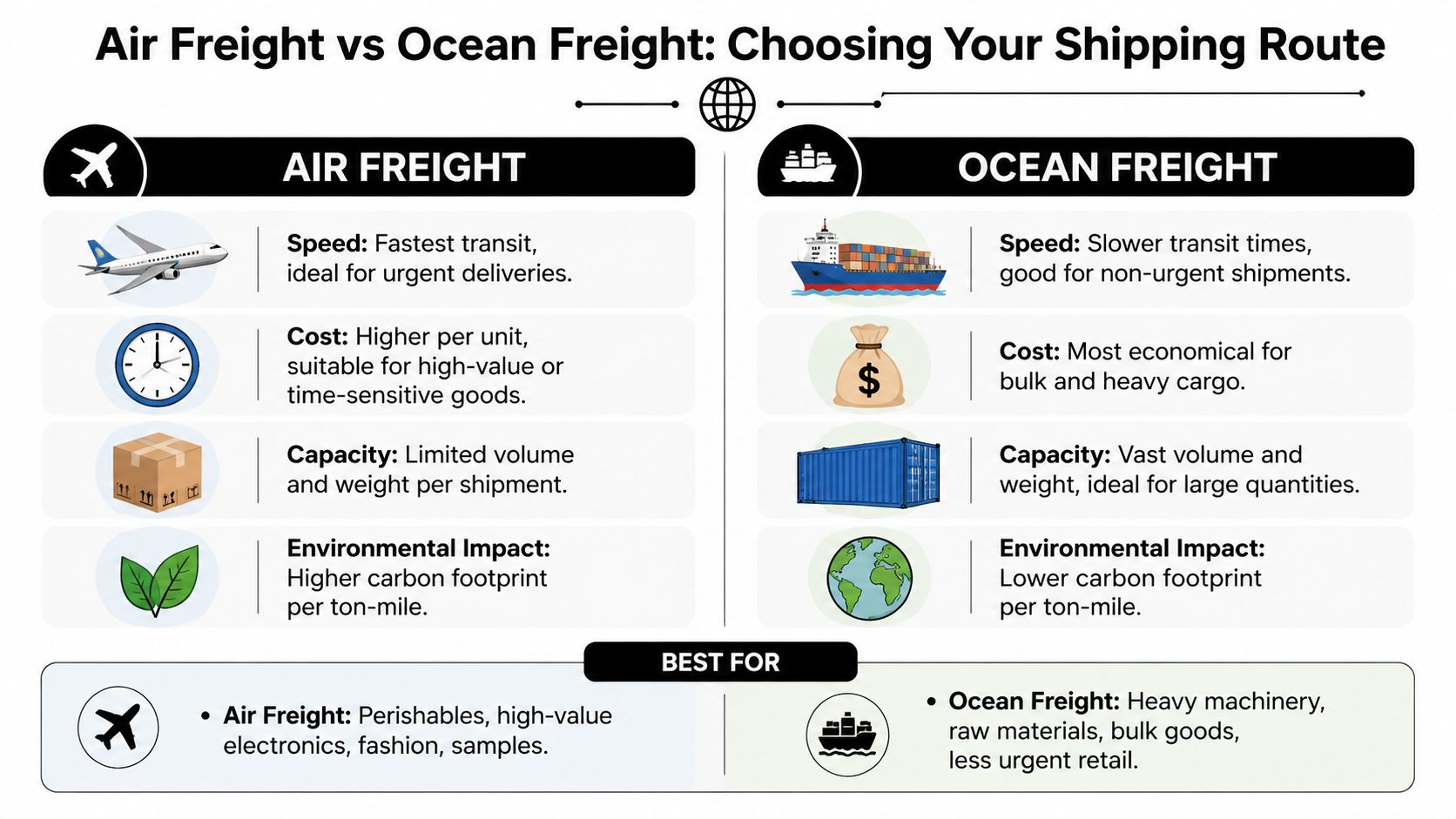
Mode choice is where strategy becomes visible. This is the point where many importers either protect margin or erode it. The wrong mode doesn’t just affect speed. It affects customs timing, inventory risk, handling patterns, and how much flexibility you keep if the order changes.
Cost comparison
Air freight usually carries a higher transport cost per unit. That makes it harder to justify for low-margin, bulky, or heavy goods unless the business cost of waiting is even higher.
Ocean freight is usually the stronger option for larger replenishment volumes, heavier cargo, and products where transit speed isn’t the main driver. It gives you more room to spread transport cost across more units, especially when the purchase profile suits container planning.
A useful way to frame the choice:
- Air freight fits urgency: You pay more for speed, responsiveness, and lower in-transit time.
- Ocean freight fits scale: You trade speed for better unit economics on larger or denser cargo.
- Split-mode strategies fit mixed demand: One urgent tranche moves by air, the balance follows by sea.
That last option often works well when a buyer needs launch stock, replacement parts, or a first-wave replenishment quickly, but doesn’t need the full order on the same timeline.
Speed and operational control
If your stock position is thin, air freight can be the least expensive choice in commercial terms even when it is the most expensive in freight terms. That sounds contradictory until you measure the cost of a late launch, missed production slot, or empty shelf.
Ocean freight brings longer transit and more handoffs, but it can support very stable planning when demand is predictable and ordering discipline is strong. It suits businesses that can forecast well and buy in larger cycles.
Air is often bought because the cargo is urgent. In practice, it’s often urgent because the planning failed earlier.
Volume and shipment profile
Mode choice gets clearer when you look at the physical profile of the cargo.
Air freight usually makes sense for
- High-value goods: Electronics, specialist parts, and premium products where carrying cost matters less than availability
- Time-critical replenishment: Goods needed to protect production, service levels, or launch dates
- Samples and prototypes: Small consignments where speed supports buying or approval decisions
- Perishable or sensitive items: Products that deteriorate or lose value if they sit in the chain too long
Ocean freight usually makes sense for
- Heavy goods: Machinery, dense materials, and industrial products
- Bulk orders: Larger procurement cycles where unit economics drive the decision
- Stable retail replenishment: Goods ordered against predictable demand
- Cargo that needs more space than speed: Shipments where volume is the central factor
FCL and LCL are different commercial tools
Within ocean freight, the next decision is often FCL or LCL.
FCL works best when you have enough cargo to use a container efficiently or when you want tighter control over handling. Fewer cargo touches usually means less consolidation risk and a cleaner chain.
LCL suits smaller ocean shipments that don’t justify a full container. The trade-off is that shared-container movements involve more consolidation and deconsolidation steps, so handling complexity rises.
A simple comparison helps:
| Option | Best use | Main trade-off |
|---|---|---|
| Air freight | Urgent, light, high-value cargo | Higher transport cost |
| Ocean FCL | Large, stable, bulk shipments | Slower transit |
| Ocean LCL | Smaller non-urgent sea freight | More handling points |
What actually works in practice
The best mode decision usually comes from one question. What cost are you trying to minimise?
If the answer is freight spend alone, you’ll tend to overuse ocean freight. If the answer is stockout risk alone, you’ll tend to overuse air. Most mature import operations optimise for total landed cost plus service continuity.
That often leads to choices like these:
- A launch order moves by air, with the replenishment by ocean
- Dense industrial cargo moves FCL, while urgent spares move air express
- Smaller regular purchase orders are consolidated into LCL until order volume supports a different structure
A decision framework for business owners
Ask these questions before choosing the route:
- What happens if the goods arrive late?
- How much margin can the shipment carry?
- Is the cargo bulky, dense, fragile, or regulated?
- Do I need all of it now, or just enough to protect continuity?
- Will more handling create more risk than the freight saving justifies?
If you answer those accurately, the mode choice usually becomes much easier.
Defining Responsibility How Incoterms Impact Cost and Risk
Incoterms shape the commercial handover between buyer and seller. They decide who arranges what, who pays for what, and at which point risk transfers. If freight mode determines the route, Incoterms determine the responsibility map.
The easiest way to explain them is as a relay race. The goods move through a chain of handoffs. At a specific point, the baton passes from seller to buyer. The earlier that handoff happens, the more control and workload the buyer takes on. The later it happens, the more the seller manages.

A deeper primer on the handover points is available in this guide to Incoterms 2020 and safe international trade.
EXW gives control, but also work
Under EXW, the seller makes the goods available at their premises. From there, the buyer takes on a great deal of the operational burden.
That can work well when the buyer has a strong forwarder setup, wants direct control over collection, and doesn’t want the supplier adding freight margin or making route decisions. But EXW is often harder than it looks. It pushes more coordination onto the buyer very early in the chain, including pickup planning and export-side execution.
FOB is often the balanced option
FOB is frequently more practical for international trade than EXW because the seller is responsible for getting the cargo to the departure port and loading it for export. The buyer then takes over for the main carriage and beyond.
For many UK importers buying from established US suppliers, FOB creates a useful balance. The seller handles origin responsibilities they are close to. The buyer keeps control over the expensive international and UK-side parts of the movement.
Working rule: If you want control over freight and customs without taking on every origin task yourself, FOB is often easier to manage than EXW.
DDP looks simple, but it can hide cost
DDP appeals to buyers because it seems turnkey. The seller handles transport, import formalities, and delivery, with charges wrapped into the sale.
That simplicity can be useful, especially for smaller or less experienced importers. But DDP can also reduce transparency. If the supplier controls the route, customs process, and duty handling, you may have less visibility over where costs sit and less influence over how problems are resolved.
A quick comparison:
| Incoterm | Seller handles | Buyer handles | Main trade-off |
|---|---|---|---|
| EXW | Minimal origin obligation | Almost everything else | Maximum control, maximum buyer workload |
| FOB | Origin through loading at departure port | Main carriage, import, final delivery | Balanced control |
| DDP | Most of the end-to-end move | Limited direct involvement | Simplicity, but less visibility |
Choose the term that matches your operating model
The right term depends on your capability. If you have internal logistics knowledge and want to control landed cost, FOB often gives a strong commercial position. If your supplier has weak export processes, EXW may create more trouble than control. If you need a simple buying experience, DDP may help, but only if the supplier can execute it transparently.
The wrong Incoterm usually reveals itself after the order is placed. The right one is negotiated before the invoice is issued.
Managing Special Cargo and UK Compliance Rules
General cargo follows one set of expectations. Regulated cargo follows another. If you import food-related products, pharmaceuticals, life sciences materials, chemicals, controlled items, or consumer products with product-specific obligations, the customs process is only one layer of the job.
According to the UK government consultation on reforming the customs treatment of low value imports into the United Kingdom, regulated goods such as pharmaceuticals or agri-food may require specific import licences and may face anti-dumping duties, and the removal of duty relief on imports under £135 is planned by 2029, which will materially affect e-commerce importers that currently rely on the low-value position.
Regulated goods need a separate import workflow
The biggest mistake in regulated shipping is trying to run it through a standard process with a few extra documents bolted on. That rarely works well.
For special cargo, the shipment plan often needs to answer additional questions before booking:
- Does the product need an import licence?
- Is there a veterinary, health, or product-control requirement?
- Will the goods attract anti-dumping treatment or other trade remedies?
- Are there packaging, marking, or product conformity requirements?
- Does the route support the checks required on arrival?
For goods that need those layers, route design matters. Not every service pattern is equally suitable once inspections, document review, or specialised handling come into play.
Pharmaceuticals and agri-food carry higher compliance risk
These product groups often trigger more document scrutiny than general industrial cargo. The issue isn’t just customs duty. It’s whether the goods can legally enter, how they must be presented, and whether the importer has lined up the required approvals.
That means your import file may need more than the standard invoice, packing list, and shipping data. Depending on the goods, you may also need licence support, certificates, and a route that can accommodate inspection procedures without compromising the product.
If your business handles sensitive goods, it also helps to review whether the cargo falls into a more specialist transport category. This overview of hazardous goods transport requirements is useful for businesses moving products that need additional handling discipline.
Special cargo should never be treated as “normal freight plus paperwork”. The compliance path shapes the transport plan from the start.
The low-value import change matters for e-commerce
Many small-parcel import models have been built around the current treatment of low-value consignments. The planned removal of customs duty relief on imports under £135 by 2029 changes that picture.
For e-commerce brands and distributors, that means the commercial model may need to shift before the rule changes arrive. The most exposed businesses are usually those importing frequent small consignments with thin margin and a high administrative touch count.
Three commercial responses are worth considering:
- Consolidate where possible so that customs and handling are managed more deliberately.
- Revisit SKU-level landed cost rather than relying on old low-value assumptions.
- Review Incoterms and fulfilment structure so responsibility for import charges is commercially clear.
Compliance planning is a route decision, not just a legal decision
Importers often separate “compliance” from “logistics.” In practice, that split causes delays. The route, service, customs process, and product obligations should be designed together.
A practical review before shipment should cover:
| Compliance area | What to test |
|---|---|
| Product controls | Does the item need a licence, certificate, or special marking? |
| Customs exposure | Is there any risk of anti-dumping or additional scrutiny? |
| Route fit | Can the chosen port or airport support the required checks? |
| Packaging and handling | Will product integrity hold through the selected service? |
| Commercial impact | Does the landed-cost model still work after compliance costs? |
If those answers are vague, the shipment isn’t ready.
Partnering for a Seamless Transatlantic Supply Chain
A reliable import from usa to uk operation is never just one good customs entry or one well-priced shipment. It’s the result of decisions that work together. Mode choice affects timing and cost. Incoterms affect control and risk. Documentation affects clearance. Compliance rules affect route design. Cash-flow planning affects how confidently you can keep buying.
That’s why experienced importers usually stop treating these as separate tasks. They build one operating model that connects procurement, freight, customs, and delivery. When that model is strong, you reduce avoidable surprises. You also get better at making trade-offs on purpose instead of making them under pressure.
The key value of a capable freight forwarding partner sits in that coordination. Not just booking a container or finding an air service, but aligning the shipment plan with the commercial objective behind it. That matters even more on transatlantic flows, where one weak handoff can affect every stage after it.
If your imports are regular, high-value, urgent, regulated, or operationally important, simplification matters. One coordinated setup usually outperforms a patchwork of separate providers, scattered data, and last-minute fixes.
If you want a partner that can coordinate road, sea and air movements, manage customs clearance, support regulated cargo workflows, and bring real visibility to your transatlantic supply chain, speak to Multica Group. Their multimodal approach is built for businesses that need more than a freight booking. They need a dependable import operation.