A chilled container is loaded, sealed, customs-cleared, and sitting at the port. The booking looked fine on paper. Then the handover slips, the plug-in window narrows, a document query appears, and suddenly you’re not managing freight. You’re managing risk.
That’s the reality for anyone moving produce, seafood, dairy, life sciences products, or any cargo that can’t tolerate a broken cold chain. A refrigerated cargo ship isn’t just transport. It’s a moving temperature-controlled environment that has to stay stable while your goods pass through terminals, inspections, power connections, and multiple transport legs.
When it works, the shipment arrives saleable, compliant, and on time. When it doesn’t, the costs spread quickly. Goods can be rejected, relationships can fray, and one avoidable delay can upset downstream stock planning across several sites.
Keeping Your Cool in Global Trade
A lot of shippers reach the same point in the cycle. Purchase orders are confirmed, production is packed, and the pressure shifts from making the product to protecting it. If your cargo is temperature-sensitive, that protection doesn’t begin once the vessel sails. It begins before collection and doesn’t end until final delivery.
The commercial problem is rarely just “get this on a ship”. It’s closer to this: keep quality intact, preserve shelf life, avoid border friction, and make sure the consignee receives exactly what was promised. That’s especially true on UK-EU lanes, where timing, document quality, and inspection readiness can matter as much as the vessel booking itself.
A cold chain usually fails at the handoffs, not in the theory.
A consignment can be perfectly packed and still run into trouble if the reefer setpoint is entered incorrectly, if airflow is blocked by poor loading, if the haulier arrives before the unit is pre-cooled, or if the customs and health paperwork don’t match the cargo description. Those are operational details, but they have direct commercial consequences.
For importers and exporters, that’s why the refrigerated cargo ship matters. It’s the central leg in a longer controlled journey. It protects cargo value while crossing water, but it only does that well when the road leg, port handling, compliance process, and delivery plan are aligned.
Understanding Refrigerated Cargo Ships and Reefers
Refrigerated sea transport didn’t start with modern smart containers. It grew from a straightforward commercial need: move perishable food over long distances without losing the cargo. In UK trade, that shift changed food supply chains permanently. The history of reefer ships records that in 1901, the Port Morant carried 23,000 stems of bananas from Jamaica to the UK, and by 1913 the UK had 230 refrigerated ships with a total cargo capacity of 440,000 tons.
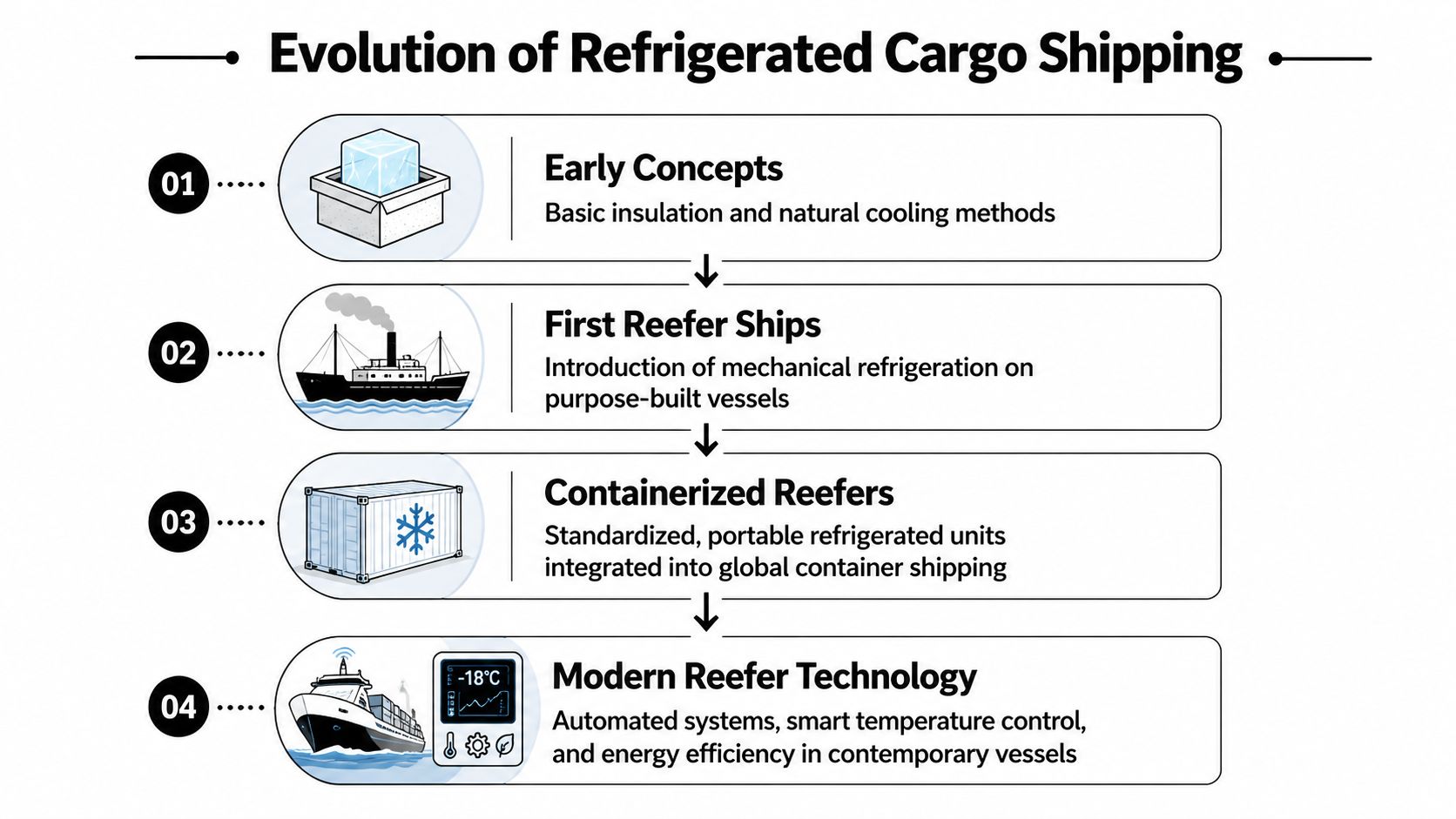
That history still matters because it explains the two models shippers use today. They solve the same problem in different ways.
The dedicated refrigerated cargo ship
A conventional refrigerated cargo ship is best understood as a floating cold-store. The vessel itself is designed around temperature-controlled cargo spaces. It’s built to carry perishables as its core purpose, not as one cargo type among many.
That model suits trades where cargo moves in larger homogenous lots, often with tight handling routines and repeatable port calls. If you’re moving a substantial volume of similar product on a regular lane, a dedicated reefer vessel can align well with that operating pattern.
Typical strengths include:
- Focused cargo environment where the ship’s design centres on perishable goods
- Fast handling for specific commodities when the trade lane is organised around them
- Operational consistency for shippers with repeat seasonal programmes
Its weakness is flexibility. If your cargo profile changes often, if volumes fluctuate, or if you need broader port options, the dedicated vessel can become harder to fit into a mixed supply chain.
The reefer container on a container ship
A reefer container is the modular version of the same idea. Instead of refrigerating the whole ship, you refrigerate the box. That box then moves through the wider container shipping network.
Think of it as the difference between renting an entire cold warehouse and using a secure temperature-controlled room inside a larger logistics estate. The second option is usually easier to position across different routes, origins, and consignees.
For many shippers, especially those moving mixed products or smaller allocations, reefer containers are the practical choice because they offer:
- Network flexibility across standard container services
- Better fit for mixed cargo programmes
- Simpler integration with road legs, depots, and distribution centres
- More modular planning for partial, staged, or multi-customer flows
Practical rule: Choose the transport format that fits your cargo programme, not the format that sounds most specialised.
Why the distinction matters commercially
Some shippers use “reefer ship” and “reefer container” interchangeably. Operationally, that creates confusion. If your team doesn’t distinguish between vessel type and cargo unit, it becomes harder to ask the right questions about loading windows, power availability, stowage, inspection handling, and onward delivery.
The distinction also affects responsibility. With a container-based move, your risk management often sits heavily around unit condition, setpoint accuracy, pre-trip checks, terminal plug-in discipline, and multimodal coordination. With a dedicated refrigerated cargo ship, the conversation shifts more towards programme planning, volume commitment, and commodity-specific handling.
What a shipper should hold in mind
Before you request rates, get clear on four basics:
- Is your cargo moving as a large single-commodity flow or as part of a mixed supply chain?
- Do you need schedule breadth and port choice, or lane-specific efficiency?
- Will the cargo need inspection, veterinary review, or detailed border handling at either end?
- Does the consignee need one delivery stream or several downstream drops?
Those answers usually tell you whether the refrigerated cargo ship you need is a dedicated reefer vessel, or a reefer container moving within the container network.
How Refrigerated Shipping Technology Works
A reefer move only looks simple from the outside. Inside the unit and around the vessel, several systems have to work together continuously. The best comparison is a hospital life-support setup. One failure might be manageable. A chain of small failures usually isn’t.

For a shipper, the key point isn’t learning every mechanical detail. It’s understanding what keeps temperature stable, where the weak points are, and which checks reduce risk.
Cooling isn’t just about cold air
A reefer container doesn’t preserve cargo by making the inside cold. It manages a controlled airflow pattern around the load. That means your packing method, pallet pattern, and headspace matter just as much as the set temperature.
If cartons are stacked too tightly against airflow channels, the machine may still run normally while parts of the cargo drift out of tolerance. That’s why good operators pay close attention to loading instructions, commodity requirements, and vent management before the container is sealed.
Three elements usually decide whether the unit performs properly:
- Setpoint accuracy so the reefer is programmed for the product’s real requirement
- Air circulation so chilled air can move through and around the cargo
- Cargo compatibility so mixed products with different tolerances aren’t forced into the same environment
A common mistake is treating all perishable cargo as “cold freight”. It isn’t. Different products need different temperature disciplines, and some also need careful humidity or ventilation control.
Redundancy matters more than headlines
At sea, reliability comes from backup design. The ABS guide for refrigerated containers carried on ships requires dual cooling water systems and redundant pumps to maintain condenser temperatures. The same guide notes that this arrangement can support 20-30% more TEU under deck, reduce energy draw by 25-35%, and save tens of thousands of pounds per voyage.
For shippers, the engineering detail translates into a practical question: what happens if one element fails? You want to know there’s a fallback, not a hope.
Ask carriers and operators about redundancy in plain language. What fails safely, what has backup, and who is alerted first?
Monitoring is your early warning system
Modern reefer operations rely on continuous monitoring. That includes onboard systems, terminal checks, and the data records that show how the unit performed during the trip. A serious shipper shouldn’t treat monitoring as a nice extra. It’s your evidence trail if there’s a claim, a dispute, or a quality concern on arrival.
Look for clarity on:
- Who records the settings at handover
- Who checks alarm status during the port stay and voyage
- How exceptions are escalated
- What data can be retrieved if the receiver questions cargo condition
Many disputes are won or lost on these grounds. If no one can show what the reefer was instructed to do, whether it remained powered, or whether alarms were addressed, the commercial argument becomes messy very quickly.
A useful visual primer on reefer operation is below.
The questions that expose weak planning
When shippers want to test whether a refrigerated cargo ship programme is effective, these questions usually reveal the truth fast:
- Was the unit pre-trip inspected and was the result reviewed, not just filed?
- Was the container pre-cooled if the commodity required it?
- Who verified the final setpoint and any ventilation requirements?
- What is the process if the terminal reports an alarm or delayed plug-in?
- How is the cargo protected during border holds, transhipment, or inland waiting time?
What works and what doesn’t
What works is disciplined execution. The reefer is selected correctly, checked properly, loaded for airflow, connected without delay, and monitored by people who know what a deviation means.
What doesn’t work is assuming the box will compensate for poor preparation. It won’t. A reefer container can maintain conditions. It can’t rescue the wrong packing pattern, the wrong instructions, or weak handover control.
Conventional Reefer Ship vs Reefer Container
Shippers don’t choose between these options on theory alone. They choose based on product mix, route design, booking flexibility, consignee expectations, and how much control they need over the full journey. The right answer for one importer can be the wrong answer for another.
A dedicated refrigerated cargo ship can be excellent for steady, high-volume programmes. Reefer containers on container vessels usually win where flexibility, mixed SKUs, and multimodal integration matter more.
Where a conventional reefer ship fits
This option tends to suit cargo owners moving larger quantities of similar goods on established lanes. If the loading programme is predictable and the discharge pattern is straightforward, a conventional reefer ship can offer a clean operating model.
It often works best when:
- Commodity flows are concentrated rather than spread across many small orders
- Port pairs are well established for the trade
- The shipper controls volume planning well in advance
- Cargo handling requirements are uniform across the lot
The trade-off is that the model is less forgiving when forecasts shift or customer allocations change late.
Where reefer containers fit better
A reefer container is usually the stronger choice when supply chains are fragmented or fast-moving. It gives shippers the ability to build around standard container schedules and move cargo in manageable units.
That matters if you’re balancing:
- several suppliers,
- multiple delivery points,
- mixed product categories,
- or onward road distribution after discharge.
It also helps when you need to match equipment choice to cargo size. If you’re reviewing 20-foot container dimensions and loading implications, that exercise often shapes whether the shipment should be planned as a compact reefer move or part of a larger allocation strategy.
Side-by-side commercial comparison
| Attribute | Conventional Reefer Ship | Container Ship with Reefer Containers |
|---|---|---|
| Best fit | Large, repeatable programmes of similar perishables | Mixed cargo, varied volumes, broader customer distribution |
| Cargo handling model | Whole-vessel or major space allocation approach | Unit-by-unit modular planning |
| Route flexibility | Strong where dedicated reefer trades are established | Strong across wider container networks |
| Port accessibility | More dependent on specific service patterns | Usually easier to match with mainstream container ports |
| Volume planning | Better for committed larger programmes | Better for variable or staged shipments |
| Multimodal integration | Can require more careful downstream coordination | Usually easier to connect with standard road and depot operations |
| Commercial agility | Lower when forecasts move late | Higher when bookings or allocations change |
| Typical shipper profile | Large exporters with consistent seasonal flows | Importers, distributors, and brands needing adaptable supply chains |
The decision test that matters
Don’t ask which option is “better”. Ask which option creates fewer failure points for your specific lane.
If your sales pattern is variable, your customer base is split, and your border process is document-heavy, modular control usually beats theoretical efficiency.
That’s why many UK-EU and intercontinental shippers favour reefer containers even when a dedicated reefer vessel sounds more purpose-built. In practice, the container model often aligns better with customs handling, inland delivery planning, and mixed inventory management.
The strongest decisions usually come from mapping the shipment backwards from delivery. Start with the consignee, receiving slot, inspection risk, and final-mile requirements. Then choose the sea method that supports that outcome with the least friction.
Navigating Costs and Compliance
The ocean rate is only part of the spend. With refrigerated cargo, the full cost is found in the combination of freight, equipment handling, power management, inspection exposure, document accuracy, and delay risk. A shipment can look competitive at booking stage and still become expensive once exceptions start appearing.
That’s why experienced shippers build the budget around total landed control, not just the headline rate.
What actually drives refrigerated shipping cost
The first driver is equipment. Reefer units are specialised assets, and they require tighter handling than dry containers. Positioning the right unit, checking it, powering it, and monitoring it all add operational intensity.
The second driver is timing. Perishable cargo rarely tolerates leisurely planning. If the product has a narrow shipping window, any missed collection, missed cut-off, or rolled booking can trigger direct losses beyond the transport charge itself.
Other common cost pressures include:
- Special handling at terminals because reefer units need power connection and closer oversight
- Border interventions when authorities request extra review of documents or goods
- Inland waiting time if collection or delivery sites aren’t ready for a temperature-controlled handover
- Claims exposure if condition, instructions, or records are disputed after arrival
Compliance is often the bigger risk than freight price
On UK-EU trade, compliance friction has become a day-to-day operational issue rather than a rare exception. Food products, animal-origin goods, and other regulated cargo can face document scrutiny, health certification requirements, and inspection procedures that must line up exactly with the shipment as packed and declared.
That means the commercial team, warehouse, haulier, customs team, and consignee all need to be aligned on the same facts. If one document says one thing and the labels or packing list suggest another, the shipment can slow down fast.
A sensible planning routine includes:
- Match the commercial invoice, packing list, and goods description before dispatch
- Confirm whether health or veterinary paperwork is needed for the commodity and lane
- Check who is responsible for customs entries at origin and destination
- Prepare for inspections operationally, not just administratively
- Agree who receives and reacts to border queries in real time
The most expensive cold chain delay is the one caused by paperwork that looked “close enough”.
Insurance and claims discipline
Many businesses assume their normal cargo cover is enough. Sometimes it is. Sometimes it isn’t, especially when the dispute turns on temperature records, packing method, or whether deterioration was caused by delay rather than a clear equipment failure.
That’s why refrigerated shippers should review policy scope and claims procedure before the first booking, not after a refusal. A practical starting point is to examine how cargo insurance applies to transit risk and documentation discipline.
Just as important, keep your own records in order. Preserve booking confirmations, loading photos, seal details, handover notes, setpoint instructions, and any alarm or exception messages. If a receiver rejects product, the side with the clearest timeline usually has the stronger position.
UK-EU friction points that catch shippers out
The recurring issues are rarely exotic. They’re ordinary mistakes under time pressure:
- Incorrect goods descriptions that don’t match supporting paperwork
- Missing health certificates or certificates that don’t align with the load
- Unclear responsibility for customs action when a border query arrives
- Delivery planning gaps after a shipment is released from port
- Late communication between exporter, importer, broker, and transport provider
These aren’t just compliance problems. They’re shelf-life problems. Every hour spent waiting for a correction can reduce commercial value, upset stock planning, or force a receiver to downgrade product.
The strongest operators treat compliance as part of temperature control. Not because paperwork changes the cargo’s condition directly, but because delays do.
Integrating Sea Freight into Your End-to-End Cold Chain
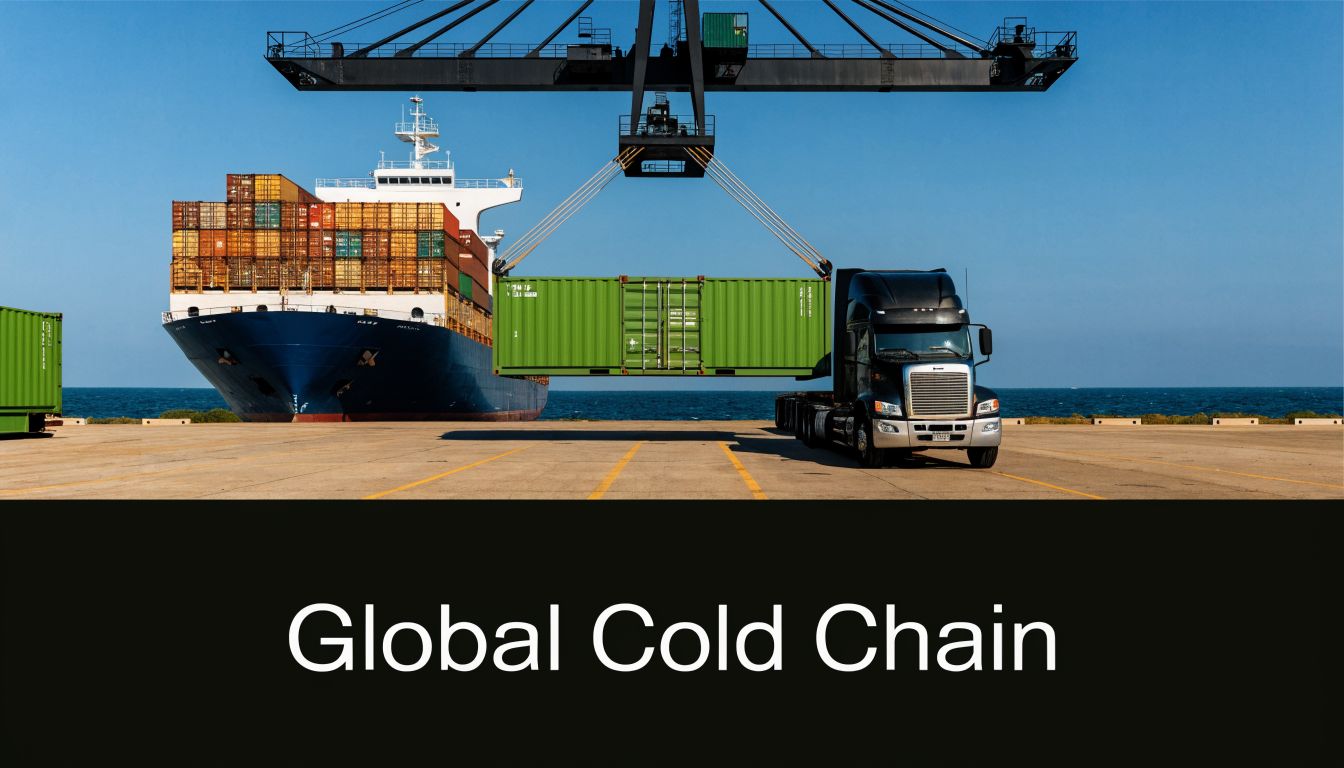
A refrigerated cargo ship is only one controlled environment in a longer chain. If the road collection is late, if the container waits unpowered at the wrong point, or if the final delivery site isn’t prepared, the sea leg can perform perfectly and the shipment can still fail commercially.
The cold chain has to be designed door to door.
The handovers deserve most of your attention
The vulnerable points are the transfers between modes. Collection from factory, arrival at port, terminal handling, discharge, customs release, and final-mile delivery all create moments where responsibility can blur.
A resilient cold chain uses one clear operating plan across those handovers. That usually means:
- Pre-agreed temperature instructions shared with every party handling the cargo
- Collection timing that fits the product and the port cut-off
- A clear plug-in and monitoring process while the unit is in terminal custody
- Arrival planning so the consignee can receive without avoidable waiting
- Exception escalation with named contacts, not generic inboxes
Sea, road, storage, and distribution must work as one flow
Many refrigerated shipments don’t move directly from port to final customer. They may go through temporary storage, cross-docking, order splitting, relabelling, or onward regional distribution. That means ocean freight decisions affect warehouse and transport decisions later in the chain.
A shipper who treats each leg separately often ends up solving the same problem repeatedly. A better approach is to build one operating sequence from origin loading to final receipt.
For businesses reviewing cold chain logistics across transport and storage stages, the key is continuity. Every leg should preserve the same handling logic, documentation accuracy, and temperature discipline.
Practical design for a multimodal cold chain
A workable end-to-end model usually follows this order:
- Prepare the cargo properly at origin with the right product temperature, packaging, and loading pattern.
- Coordinate the inland leg so the reefer handover doesn’t create avoidable dwell time.
- Manage the port phase tightly because terminal timing and border procedures can affect cargo condition indirectly.
- Plan destination handling before sailing, not after arrival.
- Align warehousing and delivery slots so product moves quickly once released.
The safest reefer move is the one where every participant knows the next handoff before the current one starts.
What good integration looks like in practice
It looks organised rather than dramatic. The collection vehicle arrives in the right window. The unit is prepared correctly. Documents match the load. The port receives clear instructions. The customs process is already assigned. The destination warehouse has booked the intake. Delivery transport is lined up before discharge.
That kind of flow doesn’t happen by accident. It comes from treating the refrigerated cargo ship as part of a multimodal system, not as an isolated freight booking.
Your Shipper's Checklist for Refrigerated Cargo
If you want fewer surprises, use a repeatable checklist. Refrigerated shipping rewards discipline. It punishes assumptions.
The list below is the one I’d want any shipper to work through before approving a booking, releasing goods, or blaming the vessel for a problem that began inland.
Before booking space
- Define the cargo properly. Don’t describe goods in broad terms if the commodity has specific handling or compliance requirements. Product identity affects paperwork, inspections, and handling instructions.
- Match the shipping method to the trade pattern. If the flow is mixed, variable, or destination-heavy, a reefer container often gives better control than a dedicated programme.
- Check lane practicality early. Don’t wait until cargo is packed to confirm service suitability, transit rhythm, and destination handling capability.
Before loading the container
- Review the PTI result. A pre-trip inspection should be checked as an operational control, not filed away as a formality.
- Confirm the setpoint in writing. Temperature instructions should be clear, final, and shared with the parties who need them.
- Load for airflow, not just for space use. A tightly packed container can still be a badly loaded container if circulation is restricted.
- Decide whether pre-cooling is required. Don’t assume the reefer unit will correct avoidable product heat.
On the ground: Most preventable claims begin with either wrong instructions or poor loading discipline.
Before the cargo reaches port
Use this short pre-gate check:
| Checkpoint | Why it matters |
|---|---|
| Documents match the cargo | Border queries often start with mismatched descriptions or quantities |
| Collection timing is realistic | Perishables suffer when transport and cut-off planning are rushed |
| Responsibility is assigned | Customs, health paperwork, and exception handling need named owners |
| Consignee is ready | Destination delays can hurt shelf life even after a good voyage |
During transit
- Monitor exception handling. You don’t need every technical detail in real time, but you do need clear escalation if alarms, delays, or document issues appear.
- Keep a decision log. Record what changed, who approved it, and when. That matters if quality is questioned later.
- Stay close to transhipment and border events. These are the points where timing risk tends to increase.
Before arrival and delivery
- Confirm destination clearance arrangements. Don’t assume someone else has customs, health, or inspection handling covered.
- Book onward transport before release. Product shouldn’t sit waiting because the final vehicle wasn’t arranged.
- Prepare the receiver. Share ETA updates, product details, and any relevant handling notes so the consignee can unload without confusion.
If something goes wrong
Don’t start with blame. Start with records.
Pull together the booking record, reefer instructions, PTI, loading photos, seal details, communication log, and arrival notes. Then establish the timeline. Most cold chain disputes become easier to resolve once the sequence is clear.
The standard worth holding
Good refrigerated shipping isn’t about chasing perfection. It’s about removing the common, expensive mistakes before they happen. Clear instructions. Strong loading discipline. Clean documentation. Defined ownership at every handoff. Fast action when an exception appears.
If your current process feels too dependent on individual heroics, it needs tightening. A reliable refrigerated cargo ship movement should run on control, not improvisation.
If you want help building a more reliable cold chain across UK-EU and intercontinental lanes, Multica Group can support the full transport picture, from road collection and ocean freight to customs handling, veterinary support, warehousing, and final delivery coordination.