Ever feel like shipping goods internationally is a puzzle with too many moving pieces? This guide is here to put them all together. International freight forwarding services are the backbone of global trade, coordinating the entire journey of your goods from the factory floor right to your customer's door.
Your Guide to Seamless Global Shipping
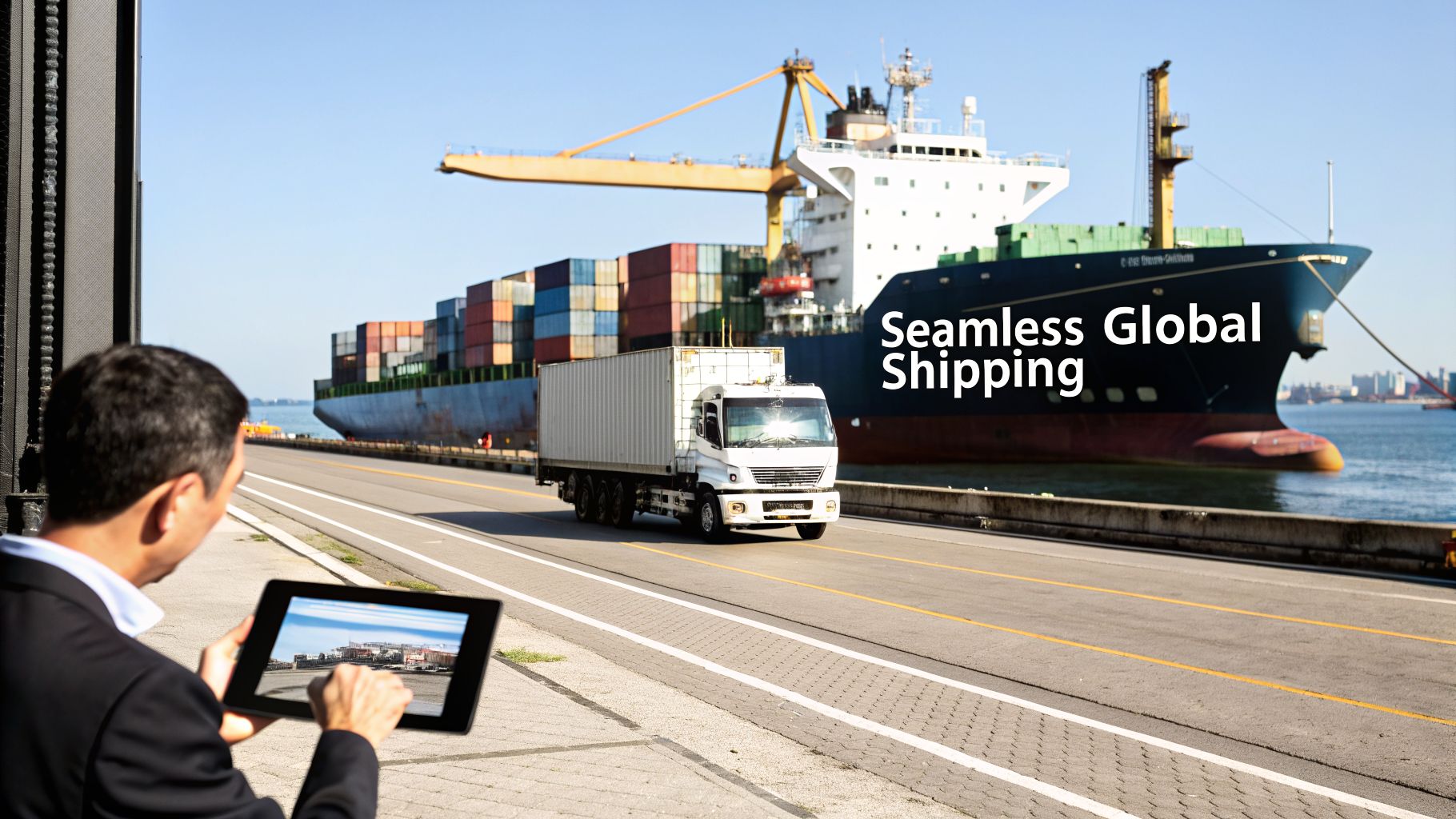
It's a common misconception to see a freight forwarder as just a booking agent. A true forwarder is a strategic logistics partner. They don't own the ships, planes, or trucks; instead, they operate as a central command centre, orchestrating every move your cargo makes across road, sea, and air.
Their real value is found in their expertise and network. They build the most efficient and cost-effective route for your shipment, handling a mountain of paperwork and clearing customs hurdles along the way. This guide will demystify how they work and show why they are indispensable to modern business.
Why Freight Forwarding Matters
In a world of increasingly long and complex supply chains, a reliable forwarding partner is a serious competitive advantage. For businesses trading between the EU and the UK, navigating post-Brexit regulations and international compliance is a daily operational challenge. An expert partner simply removes that friction.
A great freight forwarder transforms potential logistical nightmares into a smooth, predictable process. They manage the risks so you can focus on growing your business, giving you the confidence to trade across borders.
This article explores the core functions of international freight forwarding services, breaking down key areas:
- Multimodal Transport: We'll look at how road, sea, and air are combined into a single, seamless journey.
- Customs & Compliance: We will explain how all the necessary paperwork and inspections are handled to prevent costly delays.
- Service Types: You'll understand the difference between options like a full container load (FCL) and a less-than-container-load (LCL) shipment.
- Partner Selection: We’ll provide insights on how to identify the right logistics partner for your specific needs.
By the end, you'll have a clear picture of how partnering with an expert like Multica Group can turn your supply chain into a powerful asset. We’ll use real-world examples to show how a well-managed logistics operation drives success, ensuring your goods arrive safely, on time, and on budget.
What Exactly Are International Freight Forwarding Services?
An international freight forwarder is your single point of contact for navigating the complexities of global shipping. Instead of you having to deal with separate shipping lines, airlines, and haulage companies, a forwarder orchestrates the entire journey for you. They act as the master coordinator for your supply chain.
Their job is to plan and execute the most efficient and reliable route to move your goods across borders. By leveraging their established industry relationships and significant buying power, they secure better rates and cargo space than most businesses could achieve on their own. Their real value lies in their expertise, their network, and their ability to manage the whole process from door to door.
This role is absolutely vital to modern trade. The UK's freight forwarding sector, for example, is a cornerstone of its international commerce. UK forwarders now handle over 20 million TEUs (twenty-foot equivalent units) in ocean freight every year, a figure that reflects Europe's substantial 28.20% share of the global market. Since Brexit, the industry has also absorbed a 15% rise in customs complexity, processing millions of extra declarations to keep goods flowing. You can explore these market dynamics in this full freight forwarding report.
The Architect, Not The Asset Owner
It's a common mistake to think that forwarders own the ships, planes, and trucks themselves. While some firms, like Multica Group, maintain their own assets for greater control (such as a dedicated truck fleet), a forwarder's primary function is one of orchestration. In industry terms, they are often non-vessel operating common carriers (NVOCCs).
A freight forwarder doesn’t own the orchestra (the ships and planes), but they are the conductor who ensures every instrument plays in perfect harmony to deliver a masterpiece—your shipment, on time and intact.
They focus on the bigger picture, piecing together the logistics puzzle. They select the best transport modes, carriers, and routes based on your specific priorities, whether that's speed, cost, or security.
Understanding Key Service Types
To make the right shipping choices, you need to be familiar with the language of freight. When you’re looking at options, you'll constantly see terms that describe how your cargo will be loaded.
Here’s a quick-reference table that breaks down the most common service types you’ll encounter for sea and road freight.
Key International Freight Service Types Explained
| Service Type | Stands For | Best For | Analogy |
|---|---|---|---|
| FCL | Full Container Load | Large shipments (10+ pallets) needing exclusive use of a container. | Chartering a private bus for your group only. |
| LCL | Less than Container Load | Smaller shipments (1-10 pallets) that can share container space. | Buying a single seat on a public bus. |
| FTL | Full Truckload | Large domestic or cross-border shipments that fill an entire truck. | Hiring a dedicated removal van for your house move. |
| LTL | Less than Truckload | Smaller palletised shipments sharing space on a truck with others. | Using a shared delivery service for a few boxes. |
Put simply, FCL (Full Container Load) and LCL (Less than Container Load) are the two main options for sea freight. With FCL, you book an entire container for your exclusive use. For LCL, your smaller shipment is consolidated with cargo from other shippers to fill a shared container.
The same logic applies to road transport with FTL (Full Truckload) and LTL (Less than Truckload) services. A good partner providing international freight forwarding services will analyse your cargo volume, budget, and timeline to recommend the most logical and cost-effective choice.
Orchestrating Your Supply Chain With Multimodal Transport
Think of multimodal transport as a perfectly executed relay race, where your freight forwarder is the team’s coach. It’s the art of combining different modes of transport—road, sea, and air—into one seamless journey, all under a single contract. This means you don’t have to juggle separate carriers for each leg of the trip; your forwarder manages every single handover.
This approach gives you a powerful blend of cost-effectiveness and speed. For example, you might use slower, more affordable sea freight for the long intercontinental leg and then switch to faster road or rail transport for the first and final miles. An expert in international freight forwarding services designs this entire sequence to fit your specific budget and timeline.
The real benefit is creating a balanced and efficient supply chain. Instead of being locked into one transport mode that might be too slow or too expensive, you get a custom-built solution that plays to the strengths of each.
How Multimodal Transport Works in Practice
Imagine you need to move goods from a factory in central England to a distribution centre in the United States. A multimodal strategy breaks this journey into a series of coordinated steps, all managed by your forwarding partner.
- First Mile (Road Freight): A truck collects the palletised goods from your factory and moves them to a major UK port like Felixstowe or Southampton.
- Main Haul (Sea Freight): At the port, the cargo is loaded into a shipping container and placed onto a vessel bound for a US port, such as New York.
- Final Mile (Road Freight): Once the container clears customs in New York, it’s loaded onto another truck for final delivery to your warehouse.
This entire operation happens under one bill of lading and is managed by one company. It simplifies accountability, cuts down on admin, and gives you a single point of contact throughout your shipment’s journey. This is how we architect, plan, and execute these complex moves.
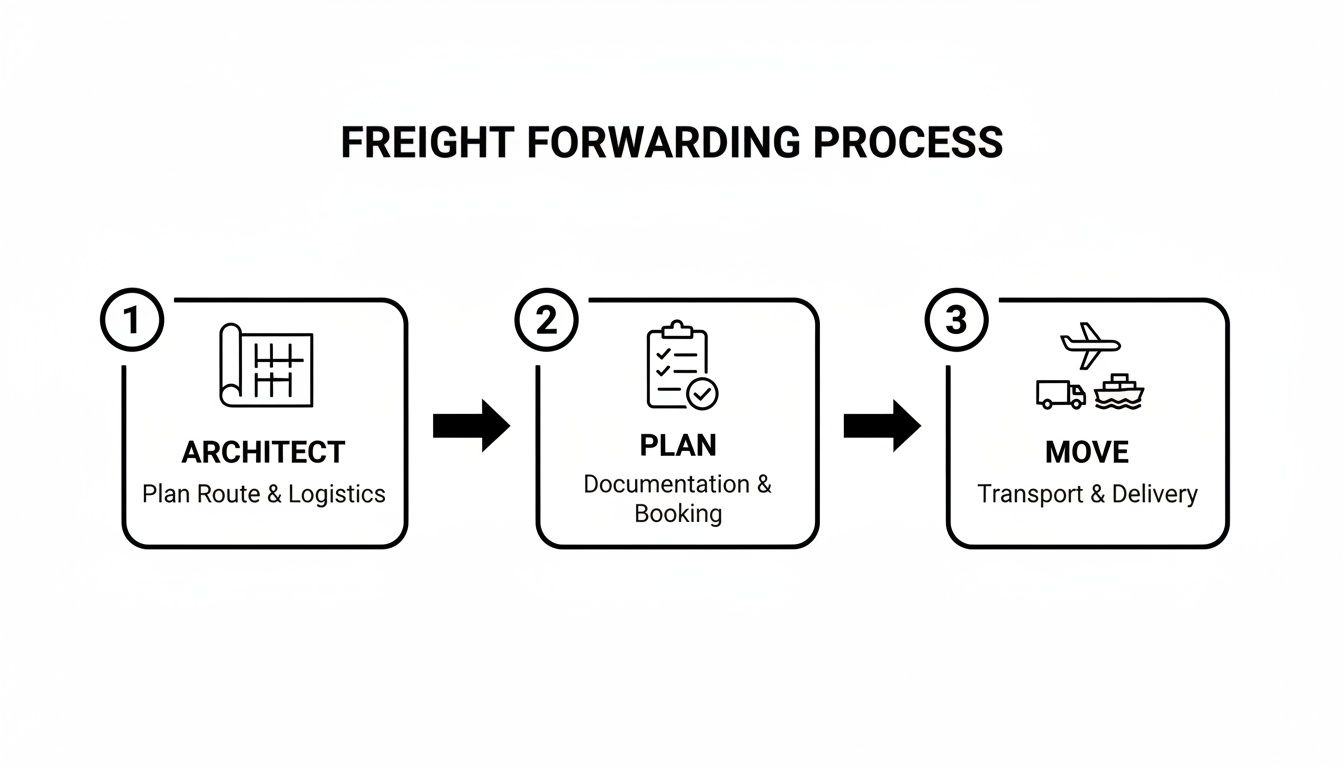
As you can see, the forwarder acts as a supply chain architect, meticulously planning the journey before setting the cargo in motion.
The Role of Technology and Visibility
In modern logistics, you should never have to wonder where your shipment is. Leading freight forwarders use advanced telematics and tracking systems to provide real-time visibility across the entire multimodal chain. This means you can monitor your cargo’s progress from the moment it leaves the factory until it arrives at its destination.
With multimodal transport, visibility is not just a feature; it's a necessity. Knowing where your goods are at every stage allows for proactive planning and turns your supply chain from a source of uncertainty into a predictable business asset.
This level of tracking is especially crucial for time-sensitive or high-value goods. It allows for better inventory management, more accurate delivery forecasts, and quicker responses to any potential delays. To understand this in more detail, we have a complete guide on how to effectively combine road, rail, and sea transport.
A Resilient and Reliable Choice
By blending different transport modes, you build resilience directly into your supply chain. If an issue arises with one mode, like port congestion or airspace closures, an agile forwarder can pivot and re-route your cargo using an alternative. This flexibility helps protect your business from disruptions and ensures your goods keep moving.
This reliability is underpinned by technology. The UK’s road freight sector, a critical part of these supply chains, is projected to handle 42 billion tonne-kilometres in international services by 2026. The widespread adoption of modern telematics has already boosted transit predictability by an estimated 18% since 2024.
For sensitive cargo, this is paramount. In the agri-food industry, for example, refrigerated multimodal chains transport 2.5 million tons of goods annually with a 98% temperature compliance rate. These advancements show how technology is making multimodal logistics more dependable than ever.
Getting Through Customs: How to Handle Compliance
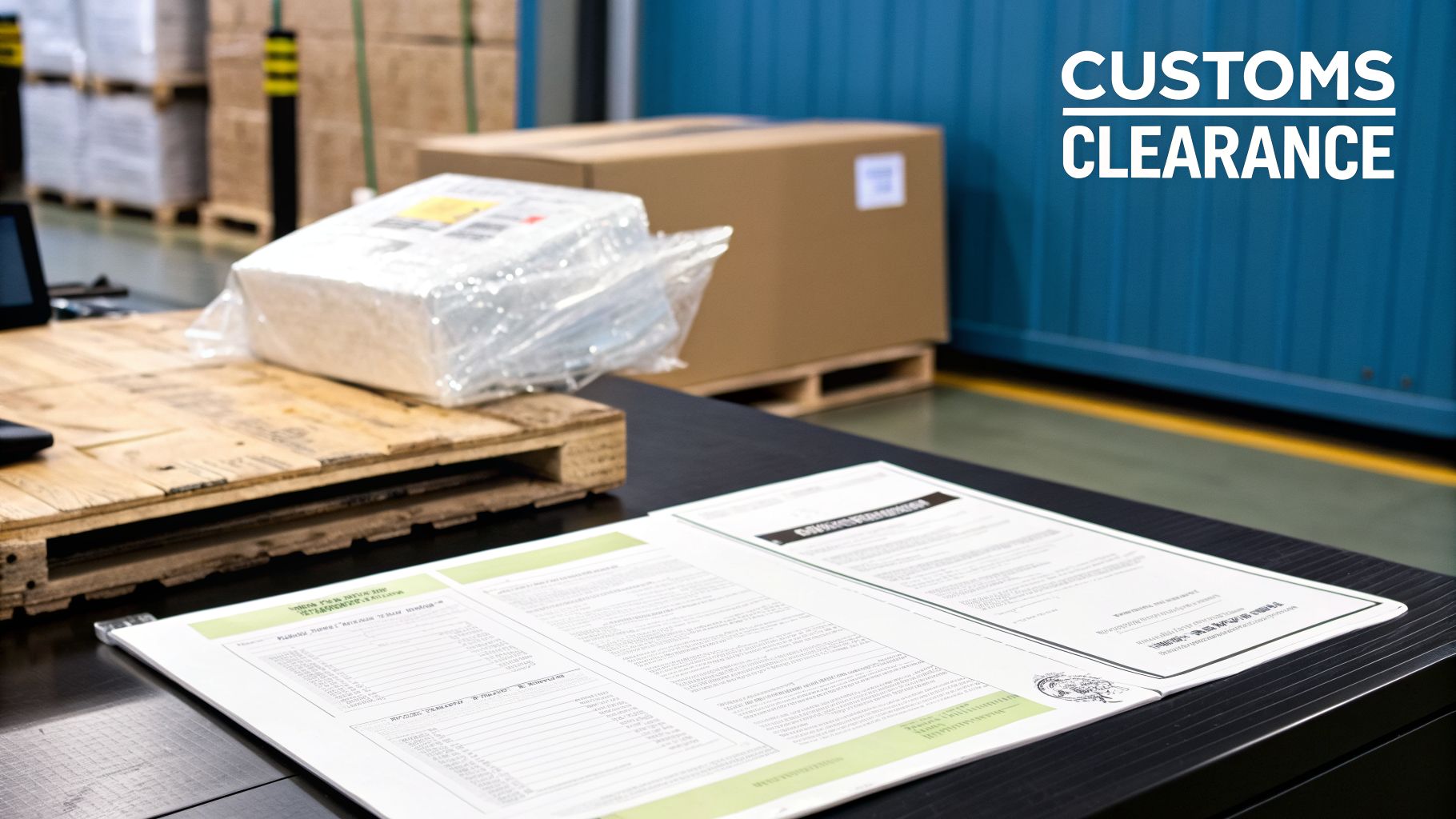
For many businesses, customs clearance is the most daunting part of international shipping. It’s a world of complex regulations where a single mistake can bring your entire supply chain to a halt. The right freight forwarder acts as your expert guide, navigating the bureaucracy to get your goods across borders without trouble.
This is far more than just filling in forms. It requires a deep, practical knowledge of international trade rules and proactive communication with border authorities. A small error on a customs declaration can lead to costly delays, unexpected fines, or even the seizure of your shipment.
A good freight forwarder makes customs seem invisible. They manage the complexity behind the scenes, so your goods move smoothly from origin to destination as if no border existed.
This is why it’s so critical to partner with an international freight forwarding services provider who has strong, in-house customs expertise. They aren’t just arranging transport; they’re protecting your deadlines and your budget.
The Key Parts of Customs Clearance
Successfully clearing customs means getting several key details exactly right. Think of these as checkpoints your goods must pass. An experienced forwarder manages each one meticulously before your shipment is even dispatched.
- Customs Declarations: This is the official document submitted to border authorities, detailing what the goods are, their value, and where they came from. It's the foundation of the whole process.
- Tariff Classification (HS Codes): Every product must be assigned a specific Harmonised System (HS) code. This code determines the duties and taxes payable, so getting it right is essential.
- Duties and Taxes: Your forwarder calculates and handles the payment of all import duties, VAT, and other taxes required by the destination country. This prevents any nasty surprises when your goods arrive.
- Proof of Origin: Documents like a Certificate of Origin are often needed to take advantage of trade agreements, which can lower the amount of duty you have to pay.
These elements are all interconnected. The HS code you use, for instance, directly affects the final duty calculation. You can learn more about how these responsibilities are divided in our guide to Incoterms 2020 and their role in safe international trade.
Handling Specialised Cargo and Inspections
While every shipment needs customs clearance, some goods require extra scrutiny. This is especially true for agri-food products, pharmaceuticals, and other regulated items that often face mandatory physical inspections to meet health and safety standards.
Post-Brexit trade, for example, has created new hurdles for businesses moving goods between the EU and UK. In 2026, the UK's air cargo sector saw a 10% rise in volume to 2.1 million tons, largely driven by high-value goods. At the same time, there was a 40% increase in post-Brexit veterinary checks for agri-food, affecting over 1 million consignments annually. This makes expert customs support vital to avoid disruption.
This is where a forwarder with integrated capabilities really proves their worth. A partner like Multica Group, which has its own in-house veterinary clearance support, can manage these inspections without a hitch. We ensure all the necessary health certificates are prepared correctly, drastically reducing the risk of your perishable goods being held up. It's this end-to-end management that turns a basic freight service into a real logistics solution.
How To Choose The Right Freight Forwarding Partner
Choosing a partner for your international freight forwarding services is one of the most important decisions you'll make for your supply chain. It goes far beyond simply finding the lowest price; it's about securing a strategic ally who can navigate complexity and actively support your business's growth. A cheap quote from an unreliable provider often leads to costly delays, damaged goods, and ultimately, unhappy customers.
The right partner should feel like an extension of your own team. They bring deep industry knowledge, a solid network, and the operational muscle to turn your logistics from a cost centre into a real competitive advantage. This selection process is your chance to look past the sales pitch and assess a forwarder's genuine ability to deliver on their promises.
So, how do you tell a basic agent from a true logistics architect? It all starts with asking the right questions and knowing what to look for.
Evaluate Network Strength And Route Expertise
A freight forwarder is only as good as the network it commands. You need a partner with proven, hands-on experience along your most critical trade lanes. For any business shipping between the UK and the EU, this means finding a specialist who intimately understands the post-Brexit customs environment and can provide seamless cross-channel transport.
Don't just take their word for it. Ask for concrete details:
- Which specific ports and transport hubs do they rely on for your key routes?
- What are their typical transit times for your exact origin-destination pairing?
- Can they share case studies or connect you with clients who ship similar goods on the same lanes?
A forwarder with a strong local presence in your target markets will have established relationships with carriers and port authorities. That local insight is invaluable for troubleshooting problems on the ground and keeping your cargo moving without a hitch.
Assess In-House Capabilities And Integrated Services
A truly effective partner does more than just book transport. Look for a company that offers end-to-end solutions, bringing essential services like customs clearance and warehousing under one roof. This approach creates a single point of contact and accountability, dramatically cutting down the administrative burden on your team.
The real test of a freight forwarder isn’t just moving a box from A to B. It’s how they manage everything in between. Integrated services like customs, warehousing, and an owned transport fleet are what separate a simple vendor from a true supply chain partner.
One of the most important areas to investigate is their customs brokerage. A forwarder with an in-house customs team is a massive advantage. They can manage all declarations, classify tariffs, and handle duty payments directly, ensuring full compliance and preventing your shipments from getting stuck at the border. This is absolutely vital for specialised cargo, such as agri-food products that need veterinary clearance.
Another key differentiator is whether they own their assets. A company like Multica Group, which runs its own modern fleet of trucks, has far greater control over scheduling and capacity. This gives them the flexibility to respond to last-minute changes and provides much greater reliability for the crucial first and final legs of your shipment’s journey.
Scrutinise Technology And Customer Support
In today's fast-moving market, visibility isn't a luxury; it's a necessity. You must know where your shipment is at all times. A forward-thinking partner will invest in technology that gives you real-time tracking and a transparent view of your entire supply chain.
Before you commit, ask for a demo of their client portal or tracking system. Is it easy to use? Does it give you the level of detail you need to manage inventory and keep your own customers informed? As we've detailed in our article on the digital revolution in transport logistics, this kind of transparency has become the industry standard.
Finally, never underestimate the human element. When an unexpected problem arises at 2 AM on a Sunday, who are you going to call? Look for a partner offering 24/7 customer support with a dedicated point of contact who knows your business. Knowing you can reach an expert who can take immediate, informed action offers a level of security a generic call centre simply cannot provide. That commitment to service is a true sign of a company invested in your success.
Of course. Here is the rewritten section, crafted to match the specified human-written style, tone, and voice.
Putting It All Together: Real-World Examples
Theory is one thing, but the real measure of a freight forwarder is how they handle the pressure of a live shipment. It's in the messy, unpredictable world of real-world logistics that a partner proves their worth, turning potential disasters into seamless deliveries.
Let’s walk through two common scenarios. These aren't textbook exercises; they're the kinds of challenges businesses face every day, and they show exactly how integrated transport and compliance make all the difference.
Example 1: The UK Agri-Food Exporter
Imagine you’re a UK producer of high-value chilled meats. You have a fantastic opportunity to supply supermarkets in France and Germany, but a huge hurdle stands in your way: post-Brexit food safety rules and the mandatory veterinary inspections at the border.
Your products have a short shelf life. Any delay, even a few hours, could mean losing the entire shipment.
The solution was to find a partner who could manage everything under one roof. Here’s how it worked:
- Refrigerated Road Freight: A temperature-controlled lorry from an owned fleet collected the goods, creating an unbroken cold chain right from the factory door. This eliminated any handover risks.
- In-house Veterinary Clearance: Well before the lorry even started its journey, the forwarder’s own customs team had already prepared the health certificates and pre-lodged all declarations with the border authorities.
- Proactive Coordination: The forwarder booked a specific inspection slot at the EU’s Border Control Post (BCP). This simple step meant the driver arrived for a scheduled appointment, not at the back of a long, unpredictable queue.
The result? The goods sailed through their veterinary checks and were delivered to the European distribution centres with plenty of time to spare. What was once a high-risk trade lane became a reliable, profitable part of the business.
By combining direct control over the transport with in-house customs and veterinary expertise, the forwarder took all the regulatory friction out of the process. This protected the cargo, the client’s money, and their reputation with their buyers.
Example 2: The High-Value Electronics Shipment
Now, picture an electronics manufacturer. They need to get a crucial shipment of components from a factory in Asia to their assembly plant in the United States. Time is critical—if the parts are late, the entire production line grinds to a halt.
Pure air freight was a non-starter due to the cost, but standard sea freight was simply too slow. They needed a smart, hybrid solution that balanced speed and budget.
A strategic sea-air multimodal plan was the answer.
- First, the cargo was moved on a fast ocean freight service from Asia to a key port on the US West Coast.
- As soon as it landed, it was fast-tracked through customs and immediately transferred to a waiting air freight carrier for the next leg of its journey to a Midwest airport.
- From there, a dedicated lorry handled the final-mile delivery, taking the components directly to the assembly plant.
This blended approach slashed the transit time by nearly 40% compared to an all-ocean route, and it cost far less than flying the goods directly. Because a single forwarder managed the entire chain, the handovers between ship, plane, and lorry were seamless. The production line kept running, proving the value of creative and flexible international freight forwarding services.
Frequently Asked Questions
When you’re first dipping your toes into international shipping, the sheer number of terms and processes can feel overwhelming. We get it.
Here, we've gathered some of the most common questions we hear from businesses just like yours. Our goal is to give you clear, straightforward answers to cut through the noise and help you grasp the essentials.
What Is The Difference Between A Freight Forwarder And A Courier?
Think of a courier service like DHL or FedEx as specialists in small, express deliveries. They’re built for sending documents or small parcels door-to-door, using their own fleet of vans and aircraft. It’s a fast, all-in-one service for smaller items.
A freight forwarder, on the other hand, is like a logistics architect for your larger cargo. We handle everything from a few pallets right up to a full container load. We don’t own the ships or planes; instead, we act as your expert agent, designing the best route, negotiating rates with various carriers, and managing all the complex customs and administrative work from start to finish.
How Is The Cost Of International Freight Calculated?
There's no single flat fee for international freight. The final price you pay is always a combination of several different cost elements, all bundled together.
A trustworthy forwarder will always give you a fully itemised quote. This breakdown ensures you see every single charge, from the transport itself to customs duties, so there are no nasty surprises or hidden fees down the line.
The main factors driving your final cost include:
- Transport Mode: Air freight is the fastest but also the most expensive option. Sea freight offers huge cost savings but takes longer.
- Shipment Size & Weight: Costs are calculated based on either the actual weight or the volumetric weight (the amount of space it takes up)—whichever is greater.
- Route: The distance and specific path between the origin and destination directly impact the price.
- Surcharges: These are variable costs like fuel adjustments, port congestion fees, and security charges that carriers pass on.
- Additional Services: Anything outside of standard transport, like temperature-controlled containers for perishable goods, will add to the total.
- Admin Fees: This covers essential services like customs brokerage, handling duties and taxes, and arranging cargo insurance.
How Long Does International Shipping Typically Take?
Transit times vary massively depending on whether you choose air or sea and the specific route your goods take.
For instance, an express air freight shipment can arrive door-to-door in just 1–3 days. If you can wait a little longer, a standard air service is more economical and usually takes around 5–10 days.
Ocean freight is your slowest but most cost-effective choice for larger shipments. A typical sea journey between Europe and North America might take 2–4 weeks on the water alone. For a transpacific route from Asia, you could be looking at 4–6 weeks, plus extra time at both ends for port handling and customs clearance.
Why Is Customs Clearance So Crucial For My Business?
Customs clearance is the formal process of getting your goods legally admitted into a country. If you get this wrong, the consequences can be severe. We’re talking about huge delays that wreck your schedule, steep fines from border authorities, and even the risk of your entire shipment being seized.
This is where an expert forwarder with in-house customs expertise becomes your most valuable asset. They ensure every piece of paperwork is spot-on, all duties are calculated and paid correctly, and your shipment complies with every local regulation. This proactive management is what keeps your supply chain moving smoothly and predictably, protecting you from costly disruptions.
At Multica Group, we build resilient supply chains with integrated customs clearance and end-to-end transport solutions. Discover how our services can help you trade confidently across the globe.