Orders are coming in. Your ads are working. Stock is moving. Then logistics starts to choke the business.
One delayed replenishment creates a stockout. A customs query holds a pallet that was meant to feed this week’s promotions. Parcels go out late, customer support tickets rise, and the warehouse team starts firefighting instead of fulfilling. Most ecommerce brands don’t hit a growth ceiling because demand disappears. They hit it because their logistics for ecommerce wasn’t built to scale across fulfilment, freight, customs, and returns as one connected system.
That’s the core function of logistics. It isn’t just getting a box from A to B. It’s protecting your delivery promise, your margin, and your reputation while the business gets more complex. If you sell across the UK, bring goods in from the EU, or source from Asia and ship onward to customers, every handoff matters. When those handoffs are fragmented, growth gets expensive fast.
Why Your Ecommerce Logistics Strategy Defines Your Brand
Customers don’t separate your product from your delivery experience. They judge the whole transaction as one promise. If the item arrives late, damaged, incorrectly labelled, or impossible to return, that failure sits with your brand, not with the carrier, broker, or warehouse operator behind it.
That’s why logistics for ecommerce belongs in commercial planning, not just operations. In the UK, the e-commerce logistics sector reached approximately £45 billion in 2024, and 3PL providers handled 69.1% of operations. The same market data notes that post-Brexit trade changes increased logistics complexity by 25% for cross-border shipments (UK ecommerce logistics market analysis). The scale of outsourcing tells you something important. Brands increasingly need specialist capability, not just extra space and vans.

The brand damage usually starts small
It rarely begins with a dramatic collapse. More often, it looks like this:
- Stock is available, but not positioned well: inventory sits in the wrong place, so delivery windows stretch and transport costs climb.
- Teams use too many disconnected providers: one firm stores the goods, another moves linehaul, another clears customs, and nobody owns the full outcome.
- Exceptions aren't handled early: missing commodity details, incomplete paperwork, or packaging issues only surface once the shipment is already moving.
- Customer service becomes the shock absorber: your team spends its time chasing statuses instead of improving the operation.
A lot of brands treat these as isolated issues. They’re usually signs of a weak logistics model.
Practical rule: If your fastest-growing sales channel creates the most manual work, your logistics design is already behind your commercial growth.
Three fulfilment models and the trade-offs behind them
Most ecommerce businesses choose between in-house fulfilment, 3PL outsourcing, or a hybrid model. None is universally right. The right answer depends on order volume, SKU complexity, margin, geography, and how much operational control you need.
| Model | What works | What tends to break |
|---|---|---|
| In-house | Tight control over packing quality, branded inserts, special handling, and internal processes | Space, labour planning, systems integration, and peak-season scaling become hard quickly |
| 3PL | Faster access to warehousing, pick-pack capability, transport buying power, and specialist expertise | Service quality varies, and weak onboarding can create visibility gaps |
| Hybrid | Keeps control for priority lines while outsourcing overflow, distant regions, or cross-border flows | Requires clear rules about which orders go where, otherwise complexity multiplies |
In-house can be sensible at an early stage or for fragile, premium, or highly customised orders. But many teams underestimate what happens after the initial success phase. One good month becomes a sustained run-rate. Your unit economics tighten. Your warehouse process, which used to work with a small team and flexible cut-offs, starts failing under volume.
3PL works well when you need capability that would be costly or slow to build yourself. That includes pallet storage, order picking, distribution, customs support, carrier coordination, and overflow management around promotions. The trade-off is that the provider has to be integrated into your business properly. A 3PL that only handles parcels but can’t support freight, inbound stock flow, or exception handling may solve one problem while creating another.
Hybrid often gives growing brands the most room to manoeuvre. Keep close control of your highest-touch orders. Outsource standard fulfilment, oversized stock movements, or regional distribution where specialist facilities and transport planning matter more than internal ownership.
Control matters, but end-to-end visibility matters more
Brands often say they want control. What they usually want is predictability. They want to know when stock will arrive, what’s saleable now, which orders can ship today, and which exception needs intervention before it affects customers.
That only happens when fulfilment, transport, and customs share data and timing. If inbound freight lands late, warehouse labour plans break. If customs holds stock, your ecommerce front end can oversell. If transport isn’t aligned with cut-off times, same-day dispatch becomes marketing copy rather than an operational fact.
Good logistics for ecommerce feels invisible to the customer because the moving parts are organised before the order is placed, not after something goes wrong.
Building Your Multimodal Transport Network
Transport decisions shape both your margin and your service promise. If you choose every movement on headline price alone, you’ll usually pay for it later in delays, split shipments, poor consolidation, or emergency upgrades to faster modes.
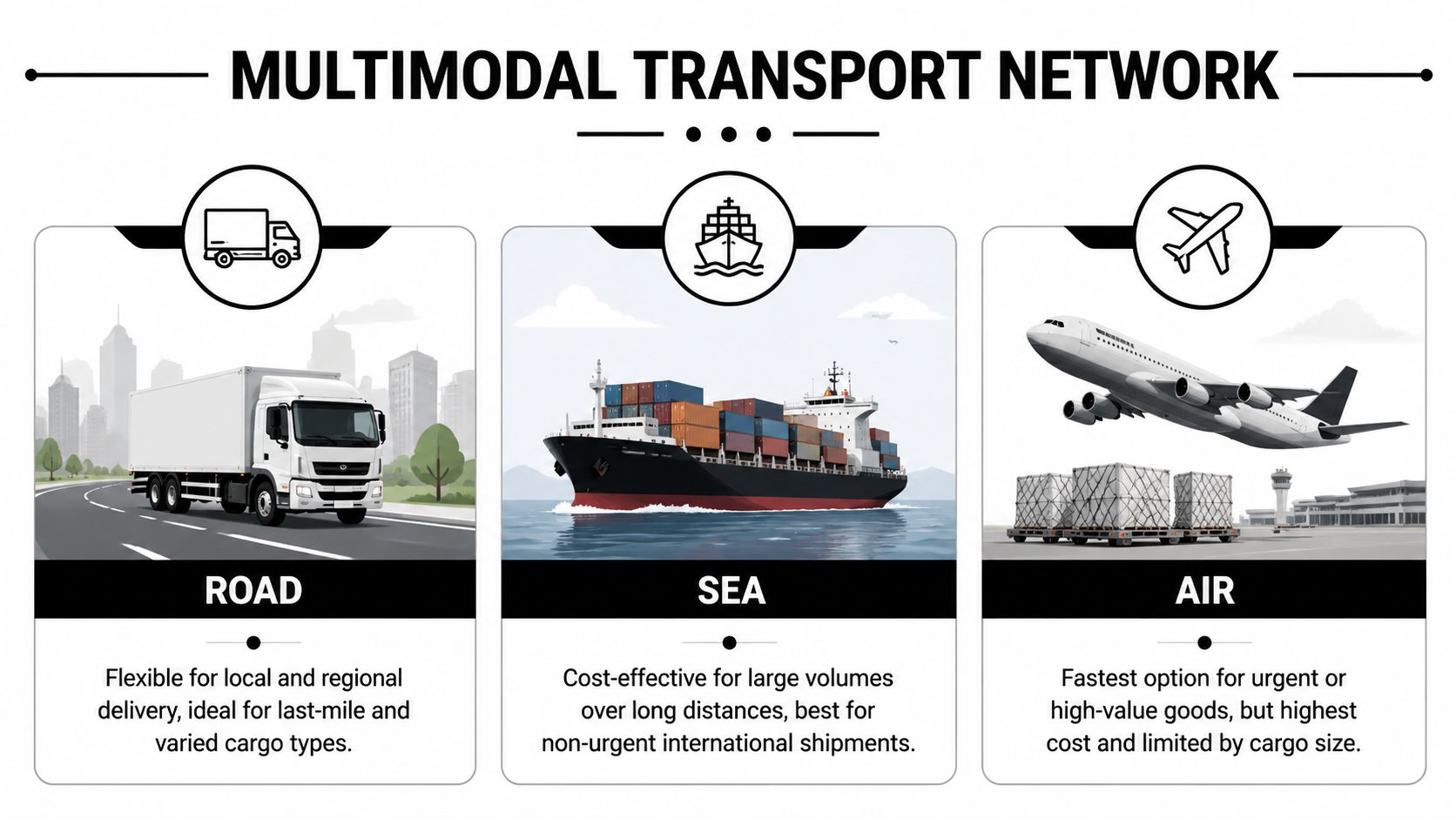
The better approach is to build a multimodal network around product type, urgency, destination, and replenishment pattern. That means knowing when to use road, sea, and air, and when to combine them without creating handoff failures.
Road gives flexibility, but choice of load type matters
For UK and EU distribution, road freight usually carries the operational burden. It connects suppliers to warehouses, ports to fulfilment centres, and stock transfers to delivery networks. It’s also where many ecommerce businesses lose money through poor load planning.
The first decision is usually FTL versus LTL. Full Truckload works when volume, time sensitivity, or cargo integrity justifies dedicated space. Less-than-Truckload works when you need to move smaller consignments efficiently without paying for unused capacity. The wrong choice leads either to wasted spend or unnecessary delay through extra touches and consolidation stops.
If you need a practical comparison, this guide to FTL and LTL choices in ecommerce transport is useful for thinking through shipment size, service expectations, and margin pressure.
Sea freight rewards planning, not improvisation
Sea freight is the backbone for bulk imports and lower-cost replenishment over longer distances. It’s usually the right fit for stable demand, planned launches, and products that can tolerate longer transit windows. The key decision is FCL versus LCL.
- FCL suits consistency: if you’re moving enough volume to fill a container or need tighter cargo control, a full container reduces handling risk.
- LCL suits mixed or smaller flows: useful for lower volumes, but it introduces consolidation and deconsolidation steps that can complicate timing.
- Sea works best for forecast-led stock: if your buying and sales teams don’t plan far enough ahead, sea quickly turns into air by default.
Many brands say sea is too slow. Usually, the issue is poor demand planning or weak coordination between factory readiness, booking, customs paperwork, and warehouse intake slots.
Air freight is expensive, but sometimes it protects profit
Air should never be treated as a routine fix for bad planning. It has a clear role, though. For product launches, urgent replenishment, premium items, or stock needed to protect major revenue periods, air can be the right call.
Consumer pressure is pushing transport networks in that direction. By 2025, 73% of UK shoppers are projected to demand same-day delivery options, and last-mile delivery costs represent 50% of total logistics expenses (UK shipping and ecommerce delivery statistics). That doesn’t mean every shipment should move by air. It means brands need faster upstream decisions so downstream delivery promises are realistic.
Don’t use premium transport to compensate for weak planning every week. Use it deliberately when the commercial upside is bigger than the freight premium.
Compare the mode against the problem you’re solving
| Mode | Best fit | Main drawback |
|---|---|---|
| Road | Regional flexibility, warehouse transfers, final approach into delivery networks | Capacity and routing efficiency matter a lot |
| Sea | Larger volumes, non-urgent stock, intercontinental replenishment | Slower and less forgiving if forecast accuracy is weak |
| Air | Time-critical consignments, urgent launches, high-value goods | Highest cost and tighter cargo constraints |
A resilient network often combines modes rather than picking one. A container can arrive by sea, clear into road distribution, then feed parcel or pallet networks from a UK warehouse. An urgent shortage can move by air while baseline stock continues by sea. EU-origin goods can run by road into UK fulfilment while US- or Asia-bound orders are routed differently based on service level.
What doesn’t work is treating each leg as a separate procurement event. Once transport is bought in fragments, nobody optimises the whole chain.
Clearing the Hurdles of Cross-Border Trade
Cross-border ecommerce breaks down when goods move faster than information. The trailer arrives, the container lands, or the pallet is ready to cross, but the declaration data, product codes, invoice detail, or supporting certificates don’t line up. That’s when a shipment that looked on schedule on paper starts standing still.
For EU-UK trade, customs is now a permanent operational discipline. It’s not a one-off admin task. Every shipment needs a usable data trail that tells border authorities what the goods are, where they came from, what they’re worth, and whether they require any special controls.
Think of customs data as a digital passport
A shipment crosses borders more smoothly when its records are complete before the vehicle or vessel reaches the checkpoint. That means commercial invoices, packing detail, correct product classification, value information, and any required customs declarations need to match the physical cargo.
For regulated categories such as agri-food, the standard paperwork isn’t enough on its own. You may also need health documentation, veterinary support, temperature control records, and evidence that the product has remained compliant throughout transit.
A useful way to think about it is this: the truck or container carries the goods, but the data gives those goods permission to move.
Where delays really come from
At ports, delay often starts with small mismatches that cascade:
- Documentation errors such as missing detail, incorrect commodity descriptions, or inconsistent values.
- Timing gaps between carriers, customs systems, and warehouse handoffs.
- Regulated goods checks for products that need additional scrutiny, especially perishables and sensitive items.
- Poor visibility in transit, which leaves teams reacting after the hold has already happened.
The operational impact is significant. At UK ports, integrated customs brokerage combined with real-time telematics can reduce clearance delays by 60%, from an average of 2-4 hours down to under 1 hour: 24-48 hour holds affect 15% of non-compliant shipments, especially perishables requiring cold chain integrity (analysis of multimodal tracking and customs delay reduction).
What good cross-border control looks like
A clean process usually includes these elements:
- Pre-shipment document review: checking declarations, invoice fields, and product information before departure.
- Brokerage integrated with transport planning: customs work shouldn’t sit in a separate silo from the movement itself.
- Live shipment visibility: telematics and milestone tracking help teams intervene before a missed handoff becomes a missed delivery.
- Exception management for regulated goods: agri-food and pharmaceutical shipments need tighter monitoring and contingency planning.
For businesses shipping temperature-sensitive products, telematics isn’t just a nice extra. It supports compliance. If a cold-chain consignment needs proof that conditions were maintained during the journey, live sensor data and shipment history become operational evidence, not just a dashboard feature.
Agri-food is where weak integration gets exposed fastest
Agri-food shipments don’t leave much room for administrative drift. If a veterinary inspection is required, or if temperature data is incomplete, the shipment can lose both time and value. The same applies to products that need customs and sanitary controls aligned before arrival.
That’s why cross-docking, pre-clearance checks, and coordinated road-sea handoffs matter so much for these categories. Moving fast is not the sole aim. It’s to keep the product compliant while reducing dwell time.
This walkthrough gives a useful visual primer on the border process and the paperwork logic behind it:
If customs, transport, and warehouse teams all work from different data, the shipment will eventually expose the inconsistency.
A partner with in-house brokerage, telematics, and control over onward transport can prevent many of these failures because they’re managing one operating chain rather than passing risk from one party to another.
The Engine Room Warehousing and Fulfilment Operations
Once stock reaches the warehouse, speed on its own stops being impressive. Accuracy becomes the discipline that matters. A fast warehouse that picks the wrong SKU, packs poorly, or misses a cut-off still creates a bad delivery experience.
Think about a normal order day inside a fulfilment operation. Goods are received, counted, checked, and placed into storage locations that make sense for pick frequency and product profile. When the order drops, the system assigns the task, a picker retrieves the items, the packing station confirms quantity and packaging choice, and the label links the parcel to the right service level and tracking flow. If any one of those steps is loose, the downstream transport network inherits the problem.
What picking, packing and labelling actually control
The basics are operational, but their commercial impact is direct:
- Picking controls order accuracy: wrong-item errors are expensive because they trigger customer complaints, replacement shipments, and avoidable returns.
- Packing controls product protection and parcel efficiency: poor carton choice can increase damage risk or transport cost.
- Labelling controls routing: bad labels create mis-sorts, delivery exceptions, and manual rework.
A good fulfilment operation treats these as one sequence, not separate warehouse tasks. The product has to be physically ready for the exact transport service it’s about to enter.
Why warehouse design matters to ecommerce growth
As order volume rises, the biggest warehouse problems are rarely dramatic. They’re repetitive friction points. Pick paths become too long. Fast-moving SKUs sit in awkward locations. Inbound receipts clash with outbound peaks. Teams start storing stock wherever space appears instead of where flow is logical.
That’s why layout, slotting discipline, and operational cut-offs matter so much. So does having the right support beyond storage. These warehousing and distribution services are a useful reference for what a modern setup should include when brands need receiving, storage, picking, labelling, and dispatch connected properly.
Cross-docking changes the timing equation
Cross-docking is one of the most practical tools for reducing unnecessary storage time. Instead of receiving goods into long-term inventory, the operation moves them from inbound transport to outbound dispatch with minimal dwell where that makes sense.
That approach works especially well when:
- Inbound stock is already allocated: the goods have a clear onward destination or customer order.
- You need to shorten handoff time: useful for promotional stock, replenishment waves, or sensitive goods.
- Storage isn’t the value driver: the priority is flow, not holding inventory.
Cross-docking requires discipline. Booking windows, paperwork, SKU visibility, and outbound planning all need to align. But when they do, it removes a whole layer of delay from logistics for ecommerce.
A warehouse shouldn’t be a parking area for uncertainty. It should either store stock deliberately or move it on purpose.
The Final Challenge Mastering Ecommerce Returns
Most brands still talk about returns as if the only goal is to suppress them. That view is too narrow. A return is also a stock movement, a service event, a data point, and sometimes a recovery opportunity. If you ignore that, reverse logistics becomes slow, opaque, and expensive.
The scale makes that impossible to dismiss. UK online retail return rates hit 32% in 2025, costing businesses £7.2 billion annually, and 55% of manufacturers struggle with the process (UK reverse logistics and returns analysis). For categories such as apparel and electronics, returns aren’t an exception to the model. They’re part of the model.
A good returns process recovers value in stages
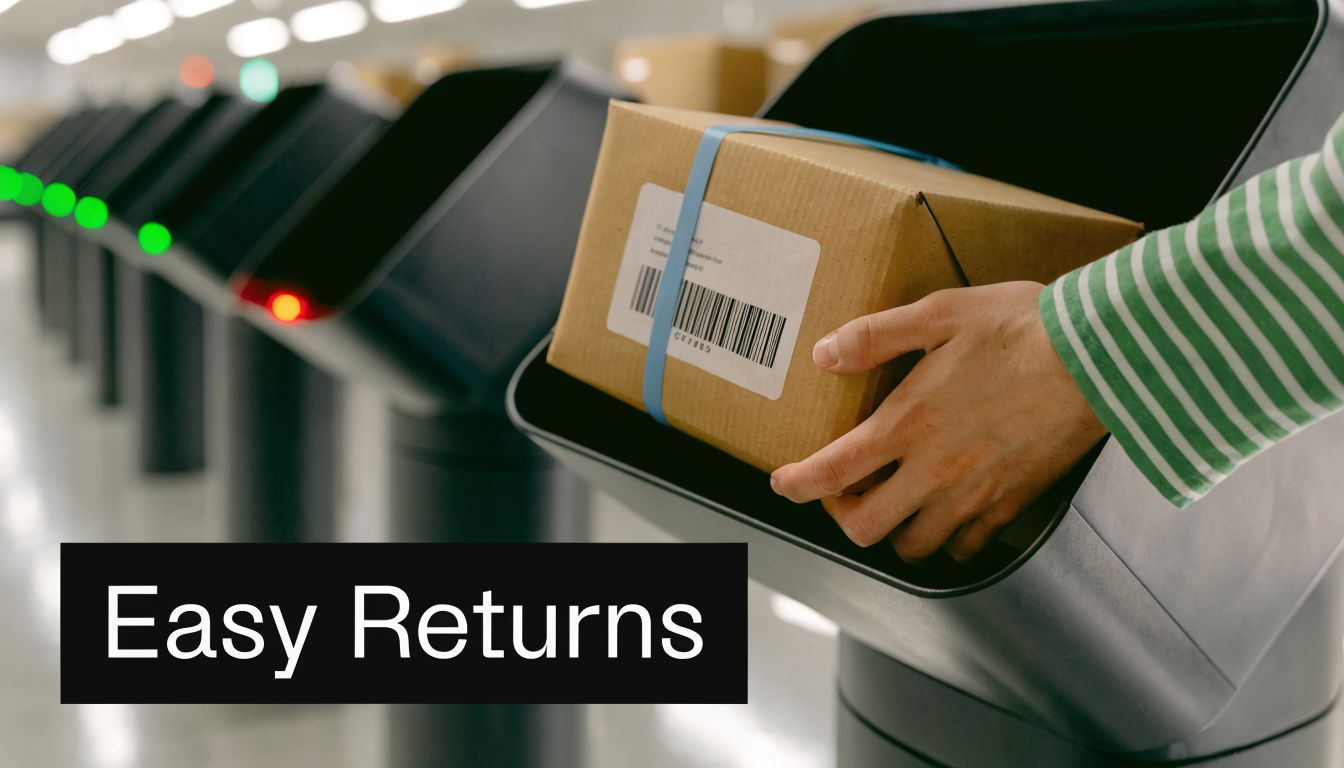
The operational sequence matters more than the returns page on your website. Once the item comes back, the business needs to decide what it is, what condition it’s in, and what should happen next.
A practical model usually looks like this:
Receipt and identification
Match the return to the original order and reason code so the team isn’t handling anonymous stock.Inspection and grading
Check condition, packaging, completeness, and resale suitability. Electronics, apparel, regulated products, and B2B returns all need different rules.Next-best action
Restock if saleable. Refurbish if recoverable. Isolate if damaged or non-compliant. Dispose responsibly when necessary.Refund or exchange trigger
Customer communication should follow operational truth, not assumption. Refunding too late damages trust. Refunding too early without control damages margin.
Generic returns setups usually fail in two places
The first failure is speed. Returned stock sits too long waiting for inspection, so businesses lose resale windows and customers chase refunds.
The second failure is network design. Brands focus only on consumer parcel returns and ignore B2B reverse flows, bulk returns after promotions, and stock balancing between locations. That’s where cross-docking and consolidation hubs can help, especially when returned goods need to move back into saleable channels quickly.
If your customer promise includes convenience, the final mile matters in reverse too. Last-mile delivery services are relevant here because collection options, local handoff points, and route planning affect both outbound delivery and returns recovery.
Returns data is operational intelligence
Returned goods tell you where the business is leaking value. They can reveal packaging weaknesses, poor product descriptions, sizing issues, recurring damage points, or channel-specific quality problems.
The mistake is to treat returns as a customer service queue rather than a logistics signal. Strong reverse logistics for ecommerce gives the commercial team cleaner information, the warehouse team clearer routing rules, and the finance team faster inventory recovery.
From Data to Decisions KPIs and Partner Selection
Most brands don’t need more logistics reports. They need fewer metrics, used more seriously.
If you can’t see where orders slow down, where costs drift, or where exceptions are repeating, you’ll keep fixing symptoms. A mature logistics for ecommerce operation measures the chain from inbound receipt to final delivery and back through returns. Then it chooses partners based on whether they can improve those outcomes across the whole flow, not just on one leg of it.
Track the KPIs that expose operational truth
You don’t need dozens of indicators. You need the ones that change decisions.
| KPI | What it tells you | Why it matters |
|---|---|---|
| Order accuracy rate | Whether the warehouse is shipping the right items correctly | Errors create returns, reshipments, and trust damage |
| On-time dispatch rate | Whether orders leave the warehouse when promised | A missed dispatch often guarantees a missed delivery |
| On-time delivery rate | Whether the transport network meets customer promises | This is what the customer actually feels |
| Cost per shipment | What it costs to move each order through the network | Helps you spot margin erosion by channel or destination |
| Customs exception rate | How often shipments are delayed by clearance issues | Vital for EU-UK and regulated goods flows |
| Returns cycle time | How quickly returned goods are processed to outcome | Affects refund speed and stock recovery |
A useful discipline is to review these KPIs by product category, destination, and service type. If you only look at blended averages, high-margin urgent orders can hide weak performance on standard flows, and vice versa.
Integration is the KPI multiplier
A provider may offer a competitive transport rate, a decent warehouse price, or acceptable brokerage support. That still doesn’t mean they improve the overall chain.
The gap usually appears in handoffs. The warehouse doesn’t see inbound timing early enough. The customs broker doesn’t get product detail in the right format. The carrier can’t adapt when orders are reprioritised. Customer service has tracking, but no operational context. Each party performs its narrow task, but the brand absorbs the friction between them.
This is why integration matters more than headline capability lists. A 2025 IMRG report found that 62% of UK ecommerce firms underestimate post-Brexit logistics hurdles, and that choosing a partner with integrated capabilities can reduce this friction by 35% (IMRG-linked analysis on post-Brexit ecommerce logistics friction).
What to look for in a logistics partner
When brands evaluate providers, they often ask the wrong opening question: “What’s your rate?” A better question is: “Where do you control risk in my chain?”
Use a shortlist like this:
Can they handle multiple modes well?
If your business uses road, sea, and air at different times, the partner should be able to plan mode changes without turning each one into a separate project.Do they understand customs as an operating function?
For EU-UK trade, customs can’t sit outside the main workflow. Brokerage, documentation, and movement planning need to be connected.Can they support regulated goods properly?
Agri-food, pharma, and temperature-sensitive shipments need more than generic freight execution.What visibility do they provide?
Milestone tracking is useful. Actionable exception management is better.Do they support warehousing and fulfilment, or only transport?
If inbound delays and outbound cut-offs are linked, the provider should understand both ends.How do they handle reverse logistics?
Returns shouldn’t disappear into a separate black box.Can they scale without rebuilding the model every quarter?
The right partner supports growth without forcing constant process redesign.
End-to-end capability changes the economics
An integrated operator can make sense as one option among others. Multica Group combines road freight, ocean freight, air freight, warehousing, cross-docking, order picking, labelling, in-house customs clearance, and support for veterinary inspections. For brands moving goods across Europe, Asia, and the United States, that matters because one provider can manage the physical movement and the compliance layer together, rather than handing those responsibilities across separate companies.
That doesn’t mean every brand needs one provider for everything. Some businesses should keep a mixed model. But every brand benefits from having fewer weak handoffs, better shipment visibility, and clearer ownership when exceptions occur.
Choose the partner that can explain how your shipment will move when something goes wrong, not just when everything goes to plan.
The commercial decision behind the operational one
A cheap provider can be expensive if they create rework, delays, poor customer communication, or inventory blind spots. An expensive provider can also be poor value if they bundle services you don’t need and still fail on execution.
The right choice usually sits in the middle. You want enough capability to manage complexity without over-engineering the operation. That means matching the partner to your actual trade lanes, product profile, delivery promise, and returns model.
For fast-growing brands, logistics becomes a strategic asset when four things happen together:
- Stock arrives where it should, when it should
- Orders are fulfilled accurately and released on time
- Cross-border movements clear without repeated disruption
- Returns recover value instead of just consuming cost
When those pieces work as one system, logistics stops limiting growth. It starts supporting it.
If your business needs a more joined-up approach to logistics for ecommerce, Multica Group can support multimodal freight, warehousing, fulfilment, customs clearance, and regulated cross-border flows across Europe, Asia, and the United States. The practical starting point is simple: map where your current handoffs are creating delay, cost, or visibility gaps, then decide which parts of the chain need tighter operational ownership.