Your orders have grown past parcels. A customer wants a mixed consignment delivered to a retailer, a wholesaler, or a distribution centre, and suddenly you’re dealing with pallet dimensions, booking windows, tail-lifts, customs paperwork, and the unpleasant possibility that one wrong decision could turn a simple shipment into a delay, surcharge, or damaged load.
That’s where most businesses first realise that pallet shipping uk isn’t just “put it on a pallet and send it”. It’s a discipline. Good pallet shipping protects margins, keeps stock moving, and prevents avoidable arguments with carriers, border authorities, and customers.
Your Introduction to Pallet Shipping in the UK
A familiar pattern plays out in growing businesses. The first few shipments go out by parcel. Then the order sizes increase, the products get heavier, and parcel networks stop being practical. You need a pallet collection, then regular pallet distribution, and suddenly your transport decisions affect stock availability, customer service, and cash flow.
That shift matters because palletised freight sits at the centre of how goods move through the UK. The UK pallet sector remains substantial and active, with network members delivering 29.3 million pallets in 2024, which was 8.4% above pre-pandemic levels, according to the 2024 APN pallet network sector report. If you sell, import, distribute, or export physical products, pallet logistics is no longer a side issue. It’s part of how your business runs.
The mistake new shippers make is treating pallet freight like a commodity. They compare one headline rate against another and assume the cheapest quote wins. In practice, cost sits downstream from a series of operational choices. Wrong pallet type, weak wrapping, poor labels, missed customs checks, or an unrealistic service level will all cost more than the small saving on the booking.
Practical rule: Pallet shipping usually goes wrong before the lorry arrives. The real errors happen in selection, preparation, and paperwork.
Businesses that handle pallet shipping well tend to do five things consistently. They choose the correct pallet footprint, build a stable load, label it clearly, understand the service they’re buying, and work with partners who can resolve issues fast. Those are the habits that keep freight moving cleanly through domestic UK networks and across EU-UK trade lanes.
Choosing the Right Pallet Type and Size
A pallet is the foundation of the shipment. Choose badly and every stage after that becomes harder. Forklift handling becomes awkward, stacking becomes unstable, trailer space gets wasted, and the risk of damage rises.
The pallets most UK shippers deal with
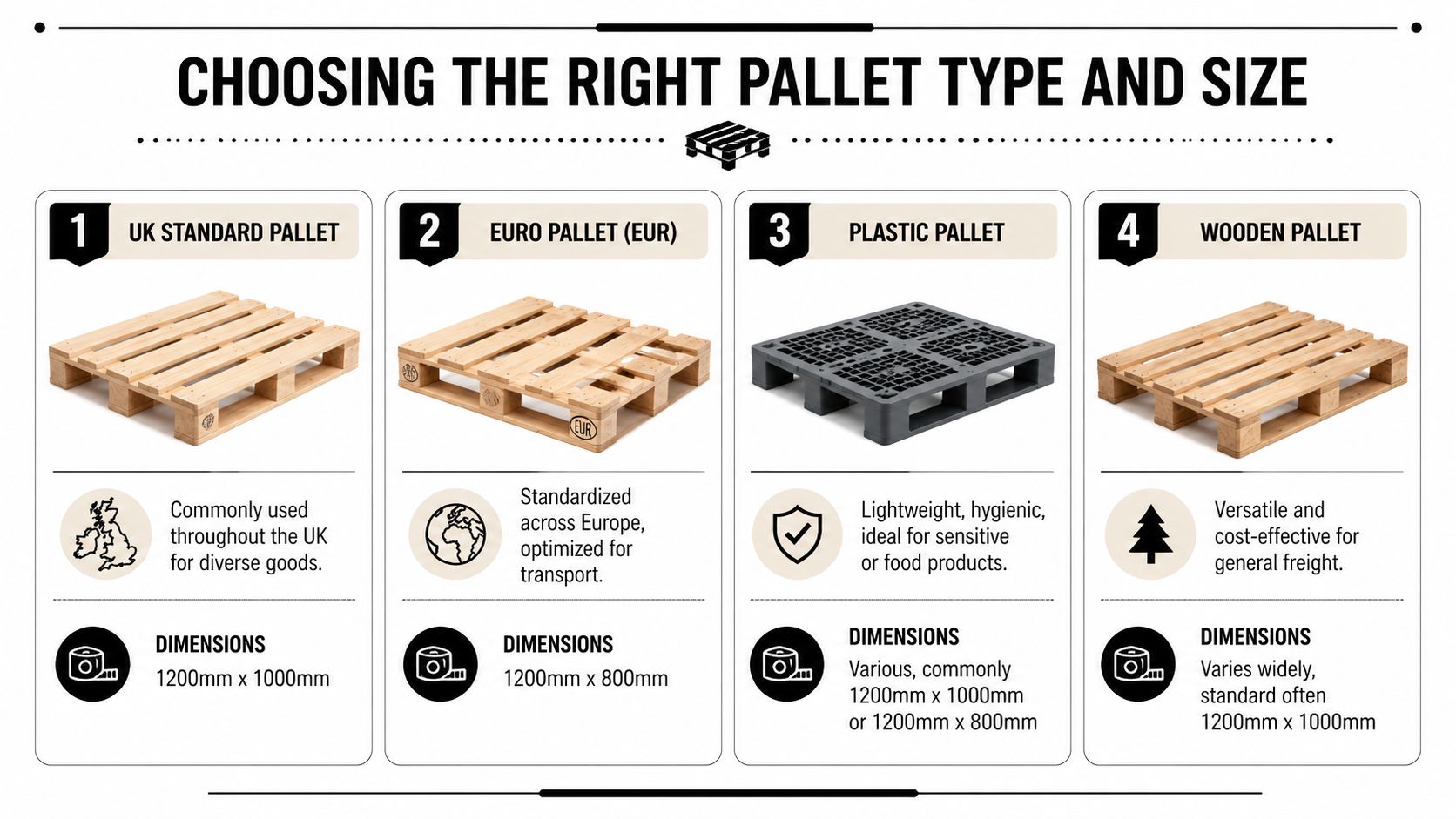
In day-to-day UK freight, the standard UK pallet is the most common reference point. Its dimensions are 1200mm x 1000mm, and it’s typically rated for 1000kg. If you exceed that, you increase the risk of pallet failure in transit and create a liability problem for everyone handling it, as outlined in PalletOnline’s guide to pallet size.
Euro pallets also matter if your goods move into European supply chains. They’re widely used for compatibility across continental handling systems, but they don’t match the footprint of a standard UK pallet. That difference sounds minor until it affects trailer loading plans, warehouse slotting, and whether goods need repalletising for a domestic leg.
Plastic pallets are a separate decision. They’re useful where hygiene, moisture resistance, or consistency matters more than repairability. Wooden pallets remain the practical default for general freight because they’re familiar, available, and accepted across most standard transport operations.
UK pallet specification comparison
| Pallet Type | Dimensions (mm) | Typical Max Load | Best For |
|---|---|---|---|
| UK Standard Pallet | 1200 x 1000 | 1000kg | General UK freight, warehousing, mixed consignments |
| Euro Pallet | 1200 x 800 | Depends on pallet condition and system requirements | EU-focused distribution and standardised continental handling |
| Plastic Pallet | Commonly 1200 x 1000 or 1200 x 800 | Varies by manufacturer and design | Food, hygiene-sensitive goods, moisture-prone environments |
| Wooden Pallet | Varies, often 1200 x 1000 | Varies by grade and build | Cost-conscious general freight |
What actually drives the decision
Most new shippers focus only on footprint. Experienced operators look at four things together:
- Handling compatibility: Will the receiving site accept this pallet size and material?
- Load strength: Can the pallet safely carry the actual weight, not the estimated one?
- Route profile: Is this a UK-only movement or part of a wider EU-UK or intercontinental journey?
- Cargo behaviour: Does the product shift, leak, compress, or require a cleaner surface?
If your goods will later move into a containerised supply chain, it also helps to understand how pallet dimensions affect space use inside shipping equipment. This breakdown of 20-foot container dimensions is useful because pallet choice often affects container loading efficiency long before the booking is finalised.
The right pallet isn’t the cheapest one available. It’s the one that fits the route, the cargo, and the receiving operation without creating rework.
Common selection mistakes
A few errors come up repeatedly:
- Using a weak recycled pallet for dense goods: Fine for light cartons, risky for heavy drums or tightly packed cases.
- Choosing Euro pallets for a UK-only delivery without checking site preference: That can complicate storage and onward handling.
- Ignoring final loaded height: Standard UK operations expect the full loaded pallet height to stay within accepted limits for vehicle and warehouse handling.
- Treating pallet grade as irrelevant: Grade affects condition, strength, and how much confidence a carrier has in the load.
Think of pallet choice the same way you’d think about choosing a container for stock storage. If the base doesn’t suit the contents and the journey, the problem won’t stay at the bottom. It will show up at collection, in transit, or at delivery.
How to Pack and Label Your Pallet for Safe Transit
A pallet shipment needs to be built for a rough journey, not a careful one. Your goods may be lifted more than once, stand in a hub, travel with other freight, and move through forklifts, trailers, and loading bays that don’t know your product as well as you do.
Build the load like a single unit
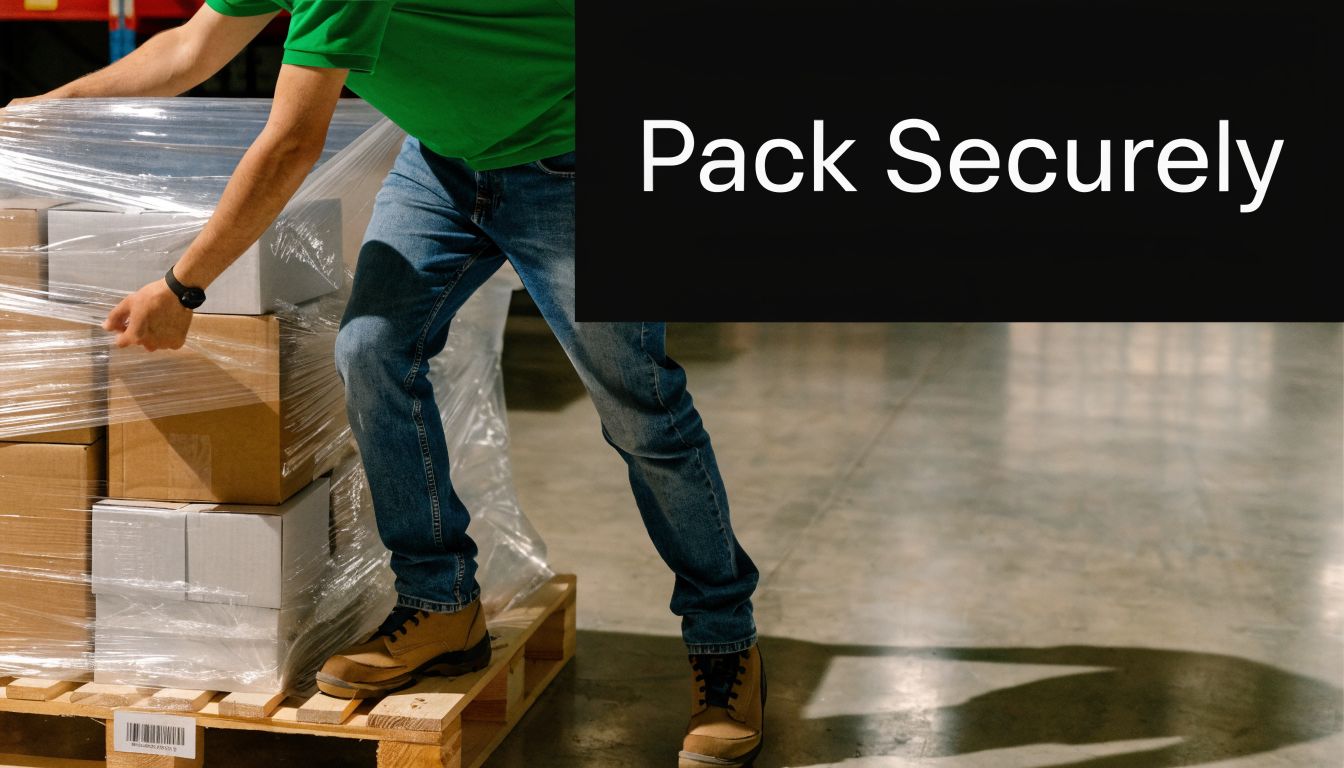
Start with the heaviest items on the bottom and keep the weight centred. Avoid overhang. If cartons or products project beyond the pallet edges, they become the first point of contact with other freight, forklift tines, and straps.
The load should behave as one stable block. That means even layers, no leaning stack, and no hollow centre that lets the load flex under pressure. Interlocking can help with some cartons, but column stacking is often better when you need compressive strength from box to box.
For fragile or irregular goods, internal protection matters before external wrapping does. Edge boards, corner protectors, anti-slip sheets, and void fill can stop movement that stretch film alone won’t control. If the goods are especially delicate, crating for shipping may be the safer option than relying on pallet wrap and hope.
Wrapping and banding that actually works
Stretch wrap should anchor to the pallet itself, not just the goods. If the wrap only grips the boxes, the load can still slide off the base. Start low, bind the base, then work upward with enough tension to secure the shipment without crushing the packaging.
Banding adds restraint where the load is dense, top-heavy, or packed in slippery outer cartons. It’s especially useful for machinery parts, beverages, and boxed products with little surface friction. Use top sheets when dust or moisture is a concern, but don’t treat them as structural protection.
A tidy pallet isn’t always a safe pallet. Stability matters more than appearance.
A quick visual check before dispatch catches many problems:
- Lean: If the load tilts before collection, it won’t improve in transit.
- Loose film: Slack wrap usually means shifting goods later.
- Soft packaging: Weak cartons under heavier layers tend to fail mid-route.
- Fork access: If the base is blocked by wrap, boards, or packaging, handling becomes risky.
Here’s a useful visual demonstration of stable pallet preparation and wrapping technique:
Labels must be visible and unambiguous
Bad labels create expensive confusion. Carriers need to identify the shipment fast, and warehouse teams need to know where to place, scan, or handle it without guessing.
Apply labels on at least two sides. Don’t place them only on the top, where another pallet or shrink wrap glare can hide them. If the goods need upright handling, use clear orientation labels. If they’re fragile, mark that too, but remember that labels don’t replace proper packing.
A useful label set normally includes:
- Delivery details: Full consignee name, address, postcode, and contact.
- Booking reference: The identifier that links the pallet to the transport order.
- Handling marks: Upright, fragile, keep dry, or other relevant instructions.
- Pallet count: Essential for multi-pallet consignments.
What doesn’t work
Some practices fail so often that they’re worth ruling out completely:
- Stacking products higher just to save on pallet count
- Wrapping unstable goods without correcting the stack first
- Using damaged cartons as the bottom layer
- Leaving old labels on reused pallets
- Relying on “handle with care” as the main protection plan
Safe transit starts with a load that can tolerate normal freight handling. If your pallet can’t handle being moved, queued, and delivered without constant special intervention, it isn’t ready.
Navigating Customs and Regulatory Requirements
Domestic UK pallet shipping is operational. Cross-border pallet shipping is operational plus administrative. Since Brexit, wooden pallets moving between the UK and EU carry a compliance burden that many businesses still underestimate.
ISPM 15 isn’t optional
For wooden pallets and wood packaging moving between the UK and EU, ISPM 15 compliance and stamping are mandatory. Non-compliant pallets can be rejected at the border, causing 48 to 72 hour delays and return costs that can exceed £200 per pallet, according to TIMOCOM’s guidance on shipping pallets between the UK and Europe.
This rule exists because untreated wood can carry pests. Border authorities don’t treat pallet timber as a minor packaging detail. They treat it as a plant health risk. If the wood packaging fails the standard, the goods can be delayed even if the commercial invoice and customs entry are otherwise correct.
What to check before the shipment leaves
A compliant wooden pallet should carry the proper IPPC mark. That stamp is the operational proof that the wood has been treated to the standard required for international movement. If the mark is missing, unreadable, or questionable, don’t load it and hope nobody notices.
For exporters moving agri-food, pharmaceuticals, or other regulated products, pallet compliance is only one part of the problem. The friction usually comes from the combination of pallet standards, customs formalities, and product-specific controls landing at the same point in the journey.
Many SMEs struggle with pallet shipping. General pallet shipping content often mentions ISPM 15 in passing but doesn’t deal with the workflow burden around documentation, checks, and timing. ForwardVia’s overview of pallet shipping from the UK highlights that compliance complexity is a real underserved issue for exporters, especially where shipments are time-sensitive and regulations are layered.
If the pallet, the customs entry, and the product documents are being checked by different people with no shared process, errors are likely.
The practical compliance workflow
Most preventable border problems come from weak pre-shipment control. Use a simple operational sequence:
Confirm the pallet material early
If the movement is UK-EU or EU-UK, decide at booking stage whether you’re using compliant wood or a non-wood alternative.Inspect the mark physically
Don’t rely on a supplier email saying the pallets are compliant. Check the actual pallet before loading.Match pallet choice to the route
A pallet that works domestically may not be the best fit for the full cross-border journey.Align customs and transport data
The exporter, warehouse, transport team, and customs representative should all be working from the same shipment details.Account for regulated goods
Agri-food and similar sectors often need extra coordination around inspections and health documentation.
If your business lacks internal customs capability, using specialist support becomes less of a convenience and more of a control measure. Experienced customs clearance agents help reduce the hand-off risk between transport and border formalities.
Where businesses usually lose money
The obvious cost is rejection or return. The less obvious cost is disruption. A delayed pallet can miss a booked slot, disrupt onward consolidation, trigger customer penalties, or leave stock unavailable when it was already sold.
Three patterns cause most of the avoidable pain:
- Ad-hoc pallet sourcing: Someone buys whatever pallets are available locally without confirming export compliance.
- Late checks: The team verifies the pallet standard after the goods are loaded.
- Fragmented responsibility: Warehouse staff assume customs checked it. Customs assume operations checked it. Nobody owns the final sign-off.
For pallet shipping uk that stays inside domestic networks, this issue may never appear. For EU-UK movements, it can define whether the shipment runs smoothly or becomes a costly exception. Treat the pallet as part of the regulated shipment, not as a disposable accessory around it.
Decoding Pallet Shipping Costs and Quotes
Pallet shipping quotes confuse people because the visible price often hides the underlying charging logic. A low headline rate can still become an expensive shipment once the carrier reclassifies the pallet, adds service extras, or charges for conditions that weren’t disclosed at booking.
What you’re usually paying for
A carrier or forwarder typically builds the price from a mix of pallet footprint, weight, route, service level, and handling requirements. The dimensions matter because pallet networks sell space as much as they sell movement. A badly used footprint costs money twice. Once in transport capacity and again in handling inefficiency.
Speed has a clear influence on the market. Next-day services account for 61.5% of total pallet volume, while economy services make up 39%, which shows that many shippers still pay for faster transit where service pressure justifies it. That split appears in the earlier APN market data already cited in the introduction, and it reflects a practical trade-off rather than a blanket rule that next-day is always better.
Single pallet versus multi-pallet thinking
The biggest commercial mistake is pricing each shipment in isolation. If you ship one pallet today, one tomorrow, and one the day after, the cheapest booking on each day may still be the wrong freight strategy overall.
That matters because existing pallet shipping content often talks in broad terms about rates varying by route, weight, and destination, but doesn’t give businesses much help on when to consolidate, when to stay with LTL, or when to move into fuller load planning. uShip’s pallet delivery overview reflects that gap around single versus multi-pallet economics, especially for businesses managing regular EU-UK traffic.
The quote needs to answer these questions
When you review a quote, check whether it reflects the shipment you’re sending:
- Is the pallet classified correctly? Quarter, half, full, oversized, and non-stackable are not minor distinctions.
- Is the weight realistic? Underdeclared weight often comes back as a correction or claim issue.
- What service are you buying? Economy and premium services solve different problems.
- Is access straightforward? Residential addresses, restricted sites, and timed deliveries often carry additional handling expectations.
- Does the quote assume forklift facilities? If not, tail-lift or special handling may matter.
Hidden costs that catch new shippers
Not every surcharge is unfair. Many are just the result of poor declaration. These are the ones that repeatedly trip businesses up:
- Failed collection charges: The freight wasn’t packed, labelled, or available when the vehicle arrived.
- Reclassification fees: The pallet was taller, heavier, or less stable than booked.
- Non-stackable handling: Often caused by weak top surfaces or fragile presentation.
- Delivery access issues: The site can’t receive the pallet as planned.
- Storage and redelivery: The receiver misses the slot or refuses the freight.
The cheapest quote is only cheap if the pallet moves exactly as declared and delivers first time.
A practical buying approach
A useful discipline is to match service to the commercial consequence of delay. If the pallet replenishes production, supports a launch, or feeds a retailer with strict booking control, faster service may protect more value than it costs. If the goods are routine stock with buffer time, economy can be sensible.
For regular shippers, cost optimisation usually comes from better rhythm rather than harder negotiation. Consolidate where practical. Standardise pallet footprints. Book with accurate dimensions and weights. Avoid sending urgency that was created internally by poor planning.
That’s the part many buyers miss. The quote is a mirror of your operation. Clean freight data and predictable shipping patterns usually produce cleaner pricing.
How to Choose the Right Pallet Freight Partner
Carrier choice matters most when something isn’t straightforward. Any provider can look acceptable on a simple domestic pallet with no special handling and no customs involvement. The real test is how they perform when the load is awkward, the delivery site is strict, or the border process introduces risk.
Reliability needs a benchmark
You shouldn’t assess a pallet freight partner on friendliness alone. Operational reliability has to be measurable. In the UK market, top pallet networks achieve 96% intact, in-time, on-full delivery performance, and that’s a useful benchmark for what serious buyers should expect. The figure comes from the APN sector data already referenced earlier.
A provider doesn’t need to be perfect to be worth using. They do need a process that makes failures visible, explainable, and recoverable. Vague promises are not a service standard.
What separates a tactical carrier from a strategic partner
A strategic freight partner reduces friction across the full shipment lifecycle. That means they don’t just collect and deliver. They help stop preventable mistakes before the freight enters the network.
Look for these qualities:
- Cross-border competence: If you move EU-UK freight, customs and transport need to work together.
- Operational visibility: Tracking, milestone updates, and fast exception handling matter more than polished marketing.
- Handling range: Some partners are strong on simple pallets but weak on regulated, perishable, or urgent cargo.
- Scalability: Your partner should support single pallets today and more complex flows later.
- Warehouse alignment: If storage, labelling, order picking, or cross-docking sits in the same chain, coordination improves.
Questions worth asking before you appoint anyone
Don’t just ask for rates. Ask how the operation works when things go wrong.
A useful shortlist of questions includes:
Who checks customs and documentation for EU-UK movements?
If the answer is vague, expect hand-off problems.How do you handle delivery exceptions?
You want a process, not “we’ll chase it”.What shipment types do you handle routinely?
General freight experience isn’t the same as competence in regulated sectors.What information do you need from us to avoid reclassification and delays?
Good operators will answer this clearly.
Good freight partners don’t just move pallets. They improve the quality of decisions made before booking.
Red flags to avoid
Some warning signs show up early:
- Rates with little detail
- No clear explanation of claims handling
- No practical guidance on pallet prep
- Fragmented communication between sales, operations, and customs
- Limited support outside standard office hours
You’re not only buying a transport movement. You’re buying problem prevention, issue ownership, and network competence. For importers, exporters, manufacturers, and distributors, that difference usually matters more than a marginal saving on the initial quote.
Your Strategic Guide to Flawless Pallet Shipping
Strong pallet shipping is rarely about one brilliant decision. It’s a chain of ordinary decisions made properly every time.
Choose a pallet that suits the cargo and route. Build the load for handling reality, not warehouse optimism. Label it so nobody has to guess. If the shipment crosses a border, treat pallet compliance and customs as one joined process. When you buy transport, read the quote for conditions, not just price. When you choose a provider, judge them on control, visibility, and recovery when exceptions happen.
A simple checklist keeps most shipments out of trouble:
- Correct pallet footprint and condition
- Stable load with no overhang
- Clear labels on multiple sides
- Accurate declared weight and dimensions
- Compliance checks completed before dispatch
- Service level matched to business urgency
- Freight partner vetted beyond headline price
Pallet shipping uk works best when it’s treated as part of supply chain design, not as a last-minute dispatch task. That’s especially true for businesses moving goods between the UK and EU, where a weak process creates costs quickly.
Frequently Asked Questions about Pallet Shipping
What should I do if a pallet is damaged in transit
Start by documenting the damage immediately. Take clear photographs before the pallet is unpacked further, keep all packaging, and note any visible external issues on the delivery record if the damage is discovered on arrival.
Then notify the carrier or freight partner without delay and provide the booking reference, delivery details, and a description of the goods affected. Claims usually become harder when the evidence trail is weak or the consignee accepted the shipment without recording visible issues. Insurance also matters, but it doesn’t replace proper packing or accurate declaration.
Can hazardous or restricted goods be sent on pallets
Sometimes yes, but never assume standard pallet network rules will cover them. Hazardous, controlled, temperature-sensitive, or otherwise restricted goods often require specific declaration, packaging, labels, and route approval.
The key point is disclosure. If a shipper tries to send restricted goods as ordinary freight, the risk shifts from a transport issue to a compliance issue. Always confirm acceptance before booking and make sure the packaging and documentation match the product classification.
How does pallet tracking usually work
Modern pallet freight usually includes milestone-based tracking rather than the same scan density you’d expect from parcel delivery. You may see collection confirmation, depot movement, onward transit, and delivery status rather than a constant live map.
For business users, the useful question isn’t whether tracking seems impressive. It’s whether the provider can tell you where the pallet is, what happens next, and who owns the issue if there’s a delay.
Is economy service always the cheapest option
Not necessarily. It’s cheaper on paper, but not always cheaper in commercial terms. If delay creates stockouts, missed slots, or customer penalties, a slower service can become the more expensive choice.
The right service depends on what the pallet is supporting in your business. Urgent production inputs, launch stock, and retailer-bound deliveries often justify a faster option. Routine replenishment may not.
Do I need a wooden pallet every time
No. Wooden pallets are common, but not always the best answer. Plastic pallets can make more sense where hygiene, moisture resistance, or export practicality matters.
The important thing is matching pallet material to route and cargo. For cross-border moves, the compliance status of wood packaging needs checking before dispatch. For domestic movements, handling strength and site acceptance may matter more.
If you need support with pallet shipping uk, cross-border customs, regulated freight, or multimodal planning, Multica Group can help you build a cleaner, safer, and more cost-effective transport process from the first pallet to full supply chain execution.