A shipment can move flawlessly from factory to port, clear the border on time, reach the regional depot without incident, and still fail where your customer notices it. The lorry arrives late. The driver can’t complete the handover. The delivery slot is missed because the site contact changed. A temperature-sensitive pallet sits longer than planned. The paperwork at the final handoff doesn’t match what the receiving team expects.
From the customer’s perspective, none of the earlier success matters much. They judge the shipment by the ending.
That’s why last mile delivery services deserve board-level attention, not just transport-team attention. The final leg isn’t a minor operational detail. It’s the point where transport cost, service reliability, customer experience, compliance, and internal efficiency all collide. For importers, manufacturers, distributors, and regulated-goods shippers moving between the UK and EU, the last mile is often where margin is protected or lost.
The Final Hurdle in Your Supply Chain
A common failure pattern looks like this. Goods leave the supplier on schedule. The international leg is booked properly. Customs preparation is largely in order. The warehouse receives the freight. Then the final delivery breaks down because the consignee can’t receive at the planned time, the route isn’t adjusted quickly enough, or the last handover requires checks nobody built into the process.
That failure feels small inside a complex supply chain. It rarely is.
For a business owner, the last mile is where your customer stops seeing “logistics” and starts seeing your reliability. If you supply retail stores, pharmacies, food buyers, production sites, or commercial customers with narrow receiving windows, the final handoff is the proof point. It confirms whether your operation is organised or fragile.
Why this stage carries disproportionate risk
The final leg has more moving parts than people assume:
- Delivery windows are tighter: Warehouses, stores, and commercial sites often won’t accept vague arrival ranges.
- Information quality matters more: A bad phone number or incomplete instruction becomes a live operational problem.
- Urban and rural conditions diverge sharply: What works in a dense city route often fails in low-density areas.
- Customer tolerance is lower: Delays at sea can be explained. Delays at the front gate feel personal.
A shipment isn’t finished when it enters the country. It’s finished when the receiver signs for it, accepts it, and can use it.
What experienced operators watch
Strong operators don’t treat the last mile as a courier booking attached at the end. They design for it earlier.
They ask practical questions early. Does the customer need booked delivery appointments? Is special handling required? Will the receiving team inspect labels, temperatures, serial numbers, or veterinary documentation? Does the load need cross-docking before final dispatch? Can one inbound flow be consolidated and then split more intelligently?
Businesses that get this right usually build the final leg into the original transport plan. Businesses that get it wrong often discover too late that a good linehaul doesn’t guarantee a good delivery.
Why Last Mile Delivery Is Your Most Critical Touchpoint
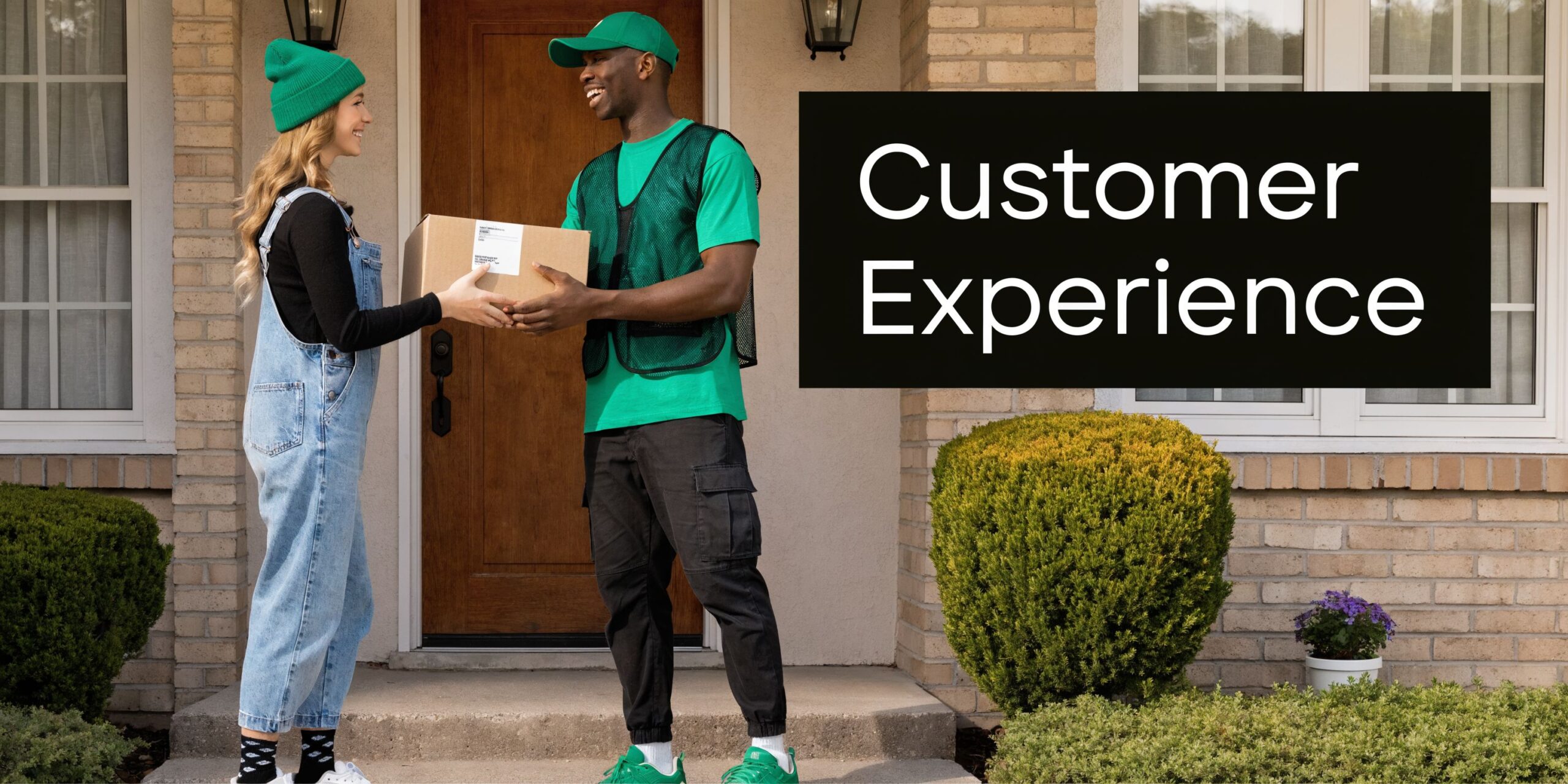
If you want a blunt commercial truth, it’s this. Customers remember the final delivery more vividly than the upstream transport architecture behind it. They don’t see the customs file, the route planning, the warehouse coordination, or the pallet build logic. They see whether the goods arrived when promised and in usable condition.
That’s why the last mile acts like the closing argument in a sales process. You can do many things right beforehand, but the final impression often decides whether the account becomes stable or starts looking at alternatives.
The hidden cost stack
Many businesses underestimate how expensive this stage can become when it isn’t managed tightly. In UK last-mile operations, fuel consumption accounts for 25-30% of costs, and average service time per stop benchmarks at 3-5 minutes in optimised fleets versus 7-10 minutes manually, according to this breakdown of last-mile delivery metrics.
That single comparison tells you a lot. A route doesn’t become expensive only because of miles travelled. It becomes expensive because of repeated micro-delays:
- Poor sequencing: Drivers lose time recovering from a bad route order.
- Excess idling: Urban waiting time consumes fuel and schedule reliability.
- Weak stop data: Missing instructions turn simple deliveries into exceptions.
- Manual planning: Dispatch teams spend effort reacting instead of controlling.
The same source notes that data-driven average service time calculation and predictive success probability can pre-empt 25% of failures, shorten routes by 15%, and boost stops per hour. Those are not cosmetic gains. They affect labour use, fleet productivity, and customer promise accuracy in a very direct way.
Service quality is operational discipline
Businesses often talk about customer experience as though it sits outside transport. In practice, delivery experience is mostly built from operational discipline.
The customer notices a few basics:
- Was the ETA believable?
- Did the delivery arrive in the agreed window?
- Was the handover smooth?
- Did someone communicate early if the plan changed?
When those basics fail repeatedly, the commercial impact spreads beyond transport cost. Sales teams field complaints. Customer service spends time chasing updates. Finance sees disputes and delayed payments. Operations teams rework schedules to correct failures that should never have existed.
Practical rule: Treat every failed delivery attempt as both a transport cost and a customer-retention event.
A lot of firms still run last mile delivery services as a downstream task. That usually leads to fragmented accountability. Warehousing blames transport. Transport blames customer availability. Customer service absorbs the fallout.
A better approach is to manage the final leg against business outcomes, not just dispatch completion. That means tracking actual delivery success, handover quality, and whether the customer received what they needed without extra intervention.
A short explainer on the delivery experience is useful here:
OTIF starts at the doorstep
For B2B shippers, On-Time In-Full is where this becomes measurable. OTIF isn’t protected by booking a good trunk movement alone. It’s protected when the final appointment, paperwork, handling requirement, and route execution all line up.
That’s why the strongest operators view last mile delivery services as a strategic function. Not because it sounds modern, but because it directly shapes repeat business, margin protection, and internal efficiency.
Exploring Different Last Mile Delivery Service Models
There isn’t one correct model for every business. The right answer depends on shipment profile, delivery density, customer expectation, product sensitivity, and how much control you need. Many firms end up using a mix rather than a single model.
Comparison of Last Mile Delivery Models
| Service Model | Best For | Cost Structure | Typical Speed | Level of Control |
|---|---|---|---|---|
| Traditional parcel network | Standard parcels, broad national coverage, routine deliveries | Pay per parcel or service band | Fast for standardised flows | Low to moderate |
| On-demand courier | Urgent consignments, local same-day needs, critical documents or parts | Premium per job | Very fast | Moderate |
| Crowdshipping or gig-driver model | Flexible local overflow, low-complexity consumer delivery | Variable, often demand-led | Fast in some urban zones | Low |
| Dedicated company fleet | Regular B2B routes, branded service, controlled handling | Higher fixed cost, lower marginal control risk | Depends on network design | High |
| White-glove specialist service | High-value, fragile, installation-linked, or compliance-heavy deliveries | Premium, service-intensive pricing | Slower but more controlled | Very high |
Traditional parcel networks
This is the default choice for many businesses because it’s simple to access and easy to scale. If you’re shipping standard cartons with predictable dimensions and broad destination spread, a parcel network works well.
Its weakness is control. Once freight enters the network, you operate largely within the carrier’s processes. That’s acceptable for standard goods. It’s far less attractive when customers need booked times, special unloading, label verification, or delivery instructions that fall outside a standard parcel workflow.
Best use case: routine shipments where consistency matters more than bespoke handling.
On-demand couriers
When something must move quickly, on-demand courier services are often the practical option. They work well for urgent replenishment, time-critical documents, replacement parts, and small shipments where speed beats consolidation.
The trade-off is cost. This model is hard to justify as a default operating method because urgency pricing can mask planning problems upstream. If a business repeatedly needs emergency courier support, the issue usually sits in inventory positioning, transport planning, or customer promise management.
Crowdshipping and gig-based delivery
This model gives flexibility, particularly in urban consumer flows or overflow periods. It can help businesses absorb spikes without adding permanent fleet capacity.
It’s less convincing for B2B and regulated movements. The more your delivery depends on controlled handling, proof standards, appointment discipline, or consistent operating behaviour, the less attractive a loosely managed driver pool becomes.
Use this model for convenience-driven delivery, not for shipments where control failure creates commercial or compliance risk.
Dedicated fleets
A dedicated fleet gives the strongest control over service standards, routing priorities, vehicle suitability, branding, and driver training. It tends to work best where delivery patterns are recurring enough to justify the fixed operating model.
This is especially useful in B2B environments where the receiver expects familiar processes. Drivers learn sites. Dispatchers understand recurring constraints. Teams can refine route logic based on actual delivery behaviour instead of generic carrier assumptions.
But dedicated fleets are not automatically efficient. If route density is poor, stop patterns fluctuate heavily, or delivery volumes are inconsistent, fixed assets can become expensive very quickly.
White-glove and specialist services
Some deliveries aren’t just “drop and go”. They involve installation support, room-of-choice placement, condition checks, serial capture, returns handling, or controlled handover. In regulated sectors, they may also involve stricter documentation and chain-of-custody requirements.
This model gives the highest service assurance. It also requires the most operational discipline.
How to choose without guessing
A useful selection framework starts with five questions:
- What are you delivering? Standard parcels, pallets, temperature-sensitive goods, fragile equipment, or regulated products need different operating models.
- What does the receiver expect? A residence, retail branch, distribution centre, and pharmacy won’t accept freight in the same way.
- How repeatable is the route pattern? Stable routes favour dedicated design. Irregular demand often favours network access.
- What does failure cost you? If a miss creates spoilage, compliance delay, or account damage, low-control models become less attractive.
- Do you need proof beyond delivery confirmation? Many B2B deliveries require more than a scan and timestamp.
What works in practice
The strongest setups are usually hybrid.
A business might use parcel networks for standard consignments, dedicated routes for key accounts, and specialist carriers for regulated or high-value deliveries. That structure isn’t inefficient. It’s often the most realistic way to align service model with shipment reality.
What doesn’t work is forcing all freight through one model because procurement wants a single tariff sheet. Uniformity looks efficient on paper. In last mile delivery services, it often produces unnecessary exceptions, avoidable claims, and poor customer outcomes.
The Technology Powering Modern Last Mile Logistics
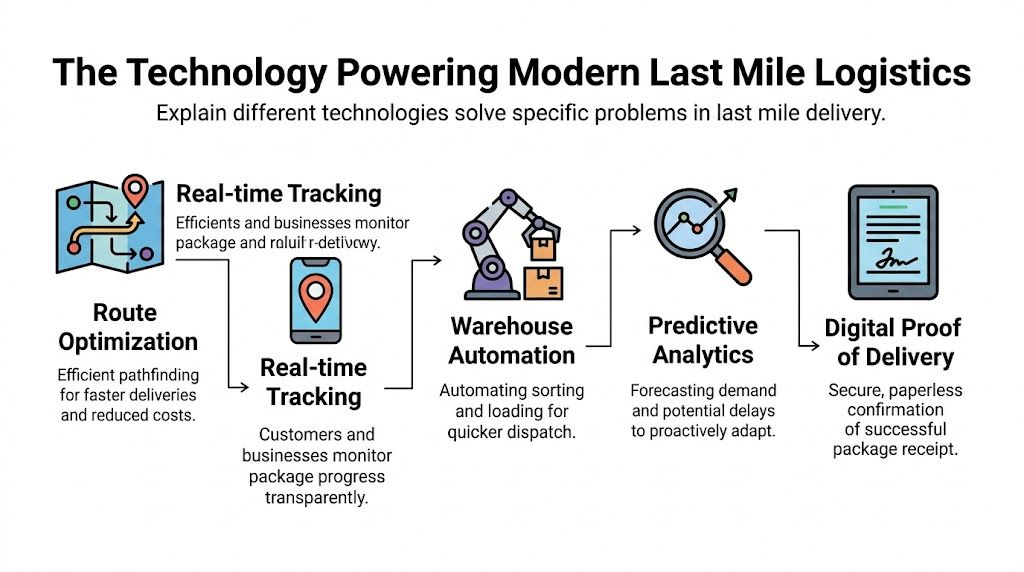
Technology matters in last mile delivery services because it solves very specific operating problems. It helps planners choose better routes, dispatchers respond to disruption quickly, warehouses release orders in the right sequence, and customers receive realistic updates instead of vague promises.
Route optimisation is no longer optional
Route planning used to rely heavily on dispatcher experience. Good planners still matter, but software now handles complexity far faster. That matters because urban disruption changes constantly, and static route plans don’t survive contact with the actual road network.
In the UK last-mile sector, first-attempt delivery success rates average 75% for traditional operations, but AI-driven dynamic routing can increase this to 95%, while redelivery costs can make up up to 15% of total delivery expenses. The same benchmark notes that dynamic routing enables fleets to reduce mileage by 11-20% according to these UK last-mile statistics.
Those gains come from practical capabilities:
- Dynamic re-sequencing: The system adjusts stop order when traffic, delays, or customer changes disrupt the original plan.
- Predictive delivery scoring: Planners can identify stops with higher failure risk before the vehicle arrives.
- Density-aware routing: The software groups work more intelligently in dense and mixed territories.
TMS and WMS stop handoff failures
A transport management system handles planning, carrier assignment, route control, and execution visibility. A warehouse management system controls picking, staging, loading, and dispatch readiness. Businesses often buy one and neglect the other. That’s a mistake.
If the warehouse stages freight in the wrong release order, even a strong route plan suffers. If transport planning doesn’t receive accurate loading status, customers get ETAs for freight that isn’t ready.
A clean last-mile process usually depends on these systems sharing data well. Order status, loading readiness, vehicle allocation, and delivery event updates need to move without manual chasing.
Businesses exploring digitised freight control often benefit from the operational direction in this overview of the digital revolution in transport logistics including e-CMR, eFTI, and EDI.
Telematics turns visibility into action
Real-time tracking is useful only when someone can act on it. Telematics gives dispatch teams live vehicle position, route adherence, stop progression, and driving pattern visibility. The primary value isn’t the map view itself. It’s decision quality.
If a driver is running late, the team can warn the customer early. If a route drifts off plan, the dispatcher can check whether the reason is traffic, access difficulty, or a handling issue. If a recurring stop always absorbs too much time, planners can redesign that part of the route.
The best visibility tools don’t just show delay. They help teams decide what to do next.
Predictive analytics and digital proof
Predictive analytics helps operators move from reactive management to controlled exception handling. It uses historical traffic patterns, stop behaviour, and delivery performance to highlight risk before the route collapses.
Digital proof of delivery matters too. In B2B, proof often needs to be stronger than a simple confirmation ping. Teams may need signatures, timestamps, condition notes, scanned documents, or delivery images. Paper-based proof creates disputes and slows resolution. Digital workflows shorten that cycle and give finance and customer service cleaner records.
A simple technology checklist
When assessing last mile delivery services, look for this stack:
- Routing engine: Must support dynamic updates, not just static planning.
- Live tracking: Customers and internal teams both need useful visibility.
- Warehouse integration: Picking and dispatch data must feed the delivery plan.
- Exception management: Delays should trigger action, not just alerts.
- Digital proof: Handover records need to stand up in commercial disputes.
Technology doesn’t replace operational discipline. It sharpens it. Poor processes remain poor when digitised. But good operators using the right tools can control cost, improve first-time success, and protect customer commitments far more consistently.
Specialised Last Mile Needs for Regulated Industries
Generic advice about last mile delivery services usually assumes a standard parcel and a simple handover. That falls apart quickly in regulated sectors.
A pharmaceutical shipment, chilled food consignment, or veterinary-controlled product doesn’t just need to arrive. It needs to arrive within handling rules, with the right documentation, under the right conditions, and often within a narrow compliance window.
The final mile can break the cold chain
For regulated shippers, the last leg is often the most exposed part of the journey. Long-haul transport may be tightly controlled, but final delivery introduces waiting time, location access problems, receiving delays, and handover errors.
For businesses moving sensitive goods, the intersection of last-mile delivery with temperature maintenance, documentation verification, and veterinary inspection requirements is a critical gap in common guidance. Failed deliveries in cold-chain scenarios waste product, and missed compliance documentation windows delay customs clearance at the final stage, as outlined in this analysis of why last-mile delivery matters.
That is the operational reality. The last mile isn’t just about where the goods are. It’s about whether the goods remain compliant and usable when they get there.
What makes regulated last mile different
The final leg for regulated products usually includes extra friction points:
- Temperature integrity: Vehicles, dwell times, unloading speed, and receiving readiness all matter.
- Documentation accuracy: The final receiver may need product, customs, or inspection paperwork aligned before acceptance.
- Site-specific acceptance rules: Labs, food facilities, wholesalers, and controlled sites often reject freight that standard consignees would accept.
- Escalation pressure: A missed delivery can trigger rebooking, storage complications, or product quality concerns.
These are not edge cases. They’re normal operating conditions for many importers and exporters in food, life sciences, and controlled trade.
Veterinary and customs timing matters at the end
Businesses often focus customs planning on border clearance alone. That’s too narrow. In practice, customs readiness and final delivery readiness are linked. If the right documents aren’t available at the right moment, the issue may only become visible once the last handover is due.
This is especially relevant in agri-food movements, where operational teams need transport planning, product handling, and border-related documentation to stay aligned. Teams dealing with these flows will recognise many of the practical issues described in this guide to transporting food products to the United Kingdom.
In regulated logistics, “delivered” only counts when the consignee can legally and operationally accept the goods.
What works better than a standard carrier handoff
For sensitive goods, the final leg needs tighter orchestration than a generic delivery booking can provide. That often means:
- Pre-validated documents before dispatch
- Booked delivery windows with confirmed receiving readiness
- Temperature monitoring through the final handoff
- Escalation paths when the site can’t receive as planned
- Drivers trained for controlled-goods procedures
A standard network can move compliant goods. It often struggles when the delivery requires exception judgement, controlled communication, or paperwork awareness on the ground.
Practical warning signs
If any of these issues appear regularly, the last-mile design is probably too generic for the product:
- The receiving site frequently asks for documents after the vehicle is already en route.
- Drivers arrive without clear handling instructions.
- Rejected deliveries are treated as routine rather than as quality risk.
- Customer service teams chase temperature or inspection status manually.
- Customs and delivery teams operate in separate workflows with weak coordination.
Regulated industries don’t need more noise around innovation. They need control. In these sectors, last mile delivery services should be designed as an extension of compliance and product protection, not merely a transport endpoint.
Integrating Last Mile with Your Multimodal Supply Chain
The most expensive mistake in last-mile design is treating it as a standalone activity. It isn’t. It’s the closing movement of a wider chain that may include road freight, sea freight, air freight, customs processing, storage, relabelling, cross-docking, and final distribution.
When businesses separate the last mile from those upstream decisions, they create avoidable cost and avoidable complexity.
The network design matters more than the final van
A lot of last-mile advice focuses only on carrier performance. That’s too narrow for B2B shippers moving freight across borders. Often, the biggest improvement comes earlier, from how freight enters the UK, how it is staged, and how it is broken down for distribution.
For companies moving LTL cargo across Europe to the UK, consolidating freight at UK entry points can distribute last-mile costs, which can exceed 50% of total shipping expense, across multiple customers. That supply-chain design approach is often missed in generic guidance focused only on route optimisation, as discussed in this piece on mastering last-mile delivery challenges and solutions.
That insight matters because many mid-market importers absorb final-delivery inefficiency one shipment at a time. They book inbound transport well enough, but they don’t redesign the handoff into local distribution.
Where warehousing changes the economics
Strategic warehousing near entry points can transform the final leg. Not because warehousing is always cheaper, but because it gives operators more options.
A consolidation hub can support:
- Cross-docking: Move freight through quickly without full put-away when speed matters.
- Order picking: Split inbound stock into delivery-ready consignments matched to local demand.
- Labelling and kitting: Finish market-specific preparation before final dispatch.
- Returns handling: Keep reverse flows close to the outbound distribution network.
Here, multimodal thinking becomes practical. Sea freight, road legs, customs clearance, and local distribution stop acting like separate contracts and start acting like one designed flow.
Why one connected chain performs better
A fragmented model creates blind spots. The inbound carrier may not know the warehouse release plan. The warehouse may not know the consignee booking rules. The final carrier may not know which customs or product documents matter at handover.
An integrated model improves three things:
Timing
Final delivery planning can begin before freight physically arrives.Data continuity
Order, transport, customs, and warehouse information stay connected.Exception handling
Teams can redirect, hold, split, or resequence freight without rebuilding the whole plan.
Businesses thinking about better network design across transport modes will find relevant operational context in this article on multimodality in practice across road, rail, and sea transport.
If the last mile feels expensive and chaotic, the root cause often sits upstream in network design, not in the driver’s route alone.
What this looks like in the real world
A strong integrated model usually follows a simple logic. Freight enters the market through the most suitable mode. Customs and documents are handled in line with the actual product flow. Goods move into a hub positioned for onward distribution. The warehouse performs only the value-added work that helps the final delivery succeed. Then the last leg is dispatched in a form that fits the consignee and the service promise.
That approach gives businesses more resilience than chasing tactical savings on single delivery legs. It also reduces the number of handoff failures between departments and providers.
Last mile delivery services work best when they’re designed backwards from the receiver, but built forwards from the whole supply chain.
Building a Resilient Last Mile Strategy
A resilient last-mile strategy isn’t built from one tool or one carrier contract. It comes from alignment. The delivery model has to fit the product. The technology has to support live control. The warehouse flow has to support the route plan. Customs and compliance steps have to be ready before the final handoff, not repaired during it.
A practical selection checklist
When reviewing last mile delivery services, check these points first:
- Service fit: Does the provider handle your actual delivery profile, or only standard consignments?
- Operational visibility: Can your team see route progress, delays, and proof of delivery in a usable way?
- Exception management: Is there a real process for failed access, missed windows, and urgent rerouting?
- Regulated-goods capability: Can the operation support controlled products, document checks, and sensitive handovers?
- Multimodal integration: Will the final delivery connect properly with your inbound freight, warehousing, and border processes?
What strong operators do consistently
They don’t judge performance only by whether a vehicle left the depot. They judge it by whether the consignee received the goods on time, in full, and without unnecessary intervention.
They also avoid false economies. The cheapest last-mile option on a rate card can become the most expensive once re-deliveries, customer complaints, rejected goods, internal rework, and account damage are counted.
Good last-mile performance is rarely accidental. Someone designed the network, data flow, and delivery rules to make success repeatable.
The commercial takeaway
If you import, export, manufacture, or distribute goods across the UK and EU, the final delivery leg deserves the same attention you already give to freight rates, customs clearance, and warehouse capacity. It isn’t the end of the chain in a trivial sense. It’s the moment where the whole chain proves whether it works.
If your business needs a logistics partner that can connect multimodal freight, customs clearance, warehousing, and final distribution into one controlled flow, Multica Group is built for that job. Its team supports road, sea, and air movements, backed by customs expertise, telematics, warehousing, cross-docking, order picking, labelling, and distribution, so your last mile is managed as part of the whole supply chain rather than as an afterthought.