A buyer is waiting for stock that was meant to arrive this morning. Production has scheduled labour around it. Sales has promised delivery dates based on it. Customer service already has two emails asking where the order is. At that point, transport by road stops being a line on a purchase order and becomes a commercial issue.
That is how most businesses experience road freight. Not as an abstract mode of transport, but as the link between procurement, inventory, customs, warehousing, and final delivery. If that link is weak, the whole chain feels it.
In the UK, road freight remains the dominant mode for inland cargo movement. In 2022, road freight transport in the United Kingdom accounted for 13.3 billion tonne-kilometres and represented over 90% of all inland freight movement, with the figure up 2.4% from 2021 according to UNECE transport statistics. For importers, exporters, manufacturers, retailers, and distributors, that matters because most supply chains still depend on a lorry at the start, the middle, or the end.
Road transport also carries a different burden in post-Brexit trade. It is no longer enough to find a carrier with available capacity. The workable solution is the one that combines route planning, customs readiness, equipment fit, timing discipline, and visibility after dispatch. Businesses that treat road freight as a commodity often pay for that mistake through delays, rework, damaged stock, and avoidable border friction.
The Unseen Engine of Your Business Supply Chain
A delayed truck can trigger problems far beyond transport. A production line can sit idle. A chilled shipment can lose shelf life. A retailer can miss a launch window. A distributor can pay staff to wait for goods that are not yet on site.

That is why transport by road should be planned as part of the wider operating model, not bought at the last minute. It connects ports to warehouses, factories to distribution centres, and suppliers to final-mile networks. Even when freight arrives by sea or air, road transport usually decides whether the shipment reaches the right place on time and in usable condition.
The UK market shows how central that role remains. In 2022, road freight transport in the United Kingdom accounted for 13.3 billion tonne-kilometres, representing over 90% of all inland freight movement, and this was a 2.4% increase from 2021, according to UNECE transport statistics. For most businesses, that translates into a simple operational truth. If you move goods in Britain, you rely on road freight whether you notice it or not.
What road freight really controls
Road freight affects more than delivery.
- Inventory posture: Faster and more predictable movements let businesses hold less buffer stock.
- Customer promises: Delivery windows only work if dispatch, routing, and handover are coordinated properly.
- Cash flow: Goods that sit in depots, queues, or customs limbo do not generate revenue.
- Compliance exposure: One paperwork error or unsuitable vehicle can turn a routine movement into a costly exception.
Some firms still compare road transport only on price per pallet or price per load. That works for simple lanes with low urgency and low compliance risk. It breaks down quickly when the shipment is regulated, cross-border, temperature-sensitive, high-value, or needed for production continuity.
The most expensive road movement is rarely the one with the highest quoted rate. It is the one that arrives late, incomplete, non-compliant, or unusable.
Full Truckload versus Less-Than-Truckload Explained
Most buying mistakes in road freight start with choosing the wrong service model.
The easiest way to think about it is this. FTL is like hiring the whole vehicle for your shipment. LTL is like paying for part of the space and sharing the truck with other consignments going through the same network.
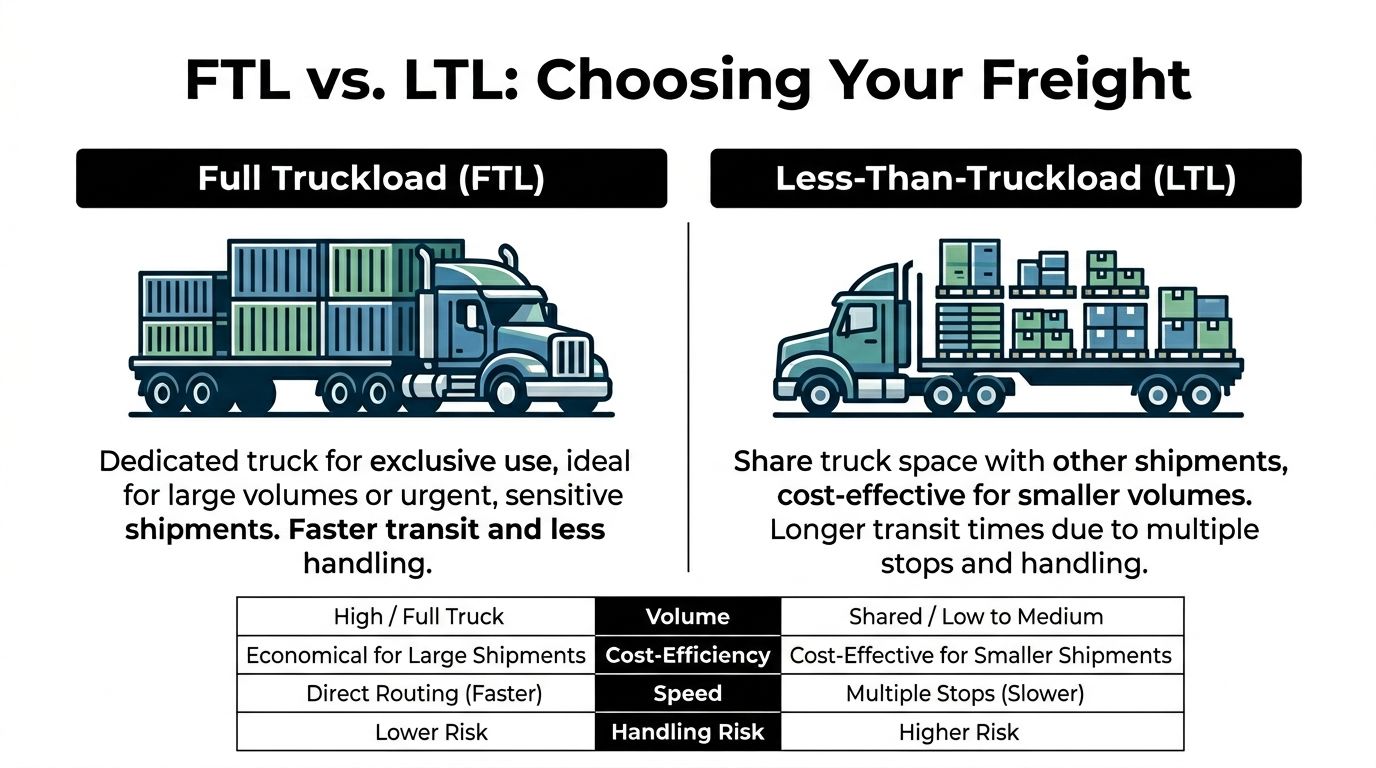
That sounds simple, but the commercial consequences are significant. Your choice affects transit time, handling frequency, claims risk, flexibility, and the way you budget transport.
When Full Truckload makes sense
Full Truckload, usually shortened to FTL, works best when the shipment is large enough to justify dedicated space or important enough to require direct control over the journey.
Typical cases include:
- High-volume freight: You have enough pallets or cargo volume to use most or all of the trailer.
- Time-sensitive loads: Manufacturing inputs, retail launch stock, or urgent replenishment where each extra stop creates risk.
- Sensitive cargo: Fragile, high-value, or tightly packed freight that benefits from less handling.
- Single-origin to single-destination moves: The route is straightforward and there is no benefit in entering a shared network.
With FTL, the truck is loaded for your movement and usually runs with fewer interruptions. That generally improves predictability. It also reduces the number of touchpoints where freight can be misplaced, cross-loaded incorrectly, or damaged by repeated handling.
The downside is obvious. If you do not need most of the trailer, you may be paying for unused capacity.
When Less-Than-Truckload is the better call
Less-Than-Truckload, or LTL, is designed for freight that does not justify a dedicated vehicle on its own.
LTL is often the right fit when:
- Your shipment is smaller: A few pallets, cartons, or a partial load.
- Cost control matters more than pure speed: You are willing to trade some transit flexibility for lower transport spend.
- You ship regularly but in modest quantities: Shared capacity can be more efficient than waiting to build a full load.
- Your business benefits from consolidation: Multiple smaller consignments can move through hubs and linehaul networks instead of dispatching separate trucks.
LTL works well operationally when the goods are packaged properly, labelled clearly, and booked with realistic timing. It works poorly when the shipper expects FTL-style direct service at LTL prices.
Shared networks mean more stops, more terminal handling, and more dependencies. If one handover point is delayed, the shipment can miss its onward movement. That does not make LTL a weak option. It just means it needs the right expectations and the right packaging discipline.
FTL vs LTL Shipping At a Glance
| Factor | Full Truckload (FTL) | Less-Than-Truckload (LTL) |
|---|---|---|
| Volume | Best for large shipments or loads that need dedicated space | Best for smaller consignments and partial loads |
| Cost-efficiency | Better when you can use most of the vehicle or need direct service | Better when you do not want to pay for empty trailer space |
| Speed | Usually faster and more predictable | Usually slower because of consolidation and extra stops |
| Handling risk | Lower, because freight is handled fewer times | Higher, because goods move through shared hubs and transfers |
The decision mistakes businesses make
A common mistake is booking LTL for freight that is commercially too important for network handling. Another is booking FTL for every urgent order, even when better planning could consolidate several shipments into one efficient movement.
A more disciplined buying approach asks four questions:
- How much space do the goods really need
- How many times can the freight safely be handled
- How important is exact delivery timing
- What costs more for your business. Extra transport spend or delay risk
For a deeper operational comparison, this guide on FTL vs LTL and how to optimise transport choices in e-commerce is useful if your order profile changes frequently.
If the cost of one late or damaged shipment exceeds the savings from sharing space, the shipment probably should not be in an LTL network.
Understanding Your Freight Costs and Transit Times
Freight quotes often look straightforward until the invoice arrives or the delivery misses its slot.
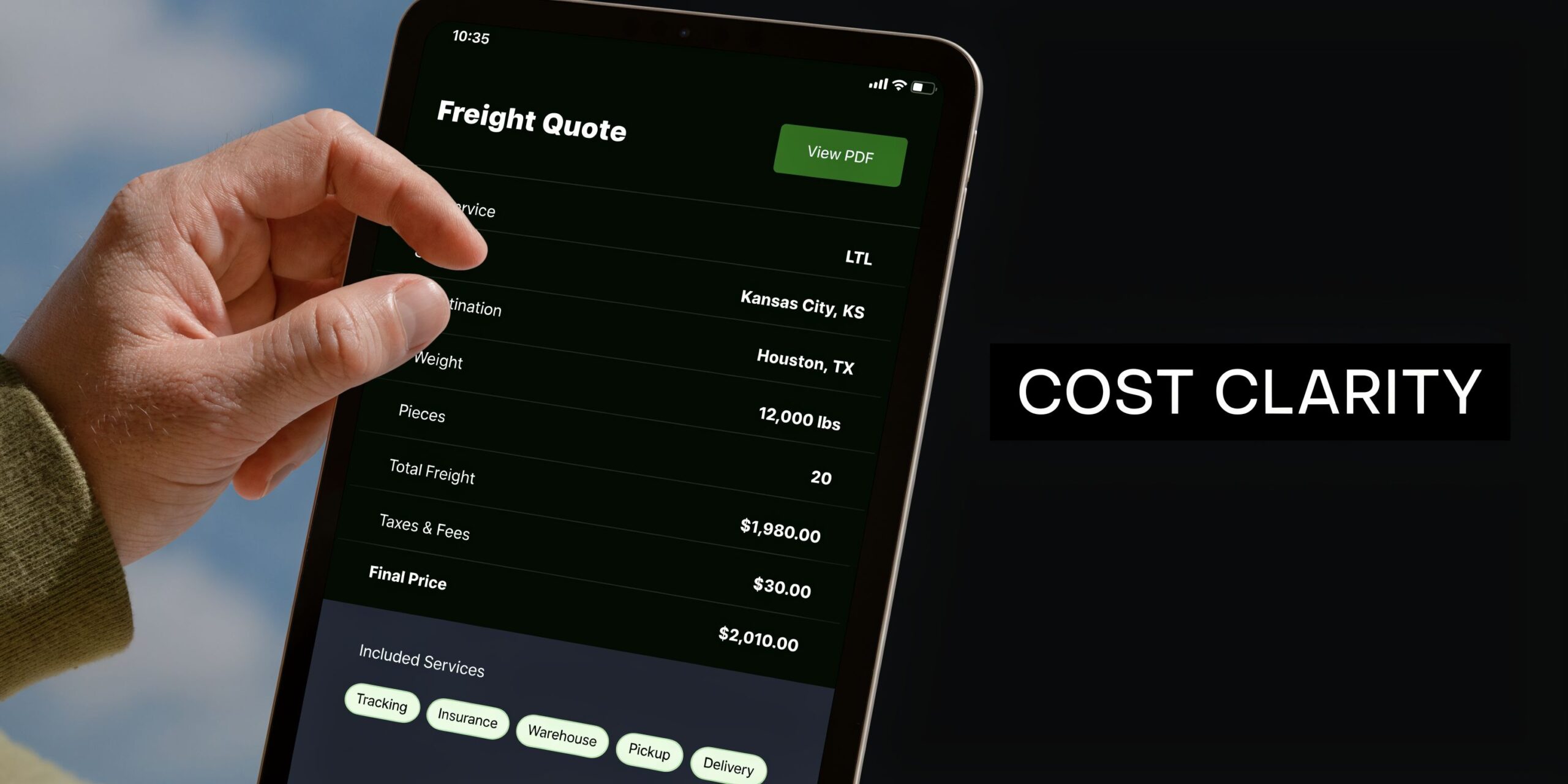
A rate for transport by road is never just about distance. It reflects time, equipment, labour, route conditions, access constraints, handling requirements, and the amount of uncertainty the carrier is taking on.
What sits behind the quote
At a commercial level, most road freight pricing comes back to a few core drivers.
- Vehicle and capacity use: A dedicated trailer costs more than a shared pallet movement because the carrier is reserving space specifically for you.
- Route and mileage: Longer routes usually cost more, but urban delivery complexity can matter as much as miles.
- Driver time: Waiting at collection or delivery points has a real cost. So do overnight constraints and legally managed working time.
- Handling profile: Tail-lift deliveries, timed bookings, re-deliveries, cross-docking, and special equipment all affect the price.
- Cargo characteristics: Awkward dimensions, temperature control, or regulated products change the operational plan.
This is why two shipments with a similar weight can price differently. One may move on a clean depot-to-depot lane. The other may need a narrow delivery window, urban access management, and additional checks before unloading.
Why transit times vary more than buyers expect
Transit planning often fails because businesses assume route time equals delivery time. In practice, the truck journey is only one part of the chain.
Loading delays at origin, missed warehouse slots, late customs release, traffic bottlenecks, and delivery refusals all extend the overall movement. The effect is especially visible on heavily used corridors. Congestion in the UK causes a £29 billion annual economic loss, with HGVs experiencing 20 to 30% longer journey times on key routes. Telematics data also shows a 15% fuel efficiency loss from factors such as idling, according to the UK road traffic statistics collection.
That matters for buyers because congestion does not just affect ETA reliability. It affects cost. More time on the road means more labour consumption, more fuel burn, and less productive use of the vehicle during the day.
The hidden costs that create friction
Some cost items are obvious on a quote. Others appear later as accessorial charges, detention, or service exceptions.
Watch closely for these pressure points:
- Booking failures: If the delivery site requires a pre-booked slot and the slot is missed, the truck may wait or return.
- Poor loading readiness: Unwrapped pallets, inaccurate counts, or goods not being available at collection create avoidable delay.
- Urban restrictions: Certain delivery areas require stricter equipment planning or timing discipline.
- Network mismatch: Booking urgent freight into a standard shared network can create expensive escalation later.
A short explainer like this can help teams align internal expectations before they tender transport:
How buyers reduce cost without damaging service
The best savings rarely come from pressing harder on the headline rate. They come from making the shipment easier to move.
Consider these practical levers:
- Consolidate where possible: Fewer, better-planned shipments usually beat frequent fragmented dispatches.
- Load accurately: Correct pallet counts, dimensions, and readiness reduce disputes and failed collections.
- Use realistic delivery windows: Narrow windows increase planning difficulty and often increase cost.
- Match service level to need: Reserve direct or express road transport for freight that needs it.
A good quote should tell you what is included, what assumptions it relies on, and what events will trigger extra cost. If that is not clear before dispatch, the problem usually shows up later.
Navigating Post-Brexit EU to UK Border Controls
A pallet leaves a warehouse in the EU on schedule. It is loaded properly, labelled correctly, and collected by a capable driver. Many businesses still assume the difficult part is over at that point. In post-Brexit trade, the difficult part may be just beginning.
The border process now rewards preparation more than improvisation. If the customs entries, references, and supporting documents are correct before the vehicle reaches the port, the movement can stay controlled. If they are wrong, even a simple shipment can become unpredictable.
What the shipment journey looks like now
Take a routine commercial movement from an EU shipper to a UK distribution centre. Before the truck departs, the parties need to align on the commercial invoice, packing data, commodity coding, origin information where relevant, and the customs filing route. The haulier also needs the correct movement references linked to the journey.
The truck itself may be road-ready and the driver may be on time, but border systems do not care about good intentions. They care about complete and correct data.
At the crossing point, the shipment may move through smoothly or it may be flagged for further checks. That outcome depends heavily on what was filed earlier and whether the consignment details match the physical goods and the supporting paperwork.
Why smaller shippers feel the pain first
Post-Brexit friction does not affect every operator equally. Analysis shows that divergence in UK and EU road infrastructure standards and customs checkpoint efficiency directly impacts transport costs, and underinvestment in cross-border infrastructure can favour larger operators over SMEs moving time-critical freight, as discussed in the University of Minnesota CTS article on underserved transport systems.
Large operators can absorb disruption more easily. They may have bigger customs teams, more route options, and more influence due to volume. Smaller importers and exporters usually cannot. One rejected filing or one missed pre-lodgement can disrupt stock, customer commitments, and cash flow quickly.
Where border movements usually fail
The recurring problems are rarely dramatic. They are usually basic and preventable.
- Incorrect document matching: Invoice, packing list, and customs declaration do not align.
- Late customs preparation: The truck is booked before the customs work is ready.
- Weak handover between parties: Supplier, broker, forwarder, and consignee each assume someone else has checked the details.
- Unclear responsibility: Nobody owns the final review before departure.
Businesses moving freight from the EU into the UK should tighten their process around a single shipment file. A consistent record is better than multiple email chains with conflicting data.
For companies trying to understand the operational side of the regime, this guide to UK border controls helps frame the moving parts clearly.
Border compliance is not a port problem. It starts at booking, document preparation, and data ownership long before the vehicle reaches the crossing.
Ensuring Compliance for Specialised and Regulated Goods
Regulated freight leaves little room for approximation. Food products, animal-origin goods, plants, pharmaceuticals, and other sensitive consignments need a road transport plan that protects both compliance and product integrity.
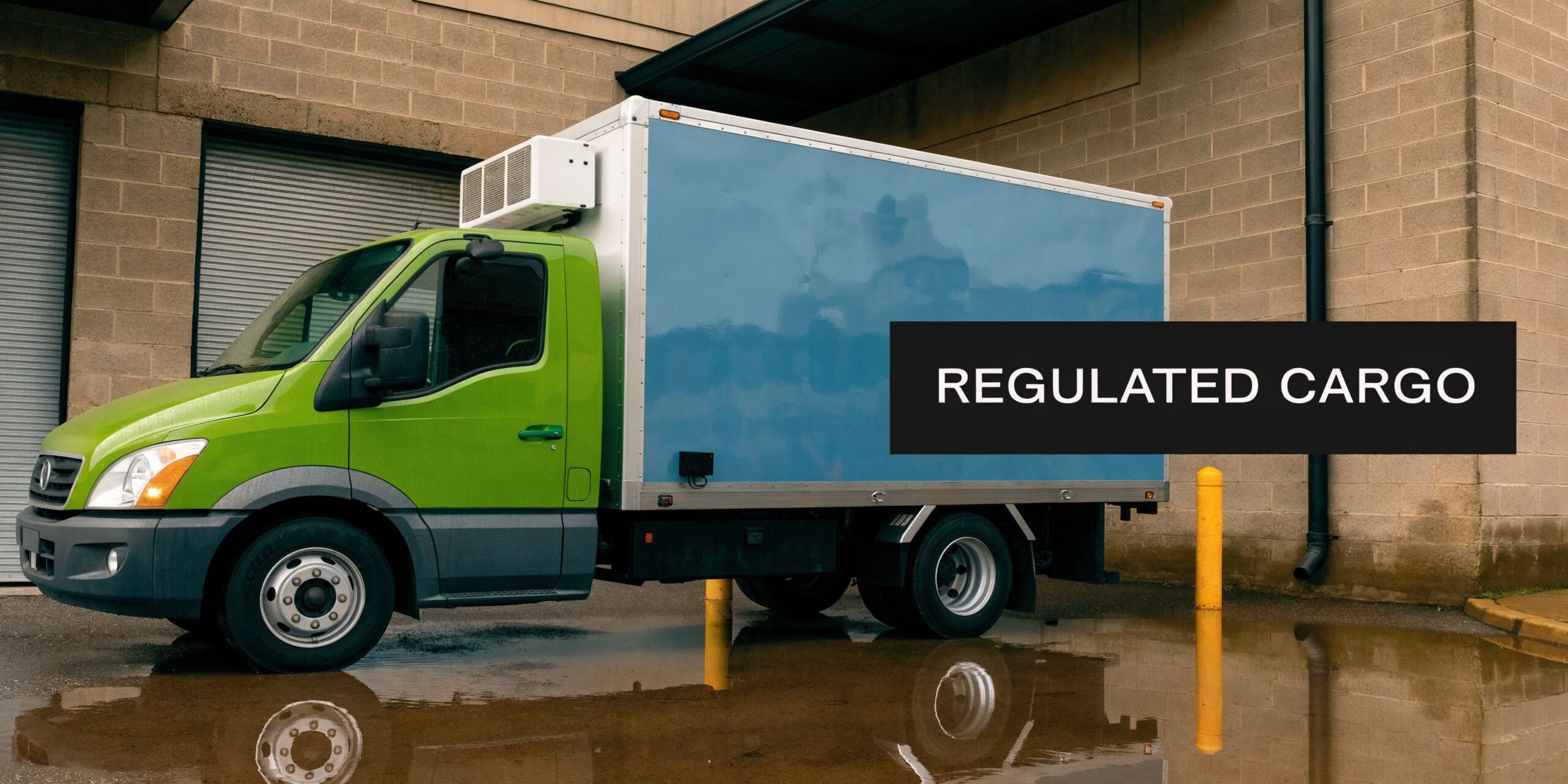
The risk is not only delay. The risk is that goods arrive but cannot be accepted, sold, or used.
What can go wrong
Temperature-sensitive freight is the clearest example. If a reefer unit is set incorrectly, if doors stay open too long during loading, or if the temperature record is incomplete, the cargo may be commercially compromised even if the truck reaches the destination on time.
Safety compliance matters too. UK regulations mandate annual HGV brake testing, and a 38-tonne articulated lorry at 56 mph requires 97 metres to stop with optimal brakes, increasing to 150 metres if efficiency drops. Brake performance issues contribute to 12% of HGV collisions. For temperature-controlled units, the added weight requires extra brake system diligence, according to the UK road accidents and safety statistics collection.
That is not an abstract maintenance point. If you move chilled or frozen cargo, the equipment choice affects both product protection and road safety.
The compliance habits that matter
Regulated movements succeed when the carrier and shipper treat compliance as an operational routine, not as end-stage paperwork.
Key checks include:
- Document readiness: Certificates, product descriptions, and shipment references must align before departure.
- Equipment fit: The vehicle has to suit the cargo, whether that means temperature control or clean loading conditions.
- Load discipline: Goods must be packed and presented in a way that supports inspection and safe handling.
- Traceability: If a question arises at the border or at delivery, the operator needs fast access to the shipment record.
For agri-food businesses, this overview of transporting food products to the United Kingdom is useful because food logistics often fail on procedural details rather than linehaul itself.
Why expertise matters more with specialist cargo
A general carrier may be enough for standard boxed freight on a simple domestic route. Specialist goods need more than available wheels.
They need disciplined temperature management, careful scheduling, equipment that fits the product, and people who understand what an inspection authority or consignee is likely to ask for. One weak handoff can undermine the whole movement.
With specialised freight, compliance is part of the service itself. If the goods are not acceptable on arrival, transport has failed even if delivery was technically on time.
How to Build Your Optimal Road Transport Solution
The strongest road freight setup is rarely the cheapest lane on paper. It is the one that fits your cargo profile, your risk tolerance, your customers’ expectations, and your internal capacity to manage exceptions.
Businesses often choose between two models. They either manage multiple carriers directly, or they use a logistics partner to coordinate movements, documentation, visibility, and handovers. Both can work. The right choice depends on complexity.
Start with your shipment reality
Do not build a transport by road strategy around generic market assumptions. Build it around your traffic.
Ask practical questions:
- Are your orders steady or erratic
- Do you move domestic only, or cross-border as well
- How often do you ship regulated or temperature-sensitive goods
- Can your team manage customs, booking windows, and exception handling internally
- Do your delivery points include rural or peripheral locations
That final point matters more than many firms expect. For businesses with supply chains extending into peripheral UK regions, logistics infrastructure can be fragmented, and rural export-focused businesses such as agri-food producers can face premium road transport costs, as noted in this discussion of transportation equity and underserved communities. If your network includes those areas, simple rate comparisons can be misleading. The issue is not only cost. It is service continuity and network design.
Use technology for control, not decoration
Visibility tools matter when they change decisions, not when they merely produce dashboards.
Telematics, milestone tracking, and exception alerts are useful when they help teams answer operational questions quickly:
- Has the truck collected
- Is the route progressing to plan
- Has the ETA changed enough to affect unloading labour
- Does the customer need to be informed now rather than later
A modern setup should let transport, warehouse, procurement, and customer service work from the same current picture. If each team uses separate updates and manual chasing, delays multiply internally before the lorry even reaches site.
One option in that model is Multica Group, which combines road services with in-house customs handling, documentation support, warehousing, cross-docking, and telematics-based visibility for businesses that need a joined-up operating approach rather than carrier-only execution.
Know when direct carrier management stops scaling
Some firms are well equipped to manage transport in-house. They have transport buyers, customs support, warehouse planners, and enough shipment volume to structure carrier relationships lane by lane.
Others outgrow that model without realising it. Warning signs include:
- Constant exception chasing: The team spends more time expediting than planning.
- Fragmented accountability: One provider hauls, another clears customs, another stores, and nobody owns the full chain.
- Poor data handoff: Shipment information is re-entered repeatedly across teams and systems.
- Reactive buying: Trucks are booked only when stock becomes urgent.
At that point, managing multiple suppliers directly may look cheaper but operate worse. Hidden costs build up through admin time, failed coordination, and service inconsistency.
Build around three commercial priorities
Most strong solutions balance these priorities rather than maximising only one.
Reliability
Reliable transport means the shipment arrives when expected and in the expected condition. It depends on realistic lead times, suitable equipment, and disciplined communication between booking, collection, border processing, and delivery.
Compliance
This becomes decisive in EU-UK trade and specialist sectors. If your business moves goods that face customs scrutiny, veterinary checks, or strict product handling requirements, the process has to be designed around those controls from the start.
Cost clarity
Cost control matters, but only in context. A lower rate is useful if it supports your service promise. It is far less useful if it creates repeated stockouts, chargebacks, production delays, or customer churn.
A practical decision rule is simple. Keep direct carrier management for straightforward flows that your team can govern well. Use an integrated logistics model when your freight mix, border exposure, or service commitments create too many moving parts for fragmented management.
Frequently Asked Questions About Transport by Road
Can I track an LTL shipment in real time
Usually, yes, but the level of detail depends on the network and the provider’s systems. Some operators give milestone updates such as collected, in transit, at depot, and out for delivery. Others provide more granular telematics-led visibility. Ask what events trigger updates and who receives them.
Is freight insurance automatically included
Not always in the way shippers assume. Carrier liability and cargo insurance are not the same thing. Carrier liability is usually limited and linked to the transport contract. If the goods are high-value or commercially critical, ask specifically what is covered, what is excluded, and whether separate cargo insurance is needed.
Does freight class matter in the UK
The UK market does not generally rely on freight class in the same way some other markets do. In practice, buyers should focus on the factors that change handling and pricing, such as dimensions, palletisation, stackability, weight distribution, fragility, and whether the goods need special equipment or timed delivery.
How far in advance should I book road freight
Book as early as you reasonably can, especially for cross-border, regulated, or temperature-controlled cargo. Early booking improves equipment availability, customs preparation time, and delivery slot coordination. Last-minute bookings reduce your options and make avoidable errors more likely.
What information should I give the carrier at booking
Provide accurate collection and delivery addresses, ready date, pallet or parcel count, dimensions, weight, goods description, any regulatory requirements, and site constraints such as booking references or restricted unloading hours. Incomplete booking data is one of the quickest ways to create delay.
Should I choose one provider or several
It depends on complexity. For simple, stable domestic lanes, using several carriers can work. For cross-border, multimodal, or regulated freight, too many separate providers can create handover gaps. The right answer is the one that gives you clear accountability and fewer avoidable exceptions.
If your business needs a road freight setup that fits customs, warehousing, specialist cargo, and cross-border execution together, Multica Group can support that planning with practical multimodal coordination across Europe, Asia, and the United States.