You usually notice crating only when it fails.
A machine leaves your site looking perfect. The paperwork is in order. The truck departs on time. Then the consignee opens the crate and finds scuffed housings, a shifted base frame, bent fittings, damp packaging, or a customs hold because the timber stamp is wrong. No dramatic accident caused it. Normal vibration, repeated handling, moisture exposure, and one avoidable compliance miss did the job.
That’s why crating for shipping isn’t just a packing task. It’s a control point. Done properly, it protects cargo from impact, vibration, compression, fork handling, and border scrutiny. Done badly, it turns a routine movement into a claims exercise, a delayed production schedule, or an awkward call with a customer who expected better.
For UK exporters and importers moving freight across EU trade lanes after Brexit, the crate now does two jobs at once. It must protect the goods physically, and it must stand up to phytosanitary and customs checks. Those are different risks, but they meet in the same wooden structure.
Why Proper Crating Is Your Shipment's First Line of Defence
The most expensive freight damage often starts small.
A poorly designed crate rarely fails because it collapses outright. More often, the cargo shifts a few millimetres on a road leg, takes repeated vibration through a sea crossing, or absorbs moisture while waiting at a terminal. By the time the consignee removes the side panels, the problem has already travelled with the load across several handovers.
A crate should be treated as a custom restraint system, not a timber shell. The outer walls matter, but internal control matters more. If the item can move, rub, rock, tip, or absorb moisture, the crate isn’t doing its job.
Practical rule: Build the crate around the risks of the journey, not around the shape of the product alone.
That distinction matters in real operations. A unit moving by LTL road service faces different handling points than one moving as FCL ocean freight or as an airfreight piece. The route, terminal handling, storage conditions, and customs touchpoints all affect the design. Good crating accounts for those variables before the first panel is cut.
The cost trade-off is straightforward:
- Pay more up front for engineered protection and you reduce the chance of damage, delay, and repacking.
- Cut corners on timber, bracing, or compliance and the savings disappear the moment the shipment is inspected, rejected, or delivered in poor condition.
- Match the crate to the cargo value and sensitivity so you’re not overbuilding low-risk freight or under-protecting equipment that cannot tolerate movement.
Crating also protects your reputation. Buyers don’t separate the product from the way it arrived. If the shipment turns up damaged, wet, contaminated, or delayed at the border, they remember the experience, not the effort that went into dispatch.
Crate Design and Material Selection for Global Trade
A crate design is set long before the timber arrives on the bench. On UK and EU lanes, especially since Brexit, the design has to satisfy two jobs at once. It must protect the cargo through handling, storage, and transit, and it must also pass border and carrier checks without expensive corrections.

I see the same pattern repeatedly. A shipper approves a crate based on basic outside dimensions and workshop cost, then serious problems appear later. The unit is awkward to lift, too tall for the booked vehicle, vulnerable to weather during a customs hold, or built with timber that cannot be traced back to an ISPM 15 treatment record. At that point, redesign costs more than getting it right the first time.
Choose the crate style based on risk
The crate style should match the cargo, the route, and the number of handling points.
| Crate type | Best suited to | Main advantage | Main drawback |
|---|---|---|---|
| Open crate | Heavy machinery with secure mounting points and low contamination risk | Lower weight and easier visual inspection | Little protection from moisture, dirt, and incidental impact |
| Skeleton crate | Industrial units that need frame restraint more than full enclosure | Good load control with less material | Exposed surfaces remain vulnerable during transfers |
| Closed crate | Export cargo, sensitive equipment, and higher-value goods | Better control of weather exposure, tampering, and surface damage | Higher timber, panel, and freight costs |
Closed crates usually make sense for longer international routes, bonded storage, port dwell time, and mixed handling environments. Open and skeleton designs can reduce spend, but only where the cargo has a strong base frame, protected components, and no real exposure risk from rain, dust, or repeated forklift contact.
That trade-off matters on post-Brexit UK to EU movements. Border delays are less predictable than they were before. If a shipment may stand outside while documents are checked, a cheaper open design can quickly become the expensive option.
Start with dimensions, handling orientation, and route limits
Measurement errors at design stage create avoidable costs all the way through the move. The workshop may still build a good crate, but the finished unit can fail the transport plan.
Record the true cargo dimensions, gross weight, centre of gravity, lifting points, and fork entry direction before you finalise the drawing. Then check the finished crate size against the booked equipment, vehicle access at both sites, and container loading plan. For ocean freight, that means checking your packed dimensions against 20-foot container internal space and loading considerations, not the product dimensions alone.
For UK and EU work, I also check where the extra height or width will be felt first. Sometimes the issue is not the container. It is the collection vehicle, warehouse door clearance, or transhipment terminal. A crate that technically fits the final leg can still trigger rehandling fees if it does not fit the first one.
Select timber and panels for the route, not just the workshop budget
Material choice should reflect transit conditions and border requirements.
Softwood framing is common for skids, runners, base structures, and load-bearing members because it is economical and easy to work with. Plywood or OSB panels can then be selected according to the level of enclosure needed, the cargo sensitivity, and expected exposure to humidity. For export work, panel performance matters because moisture damage often shows up only at destination, after customs clearance and delivery.
Marine-grade plywood costs more than lighter sheet material, but it usually earns that cost back on sea freight, long storage periods, and mixed-mode transport where the crate may sit in damp environments. Lower-grade panels can be acceptable for short domestic moves or low-risk industrial equipment. They are a poor choice for machined parts, electronics, finished surfaces, or cargo heading through ports in winter conditions.
The right question is not which sheet is cheapest per board. The right question is what it costs if the crate absorbs moisture, distorts, or loses panel integrity halfway through the journey.
ISPM 15 is a design decision, not a final tick-box
Post-Brexit trade has made this point harder to ignore. Wood packaging moving between the UK and EU must meet the relevant phytosanitary rules, and that affects procurement as much as fabrication.
If timber over the applicable threshold is used in the crate, it needs to come from an approved heat-treatment chain and carry the correct mark. The mark has to be legible and applied to the right timber components. Workshop substitutions create problems here. If uncertified stock is mixed into the job, the crate may look well built and still be rejected or delayed because the compliance trail breaks.
The practical risk is straightforward. Border staff do not assess your intentions. They assess the packaging, the marks, and the paperwork. The UK government’s wood packaging material guidance for traders sets out the treatment and marking requirements that apply to movements involving the EU and other countries using ISPM 15 standards, as explained in the official UK guidance on wood packaging material for import and export.
At Multica, we treat timber traceability as part of crate design, not an admin task at dispatch. That keeps procurement, fabrication, and export documents aligned from the start.
Design choices that usually save money
Some decisions reduce risk without pushing every job into overbuilt territory:
- Specify the opening method early. If customs inspection is likely, design the crate so panels can be removed and resecured without destroying the structure.
- Design around actual lifting and lashing points. This avoids crushed cladding, broken base members, and repacking at the depot.
- Allow for inspection and document checks. A crate that can be identified, measured, and accessed easily moves through terminals faster than one that hides basic handling information.
- Use full enclosure only where it solves a real problem. Sensitive cargo often needs it. Heavy fabricated steel often does not.
- Keep compliance records with the job file. If the timber source or treatment mark is questioned later, you need a traceable answer immediately.
Poor design choices are usually cheaper only on the day they are approved. After that, they tend to show up as rework, border delays, dimensional surcharges, or claims that could have been prevented.
The Build Process Blocking Bracing and Cushioning
A crate usually fails long before the lid goes on. It fails when a machine is allowed to rock on an uneven base, when a brace is fixed into weak timber, or when soft foam is asked to stop a tonne of steel from shifting on a wet road leg from Birmingham to Rotterdam.

For UK and EU trade lanes, that build stage carries a second risk after physical damage. If cargo moves inside the crate and customs or border control opens it after arrival, the shipment can be judged unsafe to re-handle, re-pack, or onward load. Post-Brexit, that can turn a simple inspection into storage charges, missed delivery slots, and avoidable rework at the terminal.
Block the load before you brace the crate
Start with the weight path.
The cargo needs to sit on planned bearing points that match how the item carries load. Heavy machinery should never rest on cosmetic panels, pipework, guards, or random packing fill. The base needs to hold the item low, level, and stable before any side restraint goes in.
Blocking fixes position. Bracing resists repeated movement during the journey. Cushioning deals with shock and vibration at the contact points that can safely take it.
A reliable workshop sequence is straightforward:
- Set the item on true bearing points that carry the actual load.
- Confirm balance, lifting orientation, and access before the crate closes in around the cargo.
- Fit blocking to prevent slide, twist, or rotation under braking and cornering.
- Add bracing members to resist repeated route forces through road, port, and warehouse handling.
- Apply cushioning at the right contact points where shock isolation is needed.
That order matters. If foam goes in first and restraint comes later, the cargo often settles during transit and the crate loses the fit it had in the workshop.
Bracing for real transport loads
Bracing has to match the cargo mass, centre of gravity, and route profile. A short domestic run and a UK to EU movement with depot handling, border checks, and final-mile unloading do not place the same stress on a crate.
For heavier loads, the question is not just timber size. The full restraint path matters. We check how force travels from the cargo into the skid, from the skid into the blocking, and from the blocking into the frame. If one point in that chain is weak, the crate can look well built from the outside and still fail in service.
In practice, that means:
- Using direct restraint against known structural points on the cargo
- Avoiding long unsupported spans that flex under vibration
- Choosing screw-fixed timber members over light stapled restraint for export work
- Checking that braces cannot crush vulnerable housings, cladding, or controls
- Leaving no free movement for the first few millimetres, because that is where repeated damage starts
Staples and light fixings may reduce workshop time, but they often increase claims risk. For cross-border freight, especially where the crate may be lifted several times before final delivery, that saving rarely holds up.
Workshop check: Trace the restraint path by hand from cargo to base and from base to frame. If any part relies on weak cladding, soft fill, or friction alone, rebuild it before closure.
Cushioning should absorb shock without letting the load drift
Cushioning is there to protect sensitive parts, finishes, and instrument tolerances. It is not a substitute for restraint.
Dense machinery with delicate internals needs a different treatment from medical equipment, electronics, or fragile assembled components. The common mistake is over-softening the support so the item can bounce inside the crate. Once that happens, every transfer adds wear. You then see witness marks, broken mounts, chipped finishes, or calibration issues even though the outer crate arrives intact.
A practical comparison helps:
| Cargo type | Cushioning approach | Common mistake |
|---|---|---|
| Heavy machinery | Limited cushioning at approved contact points, with strong blocking and direct bracing | Using soft foam where rigid restraint is needed |
| Precision equipment | Foam support at structural contact points plus fixed base restraint | Supporting weak covers or panels instead of load-bearing areas |
| Fragile components | Shaped inserts or layered foam with close void control | Leaving empty spaces that allow internal bounce |
A useful visual reference for secure packing principles is below.
Moisture control belongs inside the build
Condensation damage is common on UK and EU routes because cargo can move through heated workshops, cold trailers, open yards, ferry crossings, and damp delivery sites within a few days. Timber walls alone do not control that environment.
If the goods are corrosion-sensitive, moisture-sensitive, or finished to a cosmetic standard, install the internal barrier before the crate is closed. Typical measures include VCI film where appropriate, desiccant sized to the cargo and transit profile, and sealed wrapping around the item rather than loose protection draped inside the case.
Cost decisions require careful consideration. A basic moisture barrier is cheaper than strip, clean, repaint, or component replacement after arrival. That trade-off is even sharper on post-Brexit lanes, where border delay can extend dwell time and give condensation more time to form inside the crate.
Build quality shows up in claims, delays, and border costs
At Multica, we see the same pattern repeatedly. Well-blocked and properly braced shipments arrive with fewer damage issues, fewer re-packs after inspection, and fewer disputes about handling responsibility. Poor internal restraint creates the opposite result. Cargo shifts, the crate loses structural integrity, and the consignee receives a shipment that is expensive to make safe again.
That cost is rarely limited to repair. It can include inspection delays, storage, failed delivery bookings, engineer callouts, and arguments over whether the problem came from packing, handling, or the cargo itself.
Strong build quality is a cost-control measure. It reduces damage risk, protects compliance at inspection, and gives the shipment a much better chance of clearing UK and EU handling points without expensive surprises.
Fastening Palletization and Final Preparation
A crate often fails at the last stage, not because the design was wrong, but because the final closure and base setup did not match the realities of transport. We see this regularly on UK to EU movements after Brexit. A unit leaves the workshop in good condition, then loses time at inspection, gets lifted from the wrong side at a cross-dock, or arrives with fork damage because the palletization was treated as secondary work.
Final preparation decides whether the crate can be handled, inspected, reclosed, and delivered without avoidable cost.
Fasten for transport and inspection
Choose a closure method that keeps the crate structurally sound and still allows customs or border inspection teams to open it without destroying it. Screwed access panels are usually the best option for export freight. They let inspectors remove and refit a panel with limited damage, which reduces the chance of a costly repack at the terminal or consignee site.
Banding can add compression and help stabilise the load, but it should support the build, not replace it. The frame and panels must carry the structure. If straps are doing all the work, the crate is underbuilt.
A sound fastening plan usually includes:
- Primary structural closure with screws fixed into a solid timber frame
- A clear inspection point on one logical face or lid section
- Corner and edge protection where straps or handling pressure could crush the case
- Flush external surfaces with no protruding fixings that can catch in transfer
This matters commercially as much as physically. If your sale terms leave inspection or rework risk with the shipper, poor final closure can turn a routine border check into an unplanned packing bill. It helps to align crate access and handover responsibility with the shipment terms set out in Incoterms 2020 for safe international trade.
Build palletization into the crate
The base controls how the crate moves through depots, airports, groupage hubs, and delivery sites. It also affects whether handlers can keep the unit upright and stable without improvising.
For UK and EU lanes, the practical rule is simple. Build the crate on forklift-compatible skids or a pallet base that suits the transport chain and the consignee's unloading equipment. Where the cargo is temperature-sensitive, time-sensitive, or likely to move through shared food or retail handling networks, using a standard footprint can reduce delays and rehandling. The exact base size should be chosen for the goods, the carrier, and the destination equipment, not copied from a generic template.
Integrated palletization improves four things straight away:
- Fork entry is obvious from the intended sides
- Ground clearance is consistent for forklifts and pallet trucks
- Weight distribution stays controlled across the base
- Cross-dock handling is faster because teams are not forced to guess
Weak runners and improvised skids create expensive problems early. Fork tines split the timber. The base racks under load. A crate that should move in one clean lift ends up being dragged, re-forked, or held back because the operator cannot handle it safely.
On post-Brexit shipments, those mistakes often cost more than the timber you saved. Extra handling can trigger storage, missed delivery slots, redelivery charges, and inspection delays on both sides of the border.
Final checks before release
The last inspection should be functional and recorded. Check that the base is square, the crate sits flat, panels are flush, fasteners are tight, fork pockets are open, and the unit can be lifted from the marked sides without striking the case. If anything rattles, shifts, or rocks, release should stop there.
I also recommend one final question before dispatch. If this crate is opened at a border facility and closed again by someone who did not build it, will it still leave in a safe and compliant condition? If the answer is uncertain, the crate is not finished.
Small misses become invoice problems later. A weak skid, a hidden lifting point, or an awkward access panel can add labour, storage, delay, and claims exposure long after the crate has left your site.
Regulatory Compliance Labelling and Documentation
A crate clears the workshop in good order, reaches the port, and then sits in a customs hold because the gross weight on the booking does not match the weight on the case. That is a common failure point on UK and EU movements after Brexit. Border teams now look harder at the link between the physical unit, the customs entry, and the transport file. If one part conflicts with another, the shipment attracts questions, storage, and often extra handling.
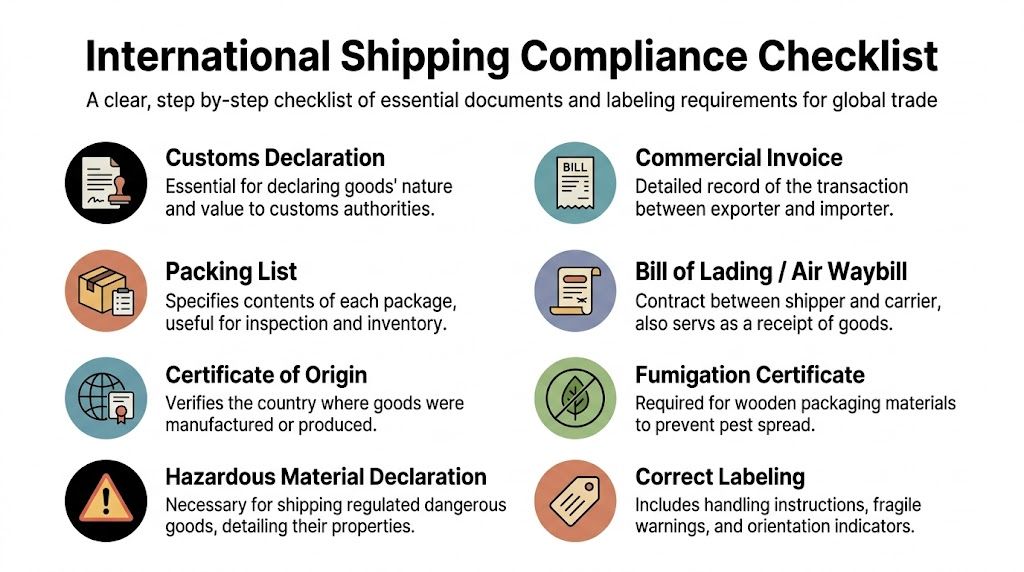
A compliant crate needs a matching document set. Dimensions, gross weight, timber treatment status, consignee details, tariff description, and handling marks should all agree across the case, the packing list, the commercial invoice, and the carrier booking. If they do not, neither the haulier nor customs will want to take responsibility for the discrepancy.
Mark the crate so handlers don't have to guess
Clear labelling reduces avoidable handling errors, especially when a crate is transferred through depots, ports, and customs examination points where the people touching it were not involved in the packing.
Use recognised marks on the faces handlers will see during loading and storage. Typical examples include orientation arrows, fragile notices, centre-of-gravity markings where relevant, forklift entry points, lift-point markings, and do-not-stack instructions where the cargo or crate design requires them.
Good labelling usually comes down to three basics:
- Visible placement on accessible sides, not hidden by strapping, wrap, or document wallets
- Consistent wording that matches the transport instructions and booking notes
- Specific handling information where generic symbols are not enough, such as approved fork-entry sides or top-lift restrictions
For UK and EU lanes, add shipment references that help the unit tie back to the customs file quickly. Purchase order numbers, consignee name, case number, and country of destination all help when a border team needs to identify a crate without opening it first.
Documentation mistakes cost money fast
The paperwork does not finish after the lid goes on. In many cases, that is when the risk starts.
Post-Brexit shipments are exposed to more checkpoints where small inconsistencies turn into direct cost. A wrong weight can trigger a carrier re-rate or a refused collection. A vague goods description can lead to customs queries. Missing timber treatment evidence can stop a wooden crate at the border until the issue is resolved. None of those costs are theoretical. They show up as storage, inspection fees, admin time, missed delivery slots, and sometimes repacking.
The common failures are familiar:
| Problem | What causes it | Likely result |
|---|---|---|
| Declared dimensions do not match the crate | Booking made from estimates before the build is complete | Re-rating, handling delay, or refusal |
| Declared weight is wrong | No calibrated final weighing, or old figures copied into new paperwork | Safety risk, carrier surcharge, customs query, or mode restriction |
| Marks and documents conflict | Workshop, export admin, and freight teams working from different records | Inspection risk, border delay, and correction charges |
| Timber compliance evidence is missing | ISPM 15 treatment mark not checked, or supporting records not retained | Hold at export or import control, with possible rework |
Air freight needs extra care. Piece dimensions, gross weight, and any handling restrictions must match the airline booking exactly. If the crate is close to equipment limits for aircraft loading or warehouse handling, confirm acceptance before collection day, not after the truck is on the road.
Build one compliance chain
The best export jobs run on one verified set of details from packing bench to customs entry. That means measuring the finished crate, weighing the finished unit on calibrated equipment, checking timber marks, and then pushing that same information into the transport and customs documents without re-keying it three different ways.
At Multica, we advise clients to treat these records as one control point:
- Finished crate dimensions and gross weight
- Timber compliance status and treatment evidence where required
- Packing list and commercial invoice details
- Carrier booking data and mode-specific transport documents
- External handling marks and consignee references
This matters even more where responsibility is split under different delivery terms. If the seller packs the goods, the forwarder books the transport, and the buyer handles import formalities, gaps appear quickly unless everyone is working from the same release data. Our guide to Incoterms 2020 and the allocation of risk in international trade helps clarify who should control each step.
One final point. If customs opens the crate, the paperwork should make it easy to identify what it is, how it should be handled, and how it should be closed and moved again. Good compliance does not just help a shipment leave your site. It helps it survive inspection without extra damage, delay, or argument.
Industry-Specific Crating Notes for Sensitive Cargo
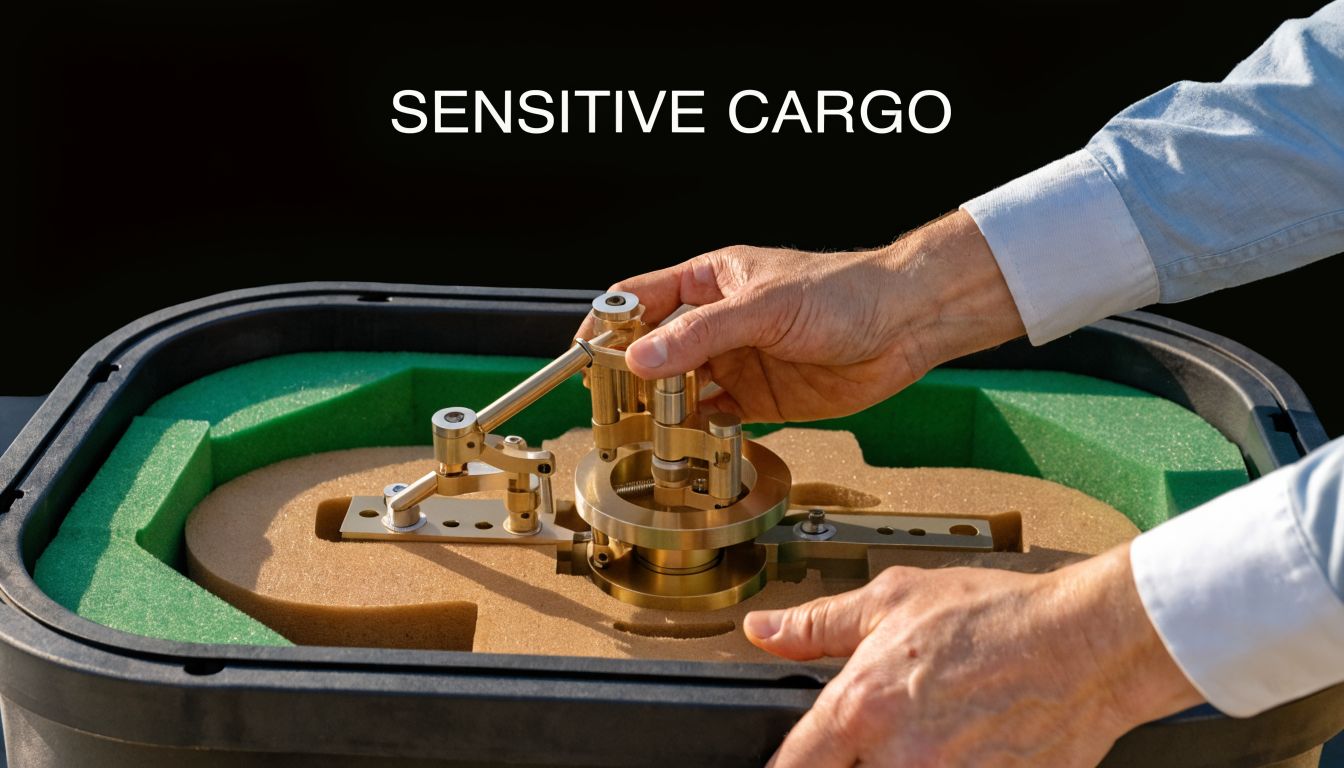
General export crating principles work well until the cargo has a specific failure point. Sensitive sectors don’t fail in generic ways. Perishables lose condition. Pharma shipments drift out of control ranges. High-value equipment arrives physically intact but operationally compromised because vibration or moisture reached the wrong component.
That’s where the crate has to support the product, the route, and the receiving process at the same time.
Agri-food and perishables
Perishable cargo needs crates that work with the transport environment, not against it. If the goods are moving under temperature-controlled conditions, the crate must allow correct handling without slowing load-in and load-out.
The practical priorities are usually:
- Fork compatibility so refrigerated loading stays quick and controlled.
- Moisture-aware materials that won’t degrade or transfer contamination.
- Non-stack protection built into the structure where top load would compromise the contents.
- Clean internal surfaces that suit the product category and inspection expectations.
For temperature-managed consignments, crate design should be coordinated with the wider cold chain logistics process and handling environment. The crate can’t fix a broken cold chain, but it can avoid making one worse.
Pharma and life sciences
Pharma shipments often appear sturdy from the outside and remain highly vulnerable on the inside. Secondary packaging, instrument housings, and internal product stability can all be affected by shock, thermal exposure, or poor internal materials.
This sector usually benefits from a more controlled crate interior:
| Requirement | Good practice | What to avoid |
|---|---|---|
| Shock control | Foam at validated contact points with rigid restraint | Soft fill that allows drift |
| Monitoring access | Space or mounts for data loggers and seals | Burying monitoring devices inside inaccessible voids |
| Cleanliness | Low-dust, tidy internal finish | Rough timber surfaces shedding debris |
| Moisture defence | Barrier layers where needed | Assuming outer panels are enough |
The main lesson is that pharmaceutical cargo shouldn’t be treated like ordinary fragile freight. The crate often needs to preserve handling discipline and monitoring visibility as much as physical protection.
Manufacturing equipment and electronics
High-value machinery and electronic systems usually fail at interfaces. A bent connector, a shifted assembly, or corrosion on one exposed component can render an otherwise intact shipment unusable.
For these loads, stronger crate engineering pays off. That often means rigid skid mounting, carefully planned brace paths, anti-rub separation between vulnerable surfaces, and clear unpacking access so the consignee doesn’t damage the item while opening the crate.
A few practical choices make a real difference:
- Keep weight on structural points. Don’t support sensitive covers or side panels.
- Separate restraint from protection. Bolts and braces stop movement. Foam and wraps protect surfaces.
- Plan the unpacking sequence. If the consignee must cut through protection layers blindly, damage can happen at destination.
- Leave room for visibility tools. Tracking devices or monitoring anchors can be valuable on high-value routes.
The right crate for sensitive cargo is rarely the cheapest timber arrangement. It’s the one that protects the exact failure points that matter for that product and journey.
Frequently Asked Questions about Shipping Crate Services
A common post-Brexit failure looks like this. The goods are built, the collection is booked, the crate is assembled in a hurry, and the problem only shows up once the shipment reaches a border check or a hub handling point. At that stage, fixing timber paperwork, relabelling, or dimensional errors is slower and more expensive than getting the crate right at the start.
Is professional crating worth it compared with building a crate in-house
For export freight, high-value equipment, and shipments crossing UK and EU borders, professional crating usually pays for itself through fewer delays, fewer reworks, and less risk at customs or inspection points.
In-house crating can work, but only if the business has trained staff, compliant timber, accurate weighing and measuring equipment, and a documented process for build quality and export checks. If one of those is missing, the crate often looks acceptable in the warehouse and then fails on traceability, dimensions, handling strength, or paperwork.
I usually tell clients to compare the full cost, not just the timber and labour. A rejected crate can mean storage charges, missed delivery slots, rebooking fees, and idle installation crews at destination.
Can I reuse an ISPM 15 stamped crate
Sometimes, but reuse needs inspection, not assumption.
The question is whether the crate is still structurally sound and whether every timber component that matters to compliance remains traceable and suitable for export. Repairs are where problems start. If a runner, cleat, or side panel has been replaced with uncertified wood, the old stamp does not clean up that change.
For UK and EU movements, that point matters because border teams may focus on the actual wood packaging condition, not the shipper's intention. If there is any doubt, we recommend reassessing the crate before dispatch or rebuilding the affected sections with fully compliant material.
How do crate dimensions affect freight cost and mode selection
They affect cost immediately.
A crate that is only slightly taller, wider, or heavier than planned can push a shipment into a different pricing bracket, reduce trailer or container efficiency, or trigger special handling. On UK and EU road movements, dimensions also affect how easily the load moves through groupage networks and cross-dock terminals. On airfreight, piece limits are tighter, so a crate can be physically protective but still commercially awkward or unacceptable to the airline.
Bad measurements also create customs and billing problems. If declared dimensions do not match what the carrier receives, expect delays, rebilling, and avoidable arguments after the shipment has already moved.
Are labels like Fragile and Do Not Stack enough to protect cargo
No.
Labels support handling. They do not replace proper restraint, fork-entry control, stack resistance, or internal protection. Busy hubs do not stop and redesign their process around one warning label. The crate has to tolerate normal handling conditions, including imperfect handling.
If top-load damage would destroy the cargo, build for that risk. If fork contact is likely, create clear entry points and protective clearance. Printed warnings help when the crate itself already does the hard work.
What’s the biggest mistake shippers make with crating for shipping
Leaving crating decisions until the day before dispatch.
That is where cost starts to climb. Last-minute crate builds often miss one of the checks that matters most on UK and EU lanes after Brexit: timber traceability, export marks, final gross dimensions, commodity-specific labelling, or the documents needed to support the movement. The result is rarely a dramatic failure in the warehouse. It is more often a delay, a challenge from the carrier, or a problem at the border that nobody priced into the job.
If the shipment matters, start crate planning as soon as the transport mode and destination are known.
If you need a crating plan that works with realities of road, sea, and air freight, Multica Group can help you align packaging, customs, and transport into one practical shipment process.