You’ve got an order booked, a customer in Australia waiting, and a quote on your desk that makes the route look straightforward. Then critical questions start. Is sea freight cheaper once stock is tied up for weeks? Will the goods qualify for UK-Australia FTA treatment? Is your pallet wood compliant? Which party is paying GST, customs charges, inspection fees, and delivery from port to site?
That’s where a first major shipment to australia usually becomes expensive. Not because the route is impossible, but because generic advice tends to flatten it into “book freight, send docs, clear customs”. In practice, Australia rewards organised shippers and punishes assumptions.
For UK businesses, the route is especially interesting now. Brexit changed the trade context, and many UK exporters are now looking at Australia as a serious growth market rather than a one-off export destination. That creates opportunity, but it also means your margin depends on things that sit outside the freight quote. Packaging, origin evidence, commodity coding, biosecurity exposure, and final-mile planning all affect landed cost.
Your Next Market The Opportunity and Challenge of Australia
A first shipment to Australia often looks straightforward until the landed cost starts to move. The freight quote may be acceptable, the buyer may be ready to place repeat orders, and the UK-Australia trade relationship is stronger than it was a few years ago. Then the practical questions start. Does the product qualify for preferential treatment under the FTA? Who is carrying GST exposure? Will the packaging trigger inspection or treatment on arrival?
That is the point where Australia separates prepared exporters from expensive first-timers.

For UK businesses, Australia is a credible growth market after Brexit, but it needs to be managed as a total-cost exercise. Distance is only part of it. The bigger risks usually sit in origin evidence, customs treatment, biosecurity exposure, and domestic delivery planning after the cargo lands. A shipment can be profitable on paper and still miss margin once storage, inspections, duty errors, or delivery delays are added back in.
I see the same pattern with first major export programmes. The commercial team focuses on demand. Operations inherits the consequences of loose terms, incomplete product data, and packaging decisions made without reference to Australian border controls.
Practical rule: Price and plan the whole move to final delivery point, not just the international freight leg.
What catches UK shippers out
A lot of published advice on exporting to Australia is written for US sellers. That leaves UK companies with the wrong assumptions about post-Brexit origin rules, UK export formalities, and how to present goods cleanly for Australian customs and biosecurity review.
The pressure points are usually these:
- FTA benefit depends on proof, not assumption. Reduced duty treatment only helps if your goods meet the origin rules and the paperwork supports the claim.
- Packaging can change the cost of the job. Timber, pallet construction, and cargo cleanliness can trigger treatment, inspection fees, and delay.
- Transit time affects more than service levels. It changes stock cover, cash tied up in inventory, and the risk of missing a selling window.
- Australia is not one delivery zone. Inland transport, residential access, remote destinations, and port-to-door handover all need planning up front.
Container planning matters here too, especially if you are testing the market with sea freight. If your team is still working out loading plans and stock density, it helps to review 20-foot container dimensions and loading considerations before you commit to shipment size or packaging format.
Handled properly, Australia is a disciplined market rather than a difficult one. The opportunity is real. So is the cost of getting the details wrong.
Choosing Your Shipping Strategy Air vs Sea Freight
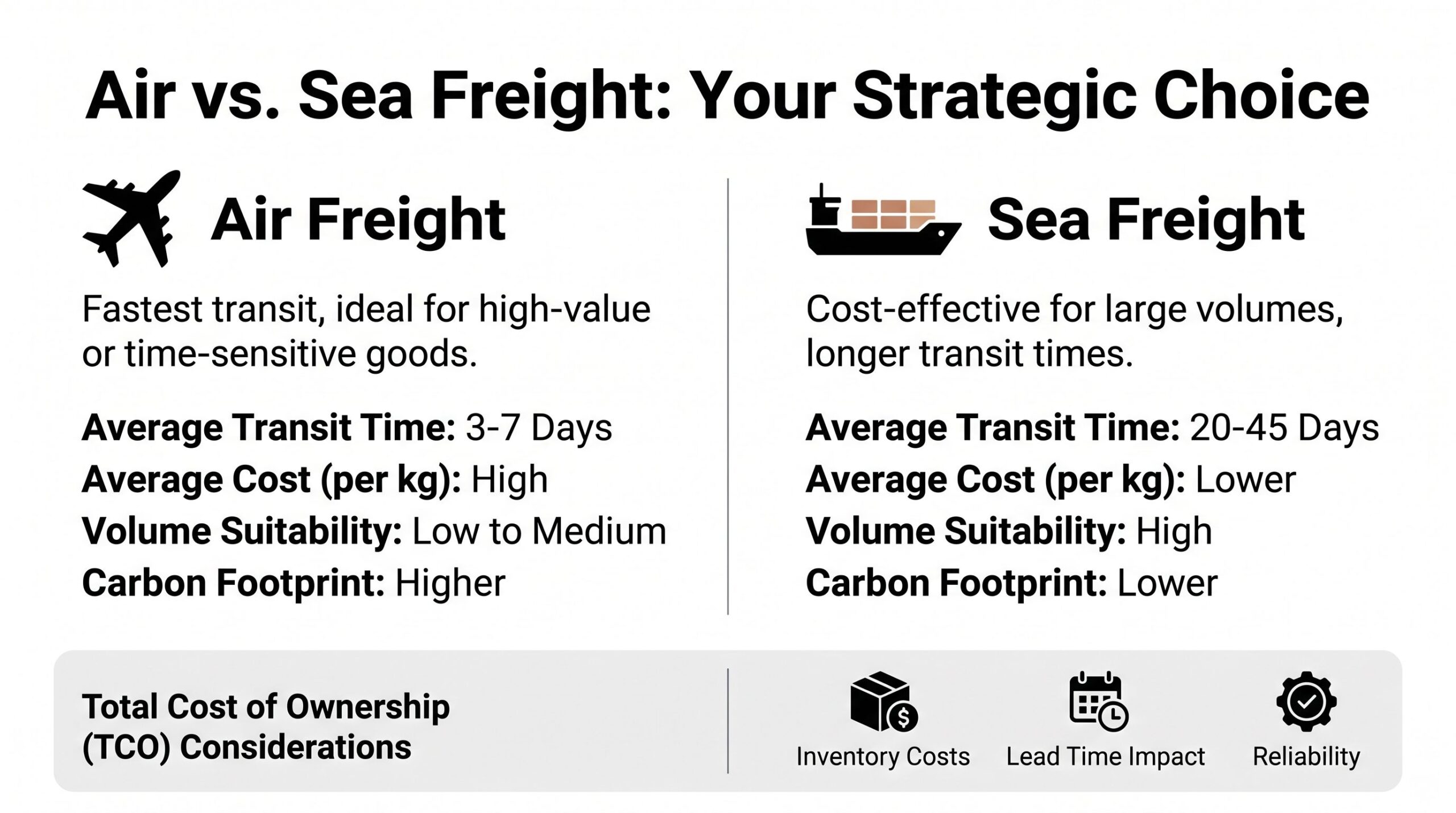
Most first-time shippers start by asking for an air quote and a sea quote. That’s reasonable, but it’s not the right decision framework. The better question is this: which option gives you the lowest total landed cost for the job you’re trying to do?
That sounds like finance language, but it matters on the warehouse floor. A freight mode isn’t just a transit method. It changes how long your stock is unavailable, how much cash is tied up, how much safety stock you need, and how exposed you are if something slips.
When sea freight wins
Sea freight is usually the right answer for replenishment stock, bulky cargo, lower-margin goods, and orders where the customer can accept a longer planning horizon. It gives you scale and generally better unit economics, especially once shipment size rises beyond what air can justify.
It’s also more flexible than many newer exporters realise. You don’t always need a full container. If you’re unsure how much stock to position in market, LCL can be a sensible first move before graduating to FCL. If container planning is still new internally, it helps to understand 20-foot container dimensions and loading practicalities before you commit to a container strategy.
When air freight earns its premium
Air freight makes sense when delay is more expensive than freight. That usually means high-value goods, launch stock, time-sensitive spares, regulated healthcare shipments, or cargo where a missed delivery window damages revenue or customer confidence.
The common mistake is using air because the first order is urgent, then using the same logic for every later order. That inflates costs fast. Air should often be used as a corrective tool or a launch tool, not as the permanent model unless the product economics support it.
Use total cost, not freight cost
One of the clearest examples of this trade-off appears in guidance that notes a £50,000 shipment via slower ocean freight may result in a higher total cost when factoring in working capital lock-up and potential stockouts, as explained in Parcelbound’s discussion of shipping cost trade-offs. Even though that example comes from broader international shipping guidance, the principle is highly relevant for UK businesses moving stock to Australia.
A useful working test is to ask three questions before choosing mode:
What happens if this stock lands late?
If the answer is lost sales, contractual penalties, or empty shelves, air becomes more defensible.How long can cash stay tied up?
Long ocean transit may be fine for stable demand, but painful for a fast-moving launch.Can you split the shipment?
Many businesses do better with a blended model. Send critical launch stock by air, then replenish by sea.
If demand is uncertain, don’t force a single-mode answer. A split shipment often costs less than either extreme done badly.
A simple decision view
| Mode | Best for | Main upside | Main risk |
|---|---|---|---|
| Air freight | Urgent, high-value, launch, regulated | Speed and lower inventory exposure | Freight cost can erode margin |
| Sea freight FCL | Larger stable volumes | Better unit cost and control | Longer planning cycle |
| Sea freight LCL | Smaller regular exports | Lower entry threshold | More touchpoints and more coordination |
The strongest shipping strategy to Australia is rarely “always air” or “always sea”. It’s matching the mode to the commercial purpose of the shipment.
Navigating the Paper Trail Required Documents and Incoterms
Shipments don’t usually fail because the truck didn’t turn up. They fail because one document says one thing, another says something else, and the importer, forwarder, and customs broker are all working from different assumptions.
For a first major shipment to Australia, paperwork needs to be treated as part of the physical movement. If the documents are weak, the cargo is weak.
The documents that matter most
Start with the commercial invoice. Many avoidable problems often begin with it. The description must be accurate and usable for customs purposes. “Parts”, “samples”, or “accessories” won’t help anyone classify the cargo properly.
The packing list has a different job. It tells the warehouse, carrier, and border authorities what is physically in the shipment and how it is packed. Good packing lists reduce inspection friction because they let people find what they need quickly.
Then there is the proof of origin or origin statement needed to support any relevant FTA treatment. If you want preferential terms, your documents must support that claim cleanly. Vague assumptions about “made in Britain” aren’t enough.
Finally, the transport document matters. For sea freight that’s commonly the bill of lading. For air freight it’s the air waybill. These aren’t just transport receipts. They link consignee details, routing, cargo details, and release control.
Incoterms decide more than people think
A lot of disputes that look like freight problems are Incoterms problems.
The easiest way to explain Incoterms is with a takeaway order. If you collect the pizza yourself, the shop’s responsibility ends earlier. If the shop delivers it to your door, their responsibility runs further. International trade works the same way, except with freight charges, customs formalities, insurance risk, and border taxes.
If you need a clearer primer, this guide to Incoterms 2020 in international trade is a useful starting point.
The terms new exporters misuse most
- EXW: Sellers often think it’s the easiest term because responsibility ends early. In reality, it can create export-control and collection problems, especially when the buyer expects the seller to know more than the term requires.
- FOB: Common in container discussions, but many businesses use it without fully understanding where risk transfers and who controls the main carriage booking.
- DDP: Attractive to buyers because it feels simple. Risky for sellers if they don’t fully understand destination tax, customs, and compliance obligations in Australia.
The wrong Incoterm won’t just change who pays. It changes who is exposed when something goes wrong.
What good document control looks like
A solid process usually includes:
- One master data set: Product descriptions, weights, values, and SKU references should match across invoice, packing list, and booking.
- Named ownership: Someone on the shipper side should own document accuracy before dispatch.
- Pre-alert discipline: The importer and broker should receive documents before arrival, not after a problem appears.
- FTA review before shipping: Don’t leave origin questions until the goods are already in transit.
If your team treats documentation as an admin task at the end of dispatch, Australia will expose that weakness quickly.
Clearing Australian Customs and Biosecurity
A shipment can be priced correctly, booked on time, and still fail at the Australian border. I see this most often with first-time UK exporters who assume customs clearance is a single process. It is not. Australia assesses the legal import entry and the biosecurity risk separately, and either one can hold the cargo.
Customs clearance decides the duty position. Biosecurity decides whether the goods are physically released.
On the customs side, the main pressure points are commodity code, customs value, origin, and importer details. For UK businesses shipping after Brexit, that matters more than many generic guides suggest. The UK-Australia FTA can reduce duty exposure, but only if the goods qualify and the origin evidence stands up to scrutiny. If your landed cost model assumes preferential treatment and the claim fails, margin disappears fast.
Experienced customs clearance agents earn their fee because a pre-shipment review is usually cheaper than a reclassification dispute, a duty reassessment, or storage charges while the broker waits for corrected paperwork.
Biosecurity is the part that catches new exporters out
Australian authorities look beyond the product itself. They assess contamination risk, packaging materials, timber, residue, and how the goods present on arrival. A clean commercial invoice does not protect a shipment if the pallet is marked badly, the crate shows signs of untreated wood, or the cargo arrives with dirt, seeds, or organic residue.
Inspection does not mean you did something wrong. It means your timeline needs slack built into it.
That point matters for total landed cost. UK exporters often quote only freight, duty, and GST, then get hit by inspection-related storage, handling, document corrections, or treatment costs. Those are the charges that turn a profitable order into an argument with the customer.
Wood packaging is a frequent failure point
Wooden pallets, crates, and dunnage must meet ISPM 15 requirements. If they do not, Australian authorities can order treatment, export, or destruction of the packaging, and sometimes hold the cargo while the issue is resolved.
I advise clients to check the pallet before booking, not on loading day. Last-minute substitutions by a warehouse or supplier are a common cause of preventable holds. If the product is perfect but the wood packaging is wrong, the shipment still has a border problem.
Check the whole load as one unit: goods, pallet, crate, dunnage, labels, and paperwork.
A quick visual refresher helps when briefing internal teams or suppliers:
A practical clearance routine for first shipments
Use a disciplined pre-clearance process:
- Confirm the tariff classification before you quote the customer or promise duty savings.
- Check whether the product needs permits, certificates, or sector-specific controls in Australia.
- Validate origin evidence before claiming any UK-Australia FTA benefit.
- Inspect pallets, crates, and dunnage for ISPM 15 compliance and visible contamination.
- Send documents to the importer or broker before arrival so queries are handled while the cargo is still in transit.
- Allow for inspection, storage, and handling costs in the landed cost calculation, not just the freight rate.
The businesses that clear Australia efficiently do the checking in the UK, before the shipment leaves the warehouse.
Packaging Labelling and Handling Restricted Goods
A shipment can clear the paperwork stage and still run into avoidable cost because the cargo was packed like a UK domestic delivery. I see this often on first shipments to Australia. The product is saleable, the documents are mostly in order, but the cartons soften, the labels smear, or the goods arrive looking untidy enough to trigger closer inspection. For UK exporters working post-Brexit, that matters because the freight quote is only one part of landed cost. Repacking, inspection handling, relabelling, storage, and missed delivery windows can wipe out the margin you expected from the UK-Australia FTA.
Australia rewards disciplined packing.
Sea freight brings long transit times, container humidity, port handling, and stacking pressure. Air freight cuts transit time, but it still involves screening, transfers, and tighter dimensional controls. Packaging has to do two jobs at once. It must protect the goods through the journey and help border officers identify what they are looking at without delay.
Pack for the actual transit risk
Start with the product, then build outward.
The inner pack protects against leakage, abrasion, or moisture. The outer carton takes the handling load. The pallet, crate, or export case keeps the shipment stable as a unit. If one layer is weak, the whole load becomes harder to move and harder to inspect.
For Australia-bound freight, I advise clients to check these points before the goods leave the warehouse:
- Moisture control: Use poly liners, sealed bags, desiccants, or barrier materials where condensation could damage packaging or contents.
- Carton strength: Export cartons need board grade and closure methods suited to stacking and long dwell time, not just local courier movement.
- Stable pallet build: Keep weight distribution even, avoid carton overhang, and secure the load so it can tolerate forklift handling and inspection.
- Durable marks: Outer labels should stay readable after wrapping, lifting, and exposure to normal port conditions.
- Reconcilable packing: Carton numbers, piece counts, and product descriptions should match the packing list clearly enough for an officer or broker to verify them fast.
Small packing faults create expensive downstream problems. A torn outer carton on a consumer goods shipment may mean relabelling. On food, health, or higher-risk product lines, the same presentation issue can lead to more questions about integrity and traceability.
Timber packaging needs its own check
Wood packaging belongs in the packing plan, not as a last-minute warehouse tick box.
If the shipment uses timber pallets, crates, or dunnage, the export team should verify that every item carries the correct ISPM 15 mark and that the wood is clean, dry, and free from obvious bark or contamination. I recommend checking this at booking stage and again at final loadout, especially if a supplier or third-party warehouse may substitute pallets at short notice.
That check is practical, not bureaucratic. One non-compliant or suspect timber item can hold up the whole consignment and add costs for inspection, treatment, unpacking, or replacement packing.
Restricted goods need product-level controls
Restricted goods are where many first-time shippers underestimate the detail. “General cargo” is not a useful assumption if the product contains animal ingredients, plant material, chemicals, therapeutic claims, or second-hand components.
For UK businesses selling into Australia, common problem categories include:
- Food and drink: Ingredients, shelf-life marking, health documentation, and product composition all affect admissibility.
- Cosmetics and health-related products: Ingredient lists, intended use, and regulatory classification can change what approvals are needed.
- Animal-origin products: These often need more than a commercial invoice and packing list.
- Used machinery and equipment: Cleanliness matters. Soil, seed, grease build-up, and organic residue can turn a routine import into a biosecurity problem.
- Timber, natural fibres, and plant-based materials: Packaging inserts, display materials, and product components can attract extra scrutiny if not declared properly.
The right approach is to review the exact product, not the broad category. A shampoo, a nutritional powder, and a leather accessory may all be packed in cartons, but they do not face the same import conditions.
| Category | What it means | What the shipper should do |
|---|---|---|
| Prohibited goods | Cannot be imported through the normal commercial process | Stop the shipment plan and verify legality before booking |
| Restricted goods | Can be imported if specific conditions are met | Confirm permits, declarations, product controls, and labelling before dispatch |
Labelling should speed up inspection
Good labelling reduces handling time and cuts the chance of avoidable queries.
Each shipping unit should be identifiable without guesswork. That usually means consistent product names, carton numbering, consignee details, country of origin where required, batch or lot references where relevant, and marks that match the packing list exactly. If the shipment is opened, the contents should be easy to check and easy to reclose.
I also tell clients to review retail and transport labelling separately. Retail artwork may satisfy marketing and shelf presentation. It may not satisfy import, safety, or traceability requirements. That gap causes more trouble than many new exporters expect.
Packing well is not about appearance. It protects margin, shortens clearance time, and keeps the total landed cost under control.
The Final Mile Tracking Timelines and Common Pitfalls
A UK exporter often feels the shipment is under control once the container sails from Felixstowe or the air waybill goes live. Australia is where that assumption gets expensive. The freight may have arrived, but stock can still be days away from your customer because terminal release, biosecurity direction, deconsolidation, and domestic delivery booking all sit between port arrival and the final proof of delivery.
For UK businesses shipping post-Brexit, this matters because margin is usually tighter than planned. The quoted freight rate is only part of the landed cost. Storage, inspection delays, missed delivery slots, and rebooking fees in Australia can wipe out the saving from choosing a cheaper route in the UK.
A sea freight movement from the UK to Australia is usually measured in weeks, not days. Air freight is much faster, but even air shipments can stall after landing if the importer, broker, and delivery site are not aligned before arrival. The practical rule is simple. Treat vessel ETA or flight arrival as an operational milestone, not as the delivery promise you give sales or the customer.

What tracking updates usually mean
Tracking helps, but only if the team reading it understands the gap between system status and physical availability.
- In transit: The cargo is moving through the chain. It may still be waiting at a hub, on-carriage facility, or bonded location.
- Arrived at destination port: The vessel or aircraft has arrived. Discharge, terminal processing, document release, and collection can still be outstanding.
- Customs cleared: Border entry may be accepted, but biosecurity action, terminal charges, or transport booking may still hold up delivery.
- Out for delivery: The shipment is on the final leg. At that stage, site access, unloading equipment, booking windows, and contact availability decide whether the truck turns quickly or sits idle.
I tell clients to read tracking together with three live questions. Has the cargo been released? Has someone booked the final delivery? Is the receiving site ready?
Build the timeline around handovers, not just transit
The cleanest way to manage expectations is to split the journey into four separate time blocks:
- Export readiness in the UK
- International transit
- Arrival, clearance, and cargo release in Australia
- Final-mile delivery to the consignee
That structure prevents a common sales mistake. Someone takes the carrier transit estimate, adds a small buffer, and presents it as the arrival date for stock. For Australia, especially on first shipments, that is too optimistic.
Under the UK-Australia trade framework, duty outcomes may improve for eligible goods, but the FTA does not remove the operational steps after landing. If a declaration needs correction, if a container misses unpack priority, or if a metro delivery slot is full, the shipment still waits and the landed cost still rises.
Common pitfalls that cause delay and extra cost
The repeated problems are rarely dramatic. They are routine errors that add charges one line at a time.
- Arrival dates treated as delivery dates: Internal teams promise too early and create avoidable pressure on the importer and warehouse.
- Documents released too late: Cargo is physically in Australia, but the broker or depot is still waiting for final paperwork or authority to act.
- Underestimating deconsolidation time: LCL freight can take longer to become available than the headline arrival suggests.
- Delivery booked without site checks: The truck arrives, but the consignee has no forklift, no booking reference, or no receiving staff on shift.
- Incoterm responsibility misunderstood: Destination handling, storage, or last-mile charges fall into dispute after arrival.
- No allowance for inspection or intervention: Even compliant shipments should carry time and cost contingency.
One avoidable error deserves special attention. UK exporters often focus on import duty and freight, then overlook local costs in Australia such as terminal storage, container detention, redelivery fees, and regional transfer charges. Those are the items that turn a profitable order into an argument about who pays.
A practical pre-arrival check
Run this review before the cargo lands, not after the first delay notice arrives.
| Check | Why it matters |
|---|---|
| Has the importer or broker confirmed they can act on arrival? | Prevents cargo sitting while authority, paperwork, or payment is chased |
| Is the ETA being treated internally as a release date or a delivery date? | Stops sales and operations from working to the wrong milestone |
| Are terminal, deconsolidation, and local delivery charges understood under the agreed Incoterm? | Protects margin and avoids disputes at destination |
| Has the delivery site confirmed access, hours, equipment, and booking rules? | Reduces failed delivery attempts and redelivery fees |
| Is there buffer for inspection, congestion, or rebooking? | Keeps one delay from disrupting stock planning or customer commitments |
The shipments that arrive cleanly in Australia are usually the ones that looked slightly overplanned at origin. That is good planning, not wasted effort.
How Multica Streamlines Your Shipment to Australia
Australia rewards careful execution. That suits a logistics partner that can control more than one part of the chain.
Multica Group helps UK businesses move freight through road, sea, and air as one coordinated process rather than a string of disconnected bookings. That matters on Australia shipments because mode choice, paperwork, customs preparation, and final routing all affect landed cost. A multimodal setup makes it easier to split urgent and non-urgent cargo, position export freight efficiently from UK collection points, and avoid the handover gaps that often create delay.
The second advantage is administrative control. Multica handles in-house customs clearance and documentation management, which is where many first-time Australia shipments go off course. When product data, export paperwork, and border preparation are aligned early, there’s less chance of a preventable hold after arrival.
That becomes even more useful for regulated and sensitive sectors. Multica also supports veterinary inspections, which is important for agri-food and related shipments where compliance work doesn’t stop at the commercial invoice.
Operational visibility matters too. Multica’s owned truck fleet and telematics improve handover control and give customers clearer status information during the movement. For long-haul export lanes, that kind of visibility helps businesses manage procurement, customer updates, and warehouse planning without relying on guesswork.
The practical value is simple. Instead of managing separate parties for collection, export documents, main carriage, customs support, and onward coordination, you get one logistics partner that can organise the shipment as a single flow.
For a business entering Australia for the first time, that reduces friction. For a business already shipping there, it helps turn a difficult lane into a repeatable process.
Frequently Asked Questions About Shipping to Australia
How long does a shipment to Australia usually take from the UK
It depends on mode, routing, and what happens at the border. For ocean freight, the main carriage alone can be lengthy, and port handling plus clearance sits on top of that. For air freight, transit is much faster, but you still need to allow for export preparation, import formalities, and domestic delivery.
Is sea freight always the cheapest option
Not always. Sea freight often has the lowest direct transport cost for larger volumes, but it can become more expensive in practice if stock arrives too late, cash is tied up for too long, or the business ends up paying for emergency replenishment later. That’s why landed cost should be looked at in full, not as a line-item freight comparison.
Do I need special documents to use the UK-Australia FTA
You need the right origin support and accurate commercial documentation. If the paperwork doesn’t properly support the claim, the importer may not get the expected treatment. FTA benefits should be checked before shipping, not after arrival.
Can I send goods on any pallet
No. If you’re using wooden packaging, compliance matters. For Australia, ISPM 15 is a key requirement. The product can be fully acceptable while the pallet causes the shipment to fail inspection.
What’s the difference between customs and biosecurity in Australia
Customs focuses on the legal import declaration side, such as classification, valuation, and duties or taxes. Biosecurity focuses on the physical and sanitary risk of the goods and packaging entering Australia. A shipment may satisfy one and still be delayed by the other.
Are food, cosmetics, or health products harder to ship
They can be, because product-level controls are often stricter. Ingredients, health certification, packaging materials, and product approvals may all matter. These goods should never be booked on assumptions.
Should I use DDP when selling to Australia
Only if you fully understand what destination responsibility involves. DDP can look customer-friendly, but it places more obligation on the seller. If those obligations are priced or managed badly, the shipment can still arrive, but the margin is gone.
What is the biggest mistake first-time exporters make
Treating the shipment like a booking problem instead of a compliance-and-cost problem. The freight booking is only one part of the move. The costly mistakes usually come from paperwork, packaging, origin assumptions, or overpromising the delivery timeline.
If you’re planning your next shipment to Australia with Multica Group, the best starting point is a route and compliance review before the goods are booked. Multica can help you align mode choice, paperwork, customs preparation, and final delivery into one workable plan, so your first Australia move doesn’t become an expensive lesson.