When you're planning any shipment, the first thing you need to get right is the container dimensions. For the workhorse of global logistics, the 20-foot container, the external measurements are fixed at 20ft long (6.06m), 8ft wide (2.44m), and 8ft 6in high (2.59m).
Getting these numbers right is fundamental to everything that follows, from booking vessel space to arranging road transport.
A Quick Reference to 20ft Container Dimensions
The reason you can send a container from Felixstowe to Singapore and have it fit perfectly on a truck, train, and ship is down to strict international standards. These dimensions are set by ISO 668 regulations, which guarantees that every 20ft unit is interchangeable, no matter where it was made or who owns it. This is the bedrock of modern multimodal transport.
However, the numbers that matter most for your cargo are the internal dimensions. Once you account for the container's structural walls and flooring, the usable space shrinks. You're typically working with an interior length of around 5.90m, a width of 2.35m, and a height of 2.39m. This gives you a total loading volume of about 33 cubic metres. That difference between external and internal size is absolutely crucial for accurate load planning – it can be the difference between your cargo fitting perfectly or needing a second container.
For a straightforward overview, here’s a table breaking down the key measurements for a standard 20ft dry container.
Standard 20ft Container Dimensions at a Glance
| Specification | Imperial | Metric |
|---|---|---|
| External Length | 20 ft | 6.06 m |
| External Width | 8 ft | 2.44 m |
| External Height | 8 ft 6 in | 2.59 m |
| Internal Length | 19 ft 4 in | 5.90 m |
| Internal Width | 7 ft 8 in | 2.35 m |
| Internal Height | 7 ft 10 in | 2.39 m |
| Door Width | 7 ft 8 in | 2.34 m |
| Door Height | 7 ft 6 in | 2.28 m |
| Cubic Capacity | 1,172 cu ft | 33.2 m³ |
| Tare Weight | 4,850 lbs | 2,200 kg |
| Payload | 48,000 lbs – 62,000 lbs (approx.) | 21,770 kg – 28,120 kg (approx.) |
| Max Gross Weight | 52,900 lbs – 67,200 lbs (approx.) | 24,000 kg – 30,480 kg (approx.) |
Keep these figures handy when planning your next shipment. While they represent the standard, always remember that exact internal dimensions and weights can vary slightly between manufacturers and container types.
Detailed External and Internal Specifications
When you're planning a shipment, it's easy to focus on the headline figure: a 20-foot container. But the critical distinction that trips up many planners is the difference between its external and internal measurements. It’s a common mistake to overlook. The container's robust structure, with its corrugated steel walls, floor, and ceiling, accounts for this important variance.
For any precise cargo planning, you absolutely must work with the usable internal space, not just the outer shell.
For instance, a standard 20ft container is externally 20ft long (6.06m), but its internal length is actually closer to 19ft 4in (5.90m). This might not seem like much, but it can make or break a shipment. The infographic below summarises the key figures you need for length, capacity, and weight.
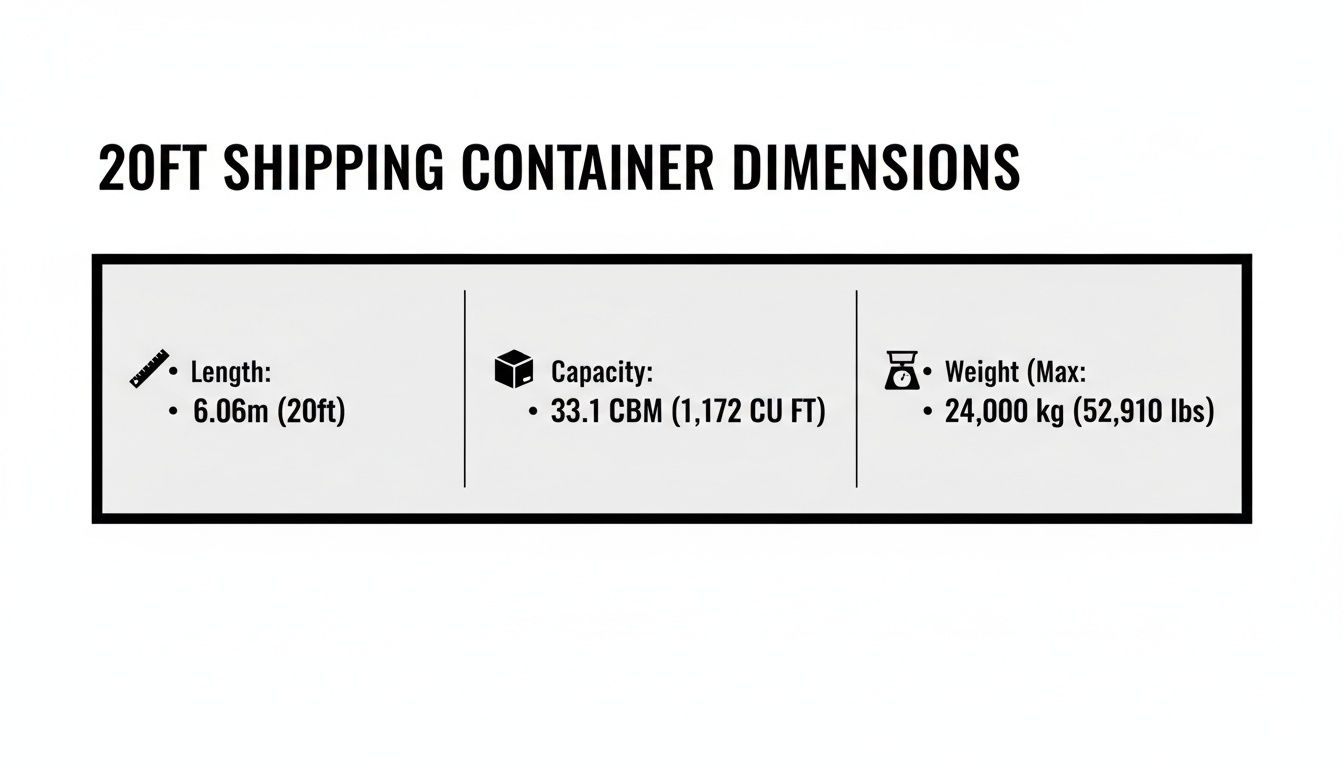
These internal figures are what truly matter. Knowing for certain that your machinery or crated goods will physically clear the 7ft 8in (2.35m) internal width and 7ft 10in (2.39m) internal height is absolutely essential for a successful shipment and avoiding costly last-minute problems.
Calculating Usable Volume and Cubic Capacity
When it comes to costing a shipment, the most critical number isn't just the container's length or width. It’s the internal volume, measured in cubic metres (CBM), that truly matters. This figure directly determines how much cargo you can physically pack and, ultimately, how your freight costs are calculated.
Getting a handle on CBM is essential for making the most of your space and your budget. For a standard 20ft container, the calculation is straightforward: you simply multiply the internal length, width, and height in metres.
Using the industry-standard formula (5.89m L x 2.33m W x 2.4m H), the total capacity works out to 33 CBM. This is the number freight forwarders and customs brokers rely on for quoting shipments, especially on UK and European trade routes. You can find more details on 20ft container capacity and specifications on mobilemodularcontainers.com.
Understanding Container Weight Limits
While getting the dimensions right is half the battle, the weight of your cargo is just as critical for planning a successful shipment. Every 20-foot container operates under strict weight limits that are essential for safety and compliance, whether it’s moving by sea, road, or rail. Getting this wrong can lead to serious fines, customs headaches, and costly delays.
To stay compliant, you need to be familiar with three key figures:
- Tare Weight: This is simply the weight of the empty container. A standard 20-foot box typically weighs around 2,200 kg (4,850 lbs).
- Payload: This is the maximum weight of the cargo you can actually load inside. It usually falls between 21,770 kg and 28,120 kg, depending on the container’s specific build.
- Maximum Gross Weight: This is the absolute total permitted weight, which is the Tare Weight added to the Payload.
Sticking to these weight limits isn’t optional. Global regulations like the SOLAS Verified Gross Mass (VGM) convention demand that every shipper accurately declares the total weight of a packed container. This declaration must happen before it can even be loaded onto a ship, as it’s fundamental to ensuring the vessel's stability and the safety of everyone in the port.
Choosing the Right 20ft Container Variant
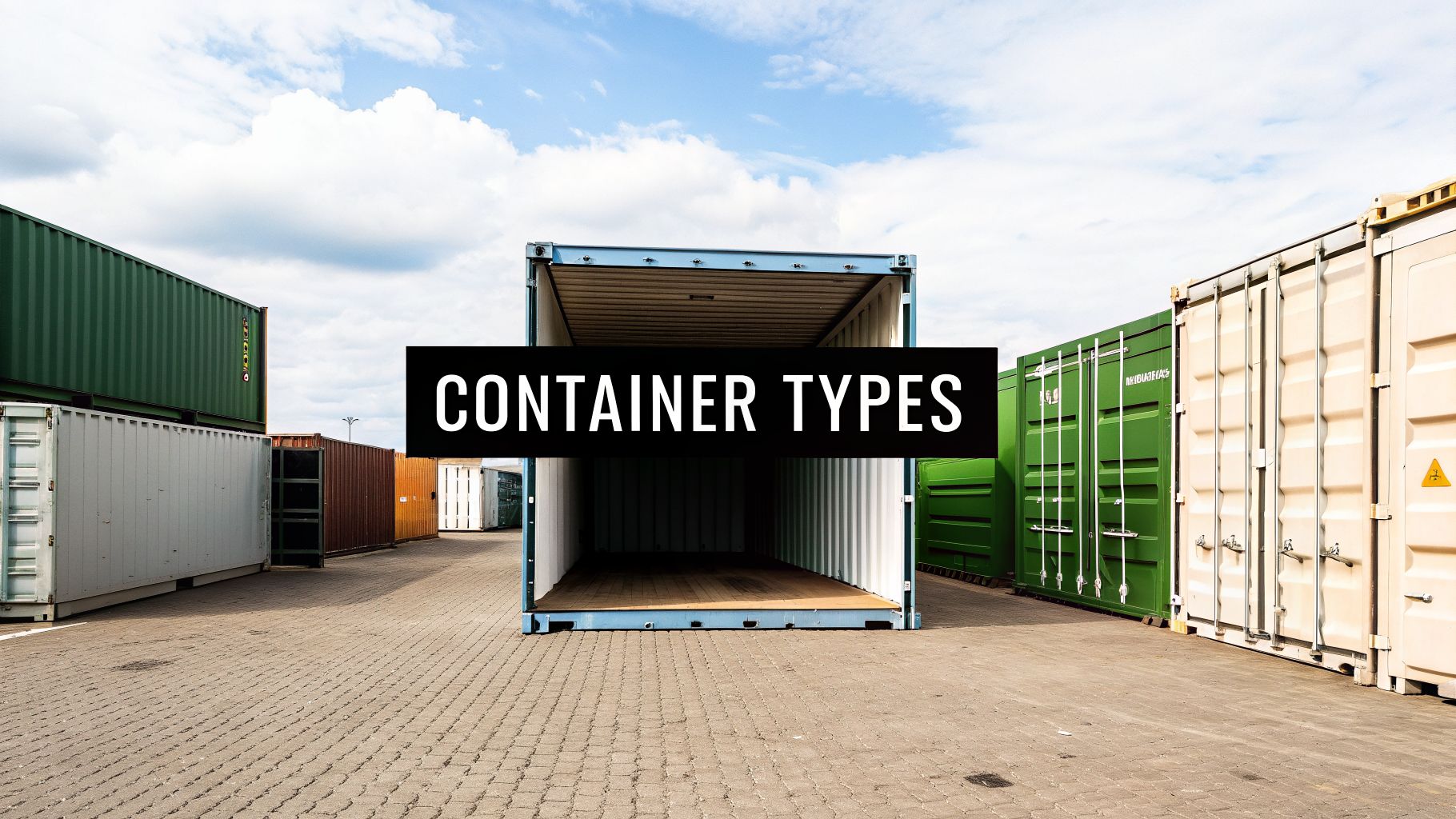
The standard 20ft dry container is the workhorse of global shipping, but it isn't always the right tool for the job. When you're dealing with specialised cargo, you need specialised equipment.
Understanding the different 20ft container variants is crucial for getting your goods from A to B safely and efficiently. While most share the same external footprint for transport purposes, their internal features, capacity, and access points can vary dramatically.
Common 20ft Container Types
Making the right choice from the outset prevents costly delays and potential damage. A Reefer (refrigerated) container, for instance, is non-negotiable for shipping pharmaceuticals or fresh produce that requires a stable temperature.
Likewise, an Open-Top container is the only practical solution for loading tall machinery with a crane. For goods that are bulky but not particularly heavy, a High Cube provides that all-important extra vertical space. Matching the container to the cargo is a fundamental part of expert freight forwarding.
To help you decide, this table breaks down the most common 20ft container variants, their key features, and what they're typically used for.
Comparison of 20ft Container Variants
| Container Type | Key Feature | Typical Use Case | Internal Height (Approx.) |
|---|---|---|---|
| Standard (Dry Van) | General-purpose, fully enclosed | Dry goods, palletised cargo, boxes | 2.39 m / 7' 10" |
| High Cube (HC) | Extra height | Lightweight, bulky cargo; over-height items | 2.70 m / 8' 10" |
| Reefer (Refrigerated) | Temperature-controlled unit | Perishables, pharmaceuticals, chemicals | 2.26 m / 7' 5" |
| Open-Top | Removable tarpaulin roof | Over-height cargo, crane loading | 2.35 m / 7' 8" |
| Flat Rack | Collapsible or fixed ends, no sides | Heavy machinery, vehicles, oversized items | N/A |
| Pallet-Wide | Wider internal dimensions | Optimised for Euro pallets (fits two side-by-side) | 2.39 m / 7' 10" |
Each type is engineered for a specific purpose. Taking a moment to assess your cargo's unique requirements against these options will ensure you select the most secure and cost-effective solution for your shipment.
Mastering Pallet Capacity and Load Planning
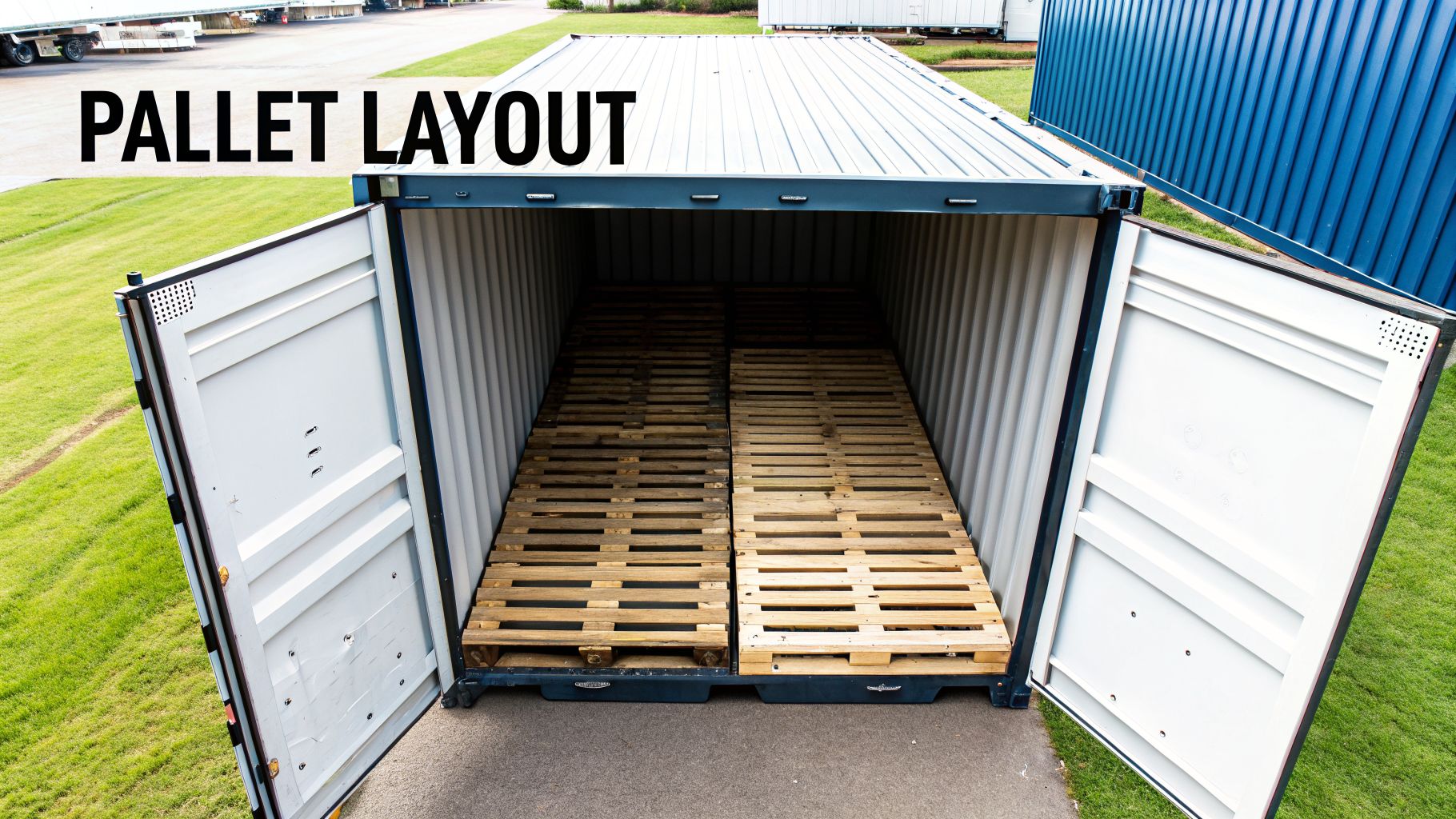
Maximising the internal dimensions of a 20-foot container is really the key to efficient shipping. The exact number of pallets you can fit isn't a fixed figure; it all comes down to their specific type and how you plan the loading process. A bit of careful planning ensures you use every available inch of floor space without ever compromising on safety.
As a general rule, you can load a single layer of:
- 11 Euro pallets (1200mm x 800mm)
- 9–10 Standard pallets (1200mm x 1000mm)
Of course, if your cargo is stable and its height allows for it, double-stacking is a great option that can effectively double your capacity. Just as crucial, though, is how you distribute the load’s weight. Getting this right is vital for safe transit.
Proper weight distribution is a core part of effective international freight forwarding services and is essential for preventing issues during transport by road, rail, or sea.
Comparing 20ft vs 40ft Containers
Deciding between a 20ft and a 40ft container is one of the most fundamental choices you'll make, and it directly affects your freight costs. It's a common misconception that a 40ft unit simply offers double the space of a 20ft.
While it is double the length, a 40ft container gives you more than double the internal volume, with around 67 CBM of usable space compared to the 33 CBM in a 20ft. The crucial point is that the shipping price is rarely double, which often makes the 40ft container a far more economical choice for voluminous cargo.
The 20ft container really comes into its own when you're shipping heavy, dense goods like machinery, stone, or metal raw materials. With this kind of cargo, you’ll almost always hit the maximum payload weight long before you run out of physical space.
On the other hand, the 40ft container is the go-to for lighter, bulkier items such as furniture, electronics, or apparel. Grasping this trade-off between volume and weight is fundamental for anyone looking into how to effectively combine transport modes.
Your 20ft Container Questions Answered
Have questions about 20-foot containers? You're in the right place. We’ve gathered the most common queries we receive and answered them here to help you plan your shipments with confidence.
This section gets straight to the point, covering everything from standardisation and High Cube variants to the practical differences between a 20ft and a 40ft unit. Our goal is to give you the exact details you need for accurate and efficient cargo planning.