You’re probably at the point where the opportunity looks obvious and the process looks messy.
You’ve found a supplier in China. The pricing works on paper. Demand is there. Then the practical questions start stacking up. Which Incoterm should you accept? Do you book sea or air? Who handles customs? What happens if the paperwork is wrong? For UK importers, that last point matters more than many first-time buyers realise, because post-Brexit importation from china now involves a level of compliance detail that many generic guides barely mention.
The good news is that this trade lane is established, active, and commercially important. UK imports from China reached £59.5 billion in 2023, representing 13.2% of total UK imports, according to ONS-based trade data referenced here. That scale matters for one reason above all others. The route is proven, but it rewards businesses that treat importing as an operational discipline, not just a buying exercise.
A first major import usually succeeds or fails long before the goods reach port. It fails when the buyer accepts vague product descriptions, leaves classification unresolved, agrees to the wrong shipping terms, or assumes customs is something the courier will “sort out”. It succeeds when each handover is planned, costed, and documented.
Your Guide to Successful Importation from China
A typical first-time importer starts with the product, not the route.
That’s understandable. You compare factories, samples, lead times, and unit price. You negotiate packaging and payment. Then freight enters the conversation almost as an afterthought, even though freight, customs, VAT, and delivery conditions often determine whether the deal is profitable.
The smarter approach is to work backwards from your delivery requirement.
If your goods are seasonal, a slower mode can destroy the margin even when the freight rate looks attractive. If they’re bulky and not urgent, paying for speed is wasteful. If they’re regulated, the transport plan has to match the compliance plan. That’s where many UK and EU importers get caught out. They follow broad advice written for US buyers and miss the post-Brexit details that now shape customs clearance, VAT handling, commodity code accuracy, and final delivery.
What a first major import really involves
A sound import job usually comes down to five practical decisions:
- Product clarity: Your supplier’s description has to match what customs and your broker will declare.
- Commercial terms: The agreed Incoterm decides who pays, who books, and where risk transfers.
- Transport mode: Sea, air, and rail all solve different problems.
- Customs readiness: EORI, commodity code, commercial invoice, and packing list must align.
- Delivery design: Port-to-door, warehousing, pallet delivery, and timing need planning before dispatch.
Practical rule: If you can’t explain your shipment in one clear sentence to a customs broker, the paperwork probably isn’t ready.
Importation from china isn’t difficult because the route is obscure. It’s difficult because every stage connects to the next one. A weak decision at the factory gate usually turns into a cost problem at the border.
The Core Importation Framework Explained
The easiest way to manage importation from china is to think in four linked phases. Not as paperwork tasks, but as a chain of decisions where each stage limits or improves the next.
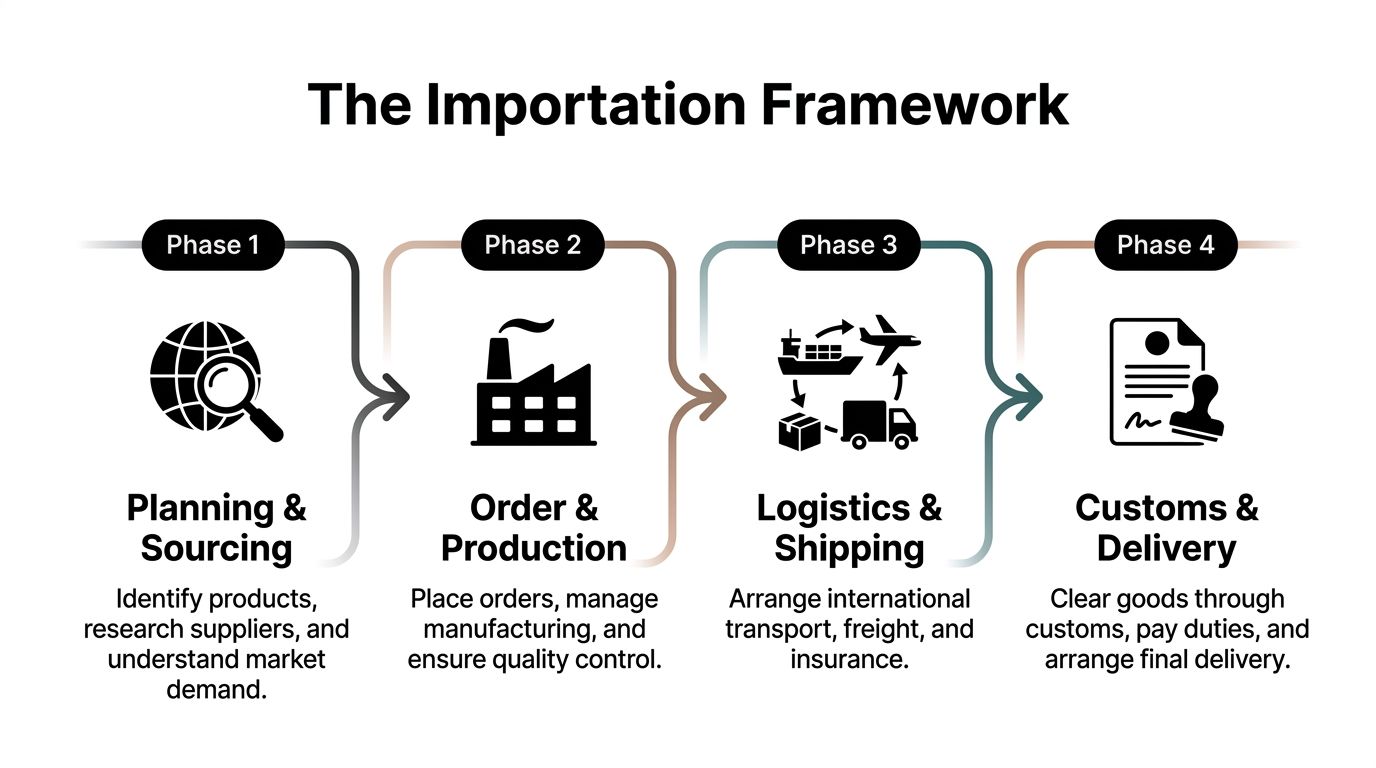
Planning and sourcing
Most avoidable mistakes begin in this phase.
You need a supplier, but you also need a product specification that survives contact with freight forwarders, customs agents, and warehouse teams. “Home accessories” or “electronics parts” isn’t enough. You need the exact goods, materials, use case, packaging format, and sales unit.
At this stage, focus on:
- Supplier identity: Confirm the legal entity you’re buying from, not just the trading name on a marketplace profile.
- Product definition: Lock down dimensions, weights, materials, and packaging before anyone prices freight.
- Commercial terms: Ask what shipping basis the supplier is quoting under before you compare offers.
A cheap factory quote often hides expensive assumptions. If the supplier’s number excludes origin charges, export handling, or inland movement to port, your landed cost will move fast.
Order and production
Once you place the order, control matters more than optimism.
Production timelines, labelling, carton markings, pallet requirements, and pre-shipment checks all need written confirmation. If your goods require special marks, retail labels, batch information, or compliance documents, this is the point to fix it. Not after the goods are packed.
Useful checks include:
- Purchase order alignment: Your PO should mirror the supplier quote, product spec, and agreed Incoterm.
- Packaging suitability: Outer cartons should suit the transport mode and final warehouse handling.
- Document readiness: Invoice details, consignee details, and product descriptions should be drafted before cargo is booked.
Logistics and shipping
This is the movement stage, but it’s also where cost control becomes real.
You choose the mode, book space, agree the handover point, and confirm cargo readiness. Freight decisions should reflect the product’s value, urgency, and shipment size. FCL, LCL, air, rail, and multimodal options all have their place. The right answer depends on your margin and your tolerance for delay.
Don’t choose a mode because it’s common. Choose it because it fits the product, the sales cycle, and the stock risk.
Customs and delivery
This final phase decides whether your shipment arrives as planned or sits still while charges build.
Goods need correct classification, a valid EORI setup, aligned commercial documents, and a clear plan for final delivery. For UK and EU importers, this phase often needs more attention than the overseas booking itself.
Treat customs as part of procurement, not a task at the end. That single shift in mindset prevents a lot of expensive surprises.
Choosing Your Transport Method Sea Air or Rail
Transport choice is where many first-time importers either protect margin or lose it.
Most goods from China to the UK still move by sea because the economics are hard to ignore. Sea freight handles approximately 80-90% of total UK import volume from China by value and tonnage, and a 20ft FCL container from Shanghai to Felixstowe averaged £1,200-£2,500 in 2023-2024, according to the trade and logistics reference used here: China-Europe transport mode analysis.
That doesn’t mean sea is always right. It means sea is usually the baseline against which the other options are judged.
Sea freight when cost matters most
Sea is usually the right choice for bulky goods, stable demand, and planned replenishment.
If you’re importing furniture, packaged consumer products, machinery, or repeat stock lines, sea freight normally gives the best landed-cost structure. The key decision is whether to use FCL or LCL.
- FCL: Better when you have enough cargo to justify a full container or when you want less handling and more control.
- LCL: Useful for smaller volumes, trial orders, or mixed buying programmes across suppliers.
- Reefer or specialised equipment: Needed where temperature, ventilation, or cargo sensitivity matters.
What doesn’t work is using LCL repeatedly without reviewing volume patterns. Many importers keep buying “small” for too long and end up paying premium handling charges over and over.
Air freight when time has value
Air is expensive, but sometimes it’s the cheaper decision overall.
If a delayed shipment means stockouts, lost launch dates, missed production schedules, or unhappy retail accounts, speed can save more than it costs. Air also suits higher-value and lower-volume goods because the freight charge takes up a smaller share of the final selling price.
Air tends to work best for:
- Urgent replenishment
- Launch inventory
- High-value components
- Samples and pilot runs
- Goods with limited shelf tolerance
What doesn’t work is sending low-margin bulk products by air just because planning was late.
Rail freight when you need a middle ground
Rail can be useful for some EU-bound movements when sea is too slow and air is too costly.
For UK importers, rail often becomes part of a wider multimodal solution rather than a simple direct answer. It may suit businesses routing through Europe, balancing speed and budget, or combining inland European delivery with onward movement into the UK.
Its strength is strategic, not universal. If your operation depends on one predictable direct lane into a UK port, sea is often simpler. If your network spans EU warehousing and cross-border distribution, rail becomes more interesting.
A practical comparison
| Metric | Sea Freight (FCL/LCL) | Air Freight | Rail Freight |
|---|---|---|---|
| Best for | Bulk cargo, regular stock, lower urgency | Urgent, valuable, compact goods | Mid-speed planning for some EU-linked flows |
| Cost profile | Lowest per unit for larger volumes | Highest transport cost | Mid-range in many scenarios |
| Transit expectation | Slowest, but economical | Fastest | Usually between sea and air |
| Handling pattern | FCL has fewer touchpoints than LCL | Airport handling is fast but costlier | Depends on route design and transfers |
| Working capital impact | More stock tied up in transit | Less stock tied up in transit | Balanced option in some networks |
| Common mistake | Choosing LCL by habit instead of reviewing container potential | Using it to fix avoidable planning failures | Assuming it’s available or suitable for every route |
A good mode decision starts with one question. What costs more for your business, waiting or overpaying?
When importation from china is new to you, start with the product profile and the stock requirement. Don’t start with a mode because it sounds familiar.
Navigating Customs and Documentation in the UK and EU
Most first imports don’t break down on the water. They break down at the paperwork stage.
For UK buyers, customs has become much less forgiving. HMRC data showed a 28% increase in customs delays for China-origin goods in 2025 due to incomplete EORI registrations and incorrect commodity codes, as noted in this Brookings-linked reference to the underlying trade issue. That statistic captures a familiar pattern. The goods are ready. The buyer has paid. The shipment moves. Then clearance stalls because the importer treated customs as an admin detail instead of a commercial risk.
The documents that must agree
Three documents drive most import clearances:
- Commercial invoice: This states what the goods are, who sold them, who bought them, and the declared value.
- Packing list: This shows how the goods are packed, including cartons, pallets, weights, and dimensions.
- Bill of Lading or Air Waybill: This confirms shipment details and transport movement.
These documents don’t work in isolation. Customs brokers compare them. If the invoice says one thing and the packing list suggests another, questions start quickly.
Common document problems include:
- Descriptions that are too vague
- Weights that don’t align across documents
- Wrong consignee details
- Missing origin details
- Invoice values that don’t match the actual transaction
EORI and commodity code discipline
A valid EORI number is a basic requirement for trading with the rest of the world. If the registration is wrong, inactive, or attached to the wrong entity in the chain, clearance slows down immediately.
Commodity codes cause even more trouble. They determine how goods are classified for customs purposes, which affects duty treatment, admissibility, and supporting requirements. First-time importers often rely on the supplier’s broad description or copy a code from a similar product online. That’s risky.
Use a proper classification review based on what the goods are, how they’re made, and what they’re used for. Similar products can attract different treatment.
Checkpoint: If your supplier writes the invoice description in sales language, rewrite it in customs language before shipment.
UK and EU realities after Brexit
Generic import guides often blur UK and EU procedures together. That’s a mistake.
The UK now operates within its own customs and VAT framework, and importers need to understand where declarations are filed, which party acts as importer of record, how VAT is handled, and what evidence is required for entry. If your goods move through the EU before entering the UK, the route design matters. So does the legal handover point under your Incoterm.
A practical way to avoid cost surprises is to model your landed cost before the booking goes live. This import tax calculator guide is useful for understanding the moving parts involved in duty, VAT, and shipment costing.
A customs checklist that works
Before cargo departs, confirm all of the following:
- Importer identity: The legal importing entity matches the customs entry plan.
- EORI status: The number is valid and ready for use on the entry.
- Commodity code: Reviewed against the actual goods, not guessed.
- Invoice language: Clear, commercial, and consistent with the goods.
- Packing data: Carton count, weights, and dimensions are final.
- Transport document details: Shipper, consignee, and route details are correct.
- Delivery plan: Port arrival, customs clearance, and final delivery are joined up.
Specialist handling matters most in this situation. A shipment can survive a modest freight rate change. It won’t easily absorb avoidable customs errors.
Understanding Incoterms and Their Impact on Your Price
Incoterms decide more than who books freight. They decide where cost responsibility ends, where operational control begins, and when the risk in the goods becomes yours.
For first-time importers, the easiest way to understand them is to stop thinking about them as legal jargon and start thinking about them as a handover map.
EXW when the factory leaves everything to you
With EXW, the seller makes the goods available at their premises. From that point, the buyer takes on almost everything else.
That sounds attractive if you want control, but it often creates friction for new importers. You or your forwarder must coordinate pickup, origin handling, export formalities, main carriage, and destination processes. If you don’t already have a strong origin setup, EXW can create gaps before the cargo even reaches port or airport.
EXW usually works best when the buyer already has a trusted freight arrangement and wants end-to-end control.
FOB when responsibility is split more cleanly
With FOB, the supplier handles the goods up to loading at the port of shipment. The buyer then takes over the main international movement and the rest of the journey.
For many sea freight buyers, FOB is the most practical starting point because it creates a cleaner division of responsibilities. The supplier handles local origin work they know well. The buyer controls the international leg and destination clearance, which is where cost visibility matters most.
This often makes comparison easier across freight providers and reduces the risk of hidden destination charges.
DDP when convenience can hide the detail
With DDP, the seller arranges delivery to the named destination, including duties and taxes.
That sounds simple, and for some buyers it is. But DDP can become opaque fast. If the supplier controls the route, clearance, and duty treatment, you may have less visibility into how the shipment is being declared, which entity is acting in customs, and what charges are embedded in the price. That can be inconvenient at best and risky at worst.
DDP can suit some low-complexity programmes. It’s less suitable when you need reliable compliance control, especially in a post-Brexit environment.
A practical way to choose
Use this lens when reviewing Incoterms:
- Choose EXW if you want full logistics control and already have capable freight support.
- Choose FOB if you want a balanced handover and clearer destination cost control.
- Choose DDP only if you fully understand how the supplier will handle customs, taxes, and importer responsibility.
A useful refresher on the wider framework sits in this guide to Incoterms 2020 and safe international trade.
The wrong Incoterm doesn’t just change your quote. It changes who is exposed when something goes wrong.
When importation from china is your first major project, FOB is often easier to manage than EXW and safer to understand than blindly accepting DDP. The right answer depends on your buying power, your internal capability, and how much visibility you need over the shipment.
Compliance for Regulated and Specialised Goods
General cargo is one thing. Regulated cargo is another job entirely.
If you import food products, ingredients, pharmaceuticals, technical components, or goods with sensitive sourcing exposure, compliance has to be built into the shipment from the start. You can’t patch it at the border.
Ethical sourcing is now a logistics issue
A lot of businesses still treat ethical sourcing as a procurement policy document. In practice, it affects whether cargo moves or gets stopped.
Under the 2025 Forced Labour Act, 65% of UK importers lacked supply chain audits, with exposure to fines up to 4% of global turnover, and seizures at Felixstowe for goods linked to specific regions rose 22% in 2025, according to the cited reference on forced labour and supply chain scrutiny available here.
That changes the standard for due diligence. If your supply chain includes textiles, apparel inputs, agricultural products, or components with opaque upstream sourcing, you need audit evidence, supplier declarations, and traceability discipline before shipment.
Useful actions include:
- Map the supplier chain: Don’t stop at the exporter. Ask who makes the inputs.
- Request audit evidence: Factory certifications alone may not answer sourcing questions.
- Keep records together: Purchase documents, declarations, and shipment files should be easy to retrieve if customs asks questions.
Agri-food and pharma need process discipline
For agri-food, perishables, and pharmaceutical-related cargo, the transport booking is only part of the job.
You may also need health certificates, veterinary or phytosanitary controls, product-specific import conditions, and careful timing around inspection points. Small document mistakes have bigger consequences here because delays can damage product quality, shelf life, or release timing.
What works:
- Matching the route to the compliance requirement
- Checking certificate wording before dispatch
- Making sure labels, batch data, and product descriptions are aligned
- Using a broker or specialist team familiar with regulated entries
What does not work is assuming a supplier that exports globally automatically understands UK-specific entry expectations.
Electronics and technical goods bring another type of risk
High-value electronics may not face the same controls as food or pharmaceuticals, but they still require precision.
Product descriptions need to be exact. Components and finished goods can classify differently. Batteries, telecom items, and technical assemblies often create questions around handling, documentation, and supporting product information. If the cargo is valuable and time-sensitive, every clearance error becomes more expensive.
Regulated imports don’t fail because the goods are unusual. They fail because the importer treats specialist requirements like standard freight admin.
For these shipments, a reliable import model depends on early document review, realistic route planning, and a logistics partner that understands the compliance burden, not just the movement.
Optimising Your Supply Chain with a Freight Forwarder
A freight forwarder earns its keep when the shipment stops being simple.
If you’re importing one supplier order a few times a year, you can often manage with a straightforward booking and customs broker arrangement. Once volumes grow, suppliers vary, timelines tighten, or goods become more sensitive, work shifts from booking freight to designing a system.
That matters even more in high-tech cargo. In 2024, UK imports of electrical machinery from China totalled £16.8 billion, making up 28% of all UK imports from China and driving a 12% growth in high-tech freight volumes that require specialised handling and compliance, according to the cited trade reference available here.
What a forwarder improves
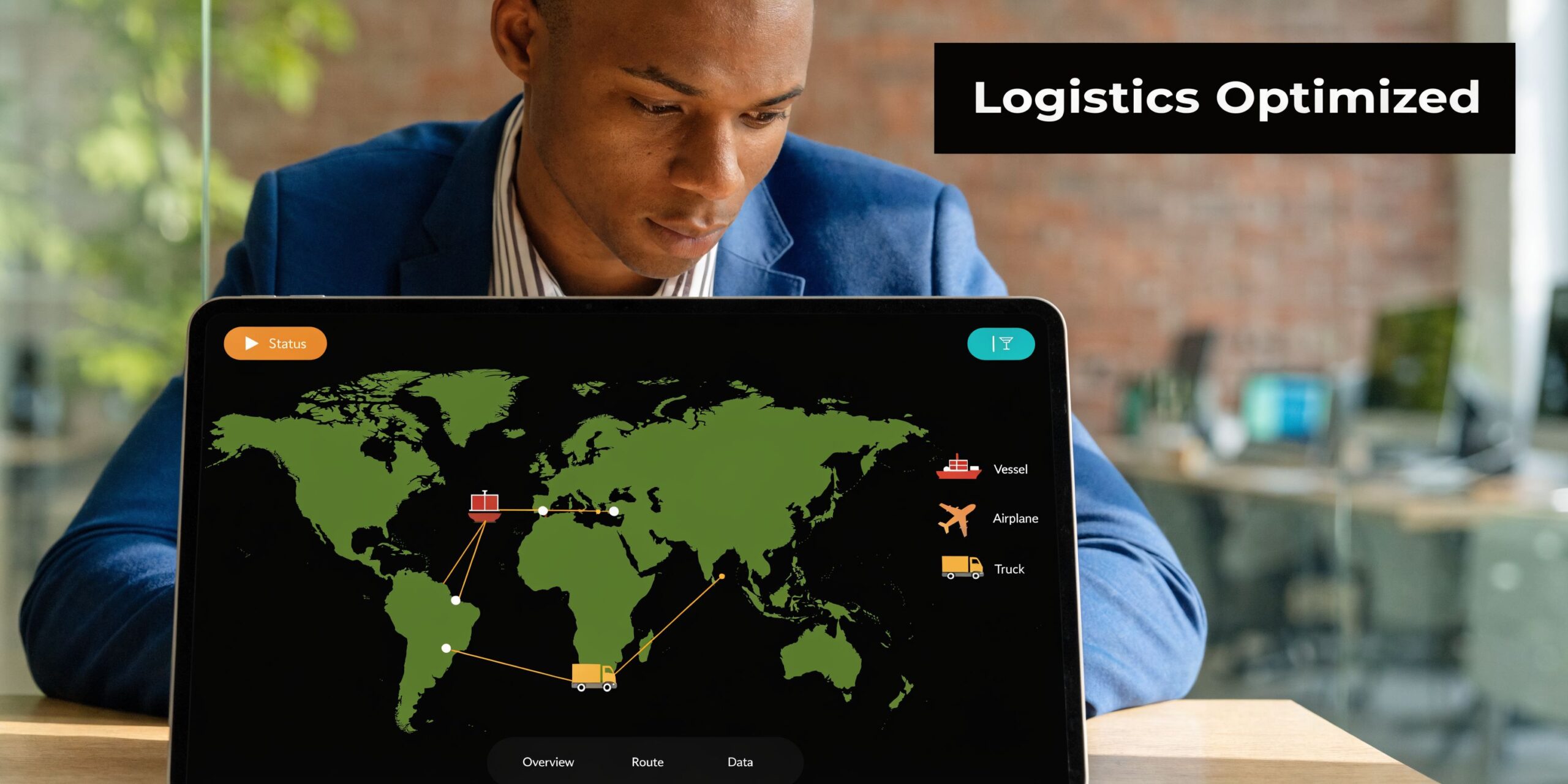
A good forwarder doesn’t just move cargo. They connect decisions across the shipment.
That can include:
- Mode planning: Sea for baseline stock, air for urgent lines, multimodal for awkward timing.
- Consolidation: Combining supplier shipments where practical to reduce repeated handling.
- Customs coordination: Making sure document flow matches the declared import plan.
- Warehousing support: Receiving, cross-docking, labelling, and onward distribution.
- Visibility: Tracking milestones so you can manage stock and customer commitments.
This matters most when shipments don’t fit neatly into one service. Many businesses need sea freight into port, customs clearance on arrival, short-term storage, pallet sorting, and final delivery into a retail or manufacturing network. Booking each part separately often creates handover problems.
What works in practice
One common importer mistake is treating freight as a one-off purchase every time. That usually produces fragmented decisions.
A better approach is to build around recurring patterns:
| Supply chain need | What usually works | What often fails |
|---|---|---|
| Small repeat orders from several suppliers | Consolidation and planned booking windows | Shipping every order separately on short notice |
| Urgent stock protection | Selective air use for priority lines only | Moving the whole order by air because planning slipped |
| Mixed UK and EU delivery requirements | Joined-up multimodal planning and customs coordination | Splitting transport and customs across too many providers |
| Retail or distribution centre delivery | Pre-booked delivery slots, labelling, and warehouse handling | Assuming port release means the hard part is over |
Choosing the right partner
The right freight partner should be able to explain the route in operational terms, not sales language.
Ask direct questions:
- Who handles customs and documentation?
- Can they support regulated or specialist entries if needed?
- What visibility will you get during transit?
- Can they manage warehousing, relabelling, or cross-docking if your buyer requires it?
- How do they handle exceptions, not just normal shipments?
One option in this market is international freight forwarding services from Multica Group, which covers sea, air, road, customs clearance, warehousing, and related handling for businesses moving goods across Europe, Asia, and the US. For an importer, that kind of joined-up model is useful when the shipment needs more than a port-to-port booking.
Saving rarely comes from the lowest freight quote. It comes from fewer mistakes, fewer handovers, and better timing.
That’s the difference between buying transport and building a supply chain.
From Supplier to Warehouse Your Next Steps
A first major import doesn’t need perfect conditions. It needs disciplined decisions.
If you define the product clearly, choose the right transport mode, set the right Incoterm, and get customs preparation done before dispatch, importation from china becomes manageable. Not risk-free, but manageable. Most serious problems come from assumptions, vague paperwork, and late decisions.
The strongest importers don’t try to know everything themselves. They know which parts they must control and which parts need specialist support. For UK and EU businesses, that’s especially true after Brexit, where compliance detail can affect timing, cost, and even whether the goods clear at all.
Treat your next shipment as a process to design, not just a purchase to arrange.
Start by answering four practical questions:
- What exactly am I importing, in customs terms?
- Which Incoterm gives me the right balance of control and simplicity?
- Which mode protects both margin and stock availability?
- Who is responsible for customs, documents, and final delivery at each stage?
Get those right, and you’ll have something more valuable than a single successful shipment. You’ll have a repeatable import model your business can scale.
If you’re planning importation from china and want a clearer route from supplier pickup to UK or EU delivery, Multica Group can help you assess the transport mode, customs requirements, and operational handovers before cargo moves. That’s often the difference between an import that merely arrives and one that arrives on time, compliant, and commercially workable.