A lot of hazardous goods problems start the same way. A company launches or scales a product, books transport, and only then discovers the shipment falls under dangerous goods rules. It might be a paint additive, a cleaning compound, a fragrance line, a battery-powered device, or a temperature-sensitive pharmaceutical item. The product is commercially routine, but the transport obligations are not.
That moment matters because hazardous goods transport isn’t just about moving cargo carefully. It’s about getting classification, packaging, documentation, equipment, routing, and handover points right across the whole journey. A mistake at the first step usually shows up later as a rejected booking, a border delay, a vehicle standstill, or a much more serious safety event.
Most clients don’t need a theory lesson. They need a working operating map. They need to know what the goods are, which rulebook applies, what has to appear on the package and on the paperwork, which mode makes sense, and who is responsible at each transfer point. That’s what makes hazardous goods manageable. Not guesswork. A disciplined sequence.
Navigating the Complex World of Hazardous Goods Transport
If you're dealing with your first hazardous shipment, the term itself can feel bigger than it is. Many people hear “hazardous goods” and think of explosives, industrial chemicals, or specialist military freight. In practice, the category is much broader. Everyday commercial products can fall into scope because they burn, corrode, react, release vapours, or create pressure during transport.

That’s why the first useful shift is this. Hazardous goods transport is not a special side issue. It’s a normal logistics process with stricter controls. Once you treat it as an operational discipline, the work becomes clearer.
What usually catches shippers out
The problem is rarely one dramatic error. It’s usually a chain of smaller assumptions:
- Product teams assume commercial name equals shipping description: It doesn’t. A sales label and a proper shipping name are not the same thing.
- Procurement buys standard cartons: Standard cartons may be fine for normal freight and completely wrong for dangerous goods.
- Warehouse staff focus on dispatch speed: Speed without verification causes rework. A fast non-compliant shipment is still a failed shipment.
- Export teams separate customs from dangerous goods compliance: In reality, the documents have to align.
Practical rule: If the SDS, package marks, consignment note, and booking declaration don’t all describe the same shipment in the same way, expect a delay.
A manageable way to think about it
The safest approach is to break every shipment into five questions:
- What exactly is the substance or article?
- How is it classified for transport?
- Which transport mode or combination of modes will be used?
- What packaging, marks, labels, and documents are required?
- Who checks compliance before release to the carrier?
When those answers are locked down early, the rest becomes execution.
For importers and exporters working across EU-UK lanes and intercontinental routes, the practical challenge is connection. Road compliance affects port acceptance. Port acceptance affects ocean departure. Air acceptance depends on pack-out, quantities, and declarations prepared earlier in the chain. The shipment only moves cleanly when someone is managing those links, not just the individual legs.
The Foundation of Compliance Understanding Hazard Classes
Classification is the foundation because every later decision flows from it. Packaging depends on it. Labels depend on it. Segregation depends on it. So does carrier acceptance. If the classification is wrong, everything built on top of it is unstable.
A useful way to explain the UN system is to think of it as a risk library. Each class groups goods by the main transport danger they present. You’re not organising products by what they are sold as. You’re organising them by how they can harm people, equipment, cargo, or the environment in transit.
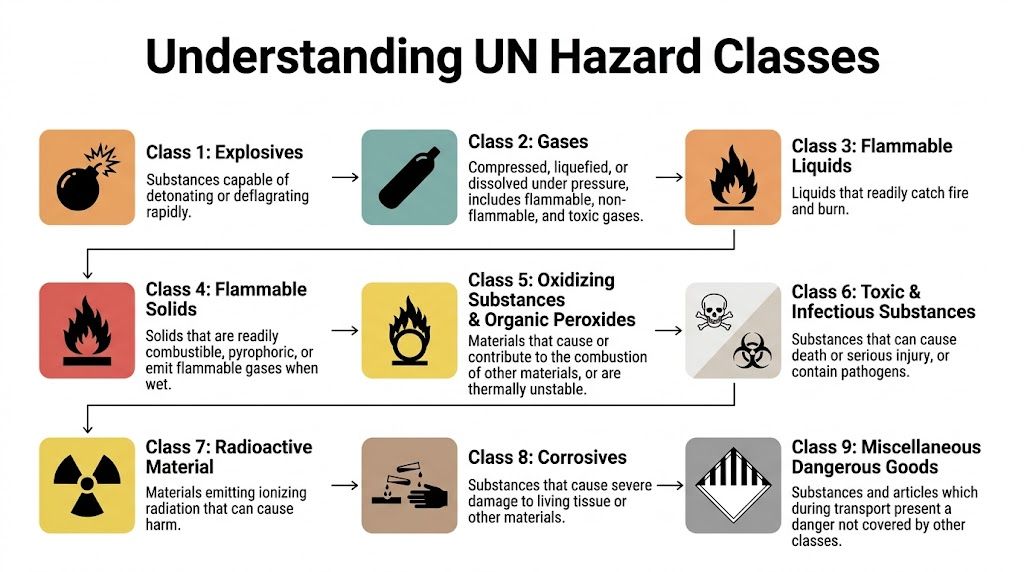
The nine classes in plain terms
| Class | Main risk | Typical commercial examples |
|---|---|---|
| Class 1 | Explosion | Fireworks, blasting products, certain specialised industrial articles |
| Class 2 | Gas under pressure, flammable or toxic release | Aerosols, cylinders, refrigerant gases |
| Class 3 | Flammable liquid | Petrol, solvent-based paints, perfumes, some cleaning liquids |
| Class 4 | Flammable solid or dangerous when wet | Matches, certain powders, reactive solids |
| Class 5 | Oxidising effect or unstable peroxide behaviour | Pool chemicals, some hardeners, certain industrial formulations |
| Class 6 | Toxic or infectious hazard | Pesticides, clinical materials, laboratory substances |
| Class 7 | Radiation | Medical isotopes and other regulated radioactive materials |
| Class 8 | Corrosion | Acids, alkalis, battery electrolyte, industrial cleaners |
| Class 9 | Miscellaneous transport danger | Lithium batteries, dry ice, some self-inflating devices |
The same commercial sector can touch several classes at once. A cosmetics exporter may handle flammable liquids and aerosols. A life sciences shipper may deal with dry ice, lithium batteries, infectious substances, or radioactive materials depending on the product.
Why class errors happen
The most common mistake is relying on product familiarity. Staff know what the product does in use, so they assume they know how it should travel. Transport law asks a different question. It cares about ignition, pressure, reaction, leakage, toxicity, and emergency response.
Another issue is that many businesses train people on rules but not on decision-making. That gap matters because human error causes one-third of accidents in hazardous goods transport, while practical guidance on error-prevention systems is still limited, as noted in CEVA Logistics’ hazardous goods overview.
A warehouse can follow yesterday’s process perfectly and still create today’s non-compliance if the product formulation, concentration, or package size has changed.
What good classification work looks like
Good classification starts with the SDS, but it doesn’t end there. The shipper checks the product composition, physical state, concentration, inner packaging, and transport configuration. They also confirm whether the goods are moving as a substance, a mixture, or an article.
Use this simple internal check before any booking goes out:
- Match the product to the SDS: Make sure the current version reflects the goods being shipped.
- Confirm the transport description: Use the proper shipping name and UN number that fit the shipment, not the marketing name.
- Check for mode sensitivity: Some goods are acceptable by road and sea but much tighter by air.
- Review packaging intent: The same product can trigger different requirements depending on pack size and outer packaging.
- Escalate uncertainty early: If the classification is unclear, stop and verify before labels are printed.
Classification isn’t paperwork. It’s the control point that protects every stage that follows.
Decoding the Rulebooks ADR IMDG and IATA DGR
The product classification tells you what the danger is. The rulebook tells you how that product may travel. In hazardous goods transport, the rulebook changes with the mode. That’s where many first-time shippers get caught. They assume one declaration or one packaging method can cover the entire journey. It usually can’t.
In the UK, road matters first because it carries most dangerous goods movements. Road transport accounts for approximately 70% of all dangerous goods movement in the UK, with over 1.2 million tonnes moved annually, and the ADR framework has helped reduce incident rates to 0.12 per billion tonne-km in 2022, according to the UK government’s road freight statistics collection. For most importers and exporters, even if the long leg is by sea or air, the shipment still begins or ends under road rules.
What each rulebook is for
ADR governs carriage by road. In the UK, it sits within the domestic legal framework for dangerous goods carried by road. ADR affects vehicle equipment, marking, driver obligations, documentation, load securing, and route considerations.
IMDG Code governs sea transport. It focuses heavily on package approval, stowage, segregation, container packing, and shipboard emergency response. Sea freight introduces different risks because cargo spends longer in transit and shares space with many other cargo types.
IATA DGR applies to air cargo acceptance and carriage. Air is usually the strictest operational environment. Quantity limits are tighter, packaging standards are exacting, and airline acceptance checks are unforgiving. A shipment that’s acceptable on a lorry may be rejected immediately for air.
Hazardous goods regulations at a glance
| Attribute | ADR (Road) | IMDG Code (Sea) | IATA DGR (Air) |
|---|---|---|---|
| Primary scope | Road vehicle movements | Vessel and container transport | Aircraft transport and airline acceptance |
| Main operational focus | Vehicle compliance, driver controls, routing, load securing | Segregation, stowage, marine environment, container packing | Package integrity, quantity limits, pressure and temperature tolerance |
| Core shipper concern | Correct description, package marking, placarding where required, driver-ready paperwork | Correct declaration, compatible stowage, container packing discipline | Exact package prep, label accuracy, strict documentation, airline-specific acceptance |
| Typical document style | Road transport documentation and emergency information | Dangerous Goods Note and related sea declarations | Shipper’s declaration and air waybill alignment |
| Common failure point | Vehicle or document mismatch at loading | Segregation or container packing errors | Package or declaration rejection at acceptance |
| Training emphasis | Road handling and vehicle obligations | Port, packing, and maritime segregation practice | Acceptance-level precision and recurrent air DG competence |
The multimodal trap
A lot of real shipments are multimodal. A pallet may move by ADR road to a port, then under IMDG by sea, then by road again at destination. A pharmaceutical consignment may move by temperature-controlled road to an airport, then by air, then into specialist final-mile delivery. Each handover changes the rule set, and those changes are not cosmetic.
For example, a package prepared loosely for road may fail air acceptance because the marking layout, declaration, or quantity configuration doesn’t satisfy airline handling requirements. A container packed without proper segregation logic may be turned away from the maritime leg even though the road collection was uneventful.
UK and US context that matters
For UK shippers, road movements sit under domestic dangerous goods regulations implementing ADR. For shipments entering or crossing the United States, you also have to account for the American hazardous materials framework under 49 CFR in addition to the mode-specific international rules where relevant. That matters especially when cargo changes custody, is reconsigned, or moves inland after international arrival.
Don’t ask which rulebook is “the main one”. Ask which rulebook applies at each leg, who checks compliance at that point, and whether the paperwork remains consistent from start to finish.
The practical discipline is simple. Build the shipment to the strictest relevant point in its journey, not just the first movement.
Proper Packaging Labelling and Documentation
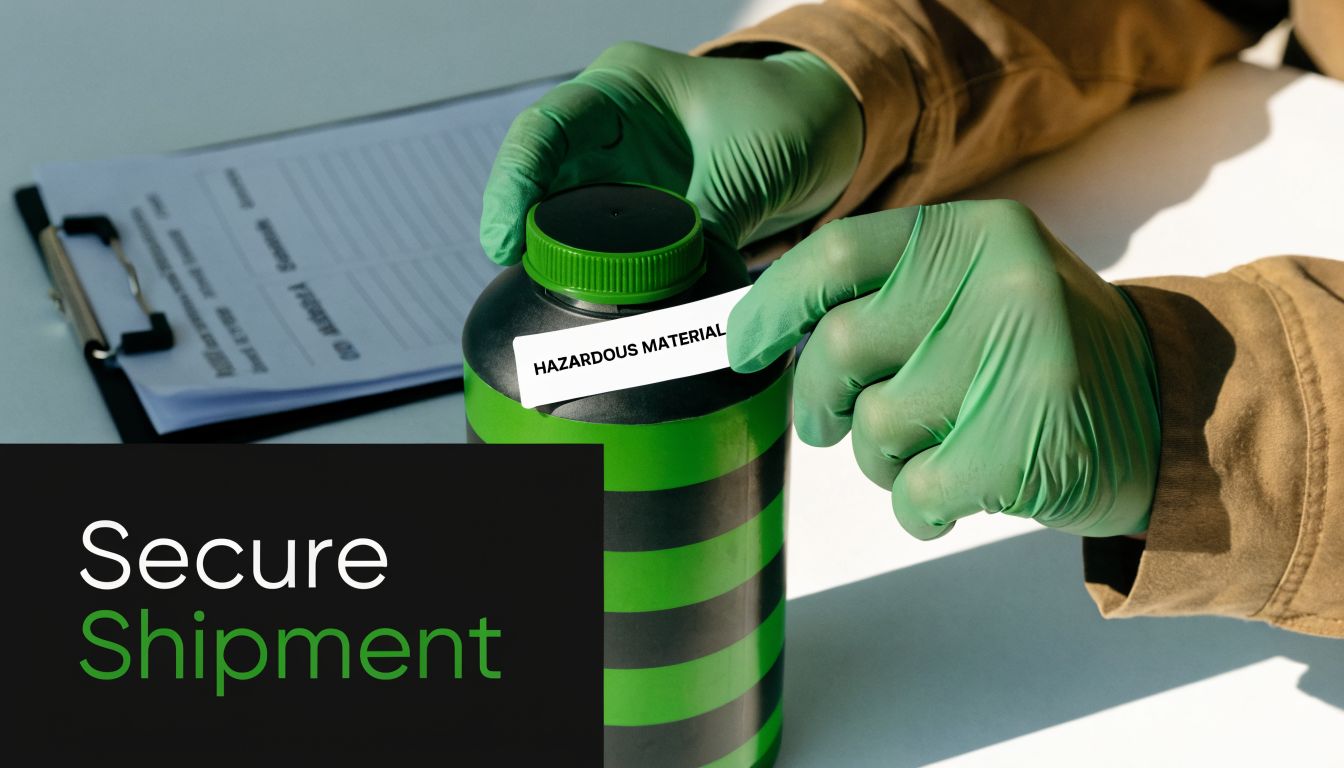
Most hazardous shipments fail on ordinary things done badly. The box is wrong. The inner packs move. The label is missing or placed badly. The declaration doesn’t match the package. None of these errors are subtle, but they are common because teams treat them as admin instead of physical risk controls.
Start with the right level of packaging
Packing Groups are easiest to explain as high, medium, and lower security requirements tied to the level of danger presented in transport. The higher the risk, the more stringent and controlled the packaging standard has to be. That affects material choice, closure method, absorbent use, inner receptacles, cushioning, and testing.
If the shipment needs wood protection, bracing, or export-ready support packaging around the approved dangerous goods packs, good crating discipline matters too. The same loading principles used for industrial freight still apply. Weak outer support causes movement, movement causes damage, and damage turns compliance into emergency response. For that reason, it helps to align dangerous goods prep with proven crating for shipping practices instead of treating hazardous packaging as a separate silo.
How to read packaging and marks
A compliant hazardous package tells a story before anyone opens it. It shows what the hazard is, whether the packaging is approved, how the package should be oriented where applicable, and whether the transport document should be checked for detail.
Use this working distinction:
- Hazard labels on the package: These identify the nature of the danger.
- Placards on the vehicle or container: These communicate the presence of dangerous goods at transport-unit level where required.
- UN packaging markings: These show the package type and approval status.
- Handling marks: These support safe orientation and handling.
A warehouse should verify all four as separate checks, not as one glance.
Documentation has to match the freight exactly
The Safety Data Sheet (SDS) is the reference point. It helps identify classification and transport detail. The transport paperwork then translates that into the language used operationally by carriers, drivers, ports, and emergency responders.
The core documents usually include:
- The SDS
The shipper begins with information that should be current, product-specific, and available to the people preparing the shipment.
The Dangerous Goods Note or equivalent transport declaration
This is what carriers and terminals use to confirm what’s moving and under which conditions.
Emergency information such as a Tremcard where applicable
This supports response actions if something goes wrong on the road leg.
Here’s a practical demonstration of how dangerous goods paperwork and physical prep are checked in real operations:
Equipment checks aren’t optional extras
Documentation and packaging have to align with vehicle readiness. Under UK CDG 2009 rules implementing ADR, vehicles carrying significant quantities of hazardous goods must carry specific fire extinguishers, including a total capacity of 12 kg for a 20-tonne payload, and compliant equipment has been associated with a 42% reduction in incident severity by enabling initial containment, as described in the hazardous materials compliance guidance referenced for this requirement.
That’s why pre-loading checks should include more than paperwork:
- Check extinguisher status: Verify presence, seal integrity, and pressure condition.
- Inspect package closures: A correctly labelled leaking package is still a failed shipment.
- Review label placement: Labels hidden by stretch wrap often trigger avoidable rejection.
- Cross-check the consignment note: UN number, proper shipping name, class, and packaging details must align with the goods on the floor.
The best pack-out teams don’t ask, “Can this leave today?” They ask, “Will the next handler accept it without needing to reinterpret anything?”
That mindset prevents delays.
Managing Risks Across Road Sea and Air Transport
Once the freight is packed and declared, the risk profile changes again. Static compliance becomes live transport risk. The question is no longer only whether the shipment is legally prepared. It’s whether it will remain safe and controllable while vehicles brake, containers roll, temperatures change, and handling teams transfer custody.
Road risk is about movement and response
Road is the most exposed mode operationally because it deals with traffic, route restrictions, loading pressure, and frequent handoffs. The cargo is moving through public infrastructure, often on schedules that encourage rushed loading and shortcuts on checks.
The practical road risks are familiar:
- Load shift: Poor blocking and bracing can turn a compliant package into a leaking one.
- Route restrictions: Tunnels, bridges, urban delivery windows, and local controls can affect feasibility.
- Driver decision points: Parking, refuelling, delays, and incident reporting all matter.
- First-response readiness: Vehicle equipment and accessible documents reduce the chance that a small event becomes a major one.
Telematics helps because it gives planners visibility into route progress and exceptions, but it only works if someone is watching the data and acting on it. Alerts without intervention are just noise.
Sea risk is about incompatibility and dwell time
Sea freight handles large hazardous volumes because it is efficient for heavy and bulk movements, but that scale creates a different operating discipline. The UK moved 45 million tonnes of hazardous goods by maritime transport in 2021, mainly petroleum and chemical products, and reportable incidents fell to 14 events in 2022 under the IMDG and MCA audit framework, according to the UK government’s port and domestic waterborne freight statistics collection.
That doesn’t mean sea is easy. It means the rule framework works when it is followed.
Key sea risks usually come from:
| Risk area | What goes wrong in practice |
|---|---|
| Segregation | Incompatible goods are packed or stowed too closely |
| Container packing | Weight distribution and securing are poor |
| Port handling | The unit is delayed, repositioned, or checked multiple times |
| Environmental exposure | Heat, vibration, salt air, and time magnify small weaknesses |
If the cargo value is significant or the supply chain is fragile, it’s worth reviewing cargo insurance considerations for international freight alongside compliance planning. Insurance does not correct a dangerous goods error, but it does belong in the same risk conversation.
Air risk is about tolerance for error
Air is the least forgiving mode. Package failure is unacceptable because pressure changes, handling intensity, and aircraft safety rules leave no room for approximate compliance. That’s why air dangerous goods acceptance is so detail-driven.
Air is usually chosen when speed, shelf life, or product criticality outweigh cost. In pharmaceuticals and life sciences, that can be the right call. The trade-off is that packaging, quantity limits, declarations, and timing all tighten at once.
A shipment that is barely compliant on paper is often operationally non-viable in air freight.
What works better than reactive firefighting
Risk control in hazardous goods transport is usually strongest when companies build routine discipline into dispatch:
- Pre-journey verification: Confirm the route, unit, documentation set, and emergency readiness before release.
- Mode-specific handover checks: Don’t assume the next carrier will fix a preparation gap.
- Exception management: Stop the shipment when details conflict. Rework is cheaper than an incident.
- Training tied to tasks: Teach packers, planners, drivers, and document staff what decisions belong to them.
The best operators reduce surprises before the wheels turn.
An Integrated Workflow for Seamless Hazardous Shipments
A shipment leaves an EU site in good order, reaches the UK hub, and then stalls before export because the dangerous goods description, temperature-control plan, and customs data do not match. That kind of failure is common in hazardous goods transport. The issue is usually not one big mistake. It is a chain that was planned in parts instead of as one controlled movement.
A temperature-sensitive pharmaceutical consignment going from the EU to the USA through the UK shows the problem clearly. The load may need dangerous goods review, cold chain protection, border processing, and handovers between more than one mode. Each part can be done correctly in isolation and still fail at the transfer point if the information set is not aligned.
Specialist teams often work to their own priorities. Dangerous goods staff focus on classification and packing instructions. Cold chain teams protect product stability. Customs teams clear the border entry and exit points. Carriers apply their own acceptance standards. The operational risk sits between those functions, where one decision affects the next leg but nobody owns the full sequence.
Emerging pharmaceutical and life sciences supply chains face the dual challenge of hazmat regulations and cold chain integrity, and mainstream guidance often overlooks that intersection for dual-regulated goods moving across post-Brexit UK-EU borders or to the USA, as noted in Mordor Intelligence’s market coverage referenced in the research brief.

Step one starts with the SDS, not the booking
The workflow starts with product data. The SDS, commercial specification, and shipment profile need to be reviewed together before anyone books transport. That review should settle a few practical points early:
- Is the product regulated for transport at all?
- Is it shipping as a substance, mixture, or article?
- Does the temperature range change the packaging method or pack-out time?
- Will one mode in the chain impose tighter quantity or packing limits than the others?
Sometimes the right operational decision is to redesign the shipment. That may mean changing pack configuration, splitting quantities, or choosing a different route before costs build up.
Build the route around the product
Suppose the consignment starts in the EU, needs controlled handling in the UK, and then moves to the USA. A workable design could involve ADR-compliant collection, temporary storage under controlled conditions, export processing, the main international leg, and specialist final delivery. The route is only viable if those stages are built around the product and its regulatory profile, not around whatever capacity happens to be available first.
That is also where international freight forwarding services for regulated cross-border movements become relevant. One provider coordinating the route, document flow, and handovers can prevent the usual gap between booking transport and preparing compliant freight.
The trade-offs are practical:
| Decision point | Better when | Worse when |
|---|---|---|
| Road plus air | Time is critical and acceptance conditions can be met | Documentation is incomplete or packaging tolerance is weak |
| Road plus sea | Product is less time-sensitive and volume economics matter | Transit time could compromise product integrity |
| Direct movement | Fewer handovers reduce risk | Capacity or border constraints make control harder |
| Staged movement with controlled handling | Extra checks protect product and compliance | Delay risk rises if responsibilities are unclear |
An integrated provider operating across road, sea, and air matters in these cases because one shipment often carries several compliance layers at once. Multica Group is relevant here for its cross-mode operations, customs capability, documentation support, warehouse handling, telematics, and experience with regulated freight that may also involve veterinary or health-related controls.
Execution depends on controlled handovers
Once the route is set, the job becomes a sequence of checks. Approved packaging is sourced first. The goods are then packed to the required standard, marked and labelled for the mode in use, and documented from verified shipment data rather than copied from a previous file. After that, the packed freight and the declaration are checked against each other before release.
Each handover needs its own control point. On collection, the vehicle, placards, driver instructions, and load details must match the booking. At the port or airport, acceptance staff compare what arrives with what was declared. If package type, net quantity, or labelling does not match, the freight stops there.
Good operators treat every transfer point as a fresh compliance event.
Clearance and visibility have to stay aligned
For international hazardous shipments, customs data and dangerous goods data need to describe the same goods in the same way. Product identity, consignee details, quantities, and supporting papers must stay aligned throughout the move. If health certificates, veterinary controls, or temperature records also apply, they need to be built into the operating plan early.
Visibility matters for a different reason. A compliant shipment can still become unusable if it is delayed, rerouted, or exposed to the wrong conditions in transit. Telematics, milestone reporting, and exception handling give the shipper time to act before a delay turns into product loss or a rejected delivery.
Well-managed hazardous goods transport is a connected workflow. Classification affects packaging. Packaging affects mode choice. Mode choice affects documents, timing, and handovers. The operators who control those links are the ones who keep freight moving reliably.
Choosing a Partner for Compliant and Efficient Logistics
By the time a shipment is ready to move, most of the risk has already been decided. It sits in the quality of classification, the choice of mode, the packaging standard, the document set, and the handover controls. That’s why hazardous goods transport shouldn’t be treated as a last-minute carrier problem. It’s a supply chain design issue.
A capable logistics partner doesn’t just book space. They help make sure the goods are described correctly, packed correctly, documented correctly, and transferred correctly between road, sea, and air environments. That matters even more for companies shipping across borders where customs, veterinary requirements, and dangerous goods obligations can overlap.
What to look for in practice
Choose a partner that can answer operational questions clearly, not just commercially.
- Can they work across modes: If your cargo may move by road, sea, or air, they need to understand where one rule set ends and another begins.
- Can they manage document alignment: Customs papers, dangerous goods declarations, and commercial documents must tell the same story.
- Can they support exception handling: Delays, rejections, and route changes happen. You need a process, not reassurance.
- Can they provide visibility: Real shipment status is more useful than generic “in transit” updates.
- Can they integrate the wider chain: Warehousing, labelling, cross-docking, and final delivery all affect hazardous shipments.
For businesses moving internationally, it helps to work with a provider that understands the broader freight picture too, not only the dangerous goods segment. That’s where a grounded view of international freight forwarding services becomes useful. Dangerous goods compliance works best when it’s embedded in the full transport plan.
Compliance is not just about avoiding penalties. It protects continuity, customer confidence, and your ability to access markets without disruption.
The companies that handle hazardous freight well usually don’t rely on heroics. They rely on process. They know when to escalate uncertainty, when to stop a shipment, and when to redesign the route. That discipline saves time more often than it costs time.
If your team is dealing with hazardous goods transport across the UK, Europe, Asia, or the United States, Multica Group can help you map the shipment properly from the start. The practical advantage is end-to-end coordination across modes, documentation, customs, and operational handovers, so regulated cargo moves with fewer surprises and clearer control.