A trailer is booked for Friday. The goods are packed. Your customer expects delivery on Monday. Then the final document check finds a commodity code that does not match the product specification, invoice wording that is too loose for the declaration, or health paperwork that has not cleared in time. The shipment either misses departure or reaches the border and stops there.
That is usually the point an import or export manager sees customs for what it is. A control point that affects the whole movement, not a formality added at the end. Once customs data is wrong, the knock-on costs start fast. Hauliers wait, storage charges begin, booked delivery windows are lost, and customer service teams are left explaining delays they did not cause.
The pressure is higher in the UK now because border processes involve more systems, more checks, and less room for assumptions. Businesses dealing with food, chemicals, excise goods, controlled products, or dual-use items feel that first, but general cargo is not immune. A small classification error or missing instruction can turn a routine shipment into a week of rework.
That is why choosing support on customs is not only about finding someone to submit an entry. It is about deciding who will catch problems before wheels turn, who understands the operational cost of a hold, and who can coordinate transport, documentation, and border timing together. For firms adjusting to the current UK border controls and import requirements, that difference matters more than the clearance fee itself.
A standalone customs agent can file declarations. An integrated logistics partner can also see the wider failure points. That includes document quality, carrier cut-offs, pre-lodgement timing, port routing, and the extra controls that regulated goods often trigger. That broader view is where hidden cost is usually found, and where it is best contained.
Your Guide to Navigating Modern UK Customs
A shipment can leave the warehouse on time, have the right carrier booked, and still fail at the border because one field in the declaration does not match the invoice or a supporting certificate is missing. That is usually the moment a business starts taking customs support seriously.
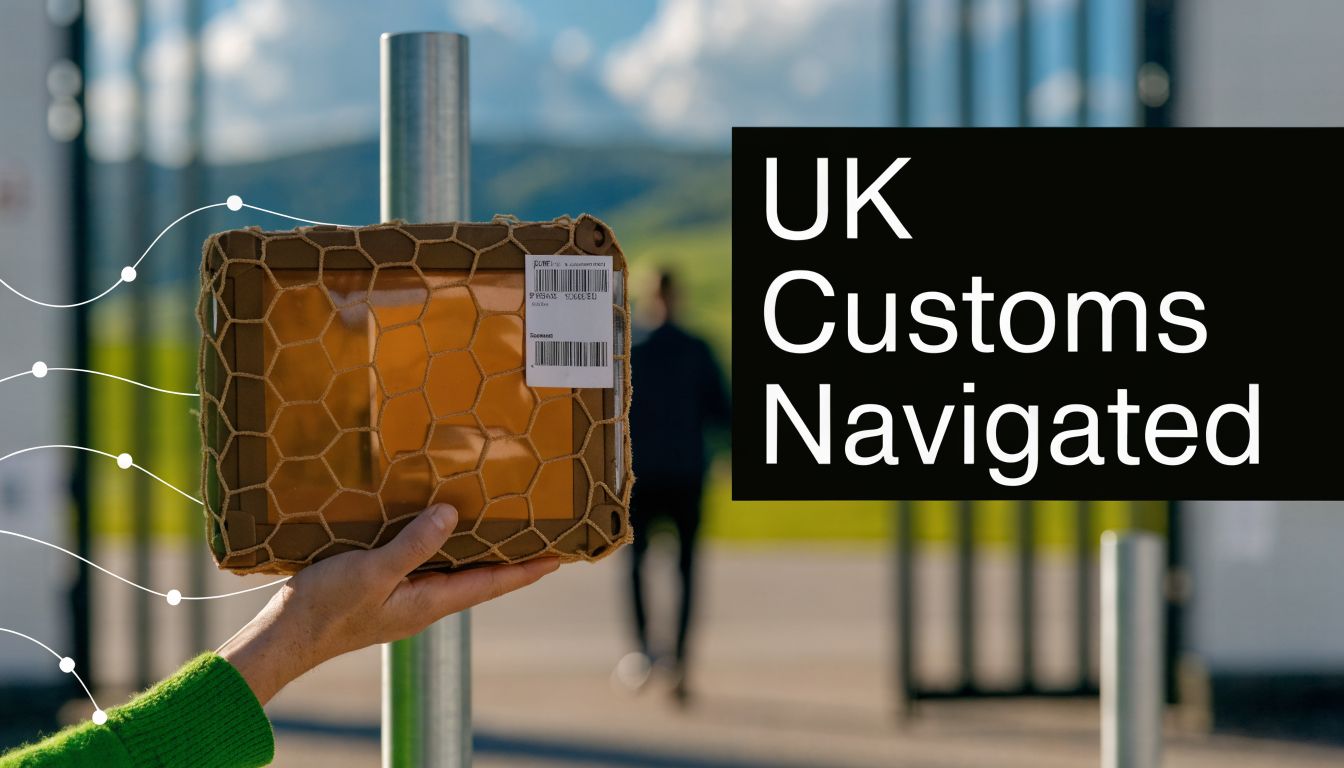
Modern UK customs work puts pressure on more than compliance teams. It affects transport planning, warehouse release, customer delivery promises, cash flow, and stock availability. For regulated goods, the exposure is higher again because customs is only one layer. Sanitary controls, licensing, excise treatment, product-specific documentation, and port health checks can all sit around the same movement.
Why the pressure feels higher now
UK border processes now involve more systems, more data points, and tighter timing than many importers and exporters were used to before. Errors that once might have been corrected with a quick call now tend to create a hold, a reroute, or a full resubmission. The operational cost often outweighs the clearance fee.
Customs agents work in the space between your commercial documents and what border systems will accept. The good ones do more than transmit an entry. They check whether the shipment is ready to clear, whether the route and timing fit the declaration model, and whether regulated goods are likely to trigger extra intervention.
If your team is still adapting to current UK border controls and import requirements, it helps to understand the border as an operating constraint, not an admin task.
Practical rule: If a shipment is urgent, customs preparation starts before departure, not when the goods reach the port.
What good customs support changes
Strong customs support prevents avoidable friction before it becomes delay. That includes checking document quality, questioning vague product descriptions, spotting valuation or origin issues, and making sure pre-lodgement and routing decisions match the actual movement.
The impact is greatest when goods are perishable, controlled, high-value, or booked into narrow delivery windows. In those cases, customs mistakes do not stay inside the customs function. They turn into storage, demurrage, missed slots, rejected deliveries, and extra customer service work.
A standalone customs agent can often submit the declaration correctly. An integrated logistics partner usually has a wider view of the failure points around that declaration, including carrier cut-offs, port processes, document handover, and the added controls that regulated goods attract. That broader coordination is where hidden cost is reduced.
What Does a Customs Clearance Agent Actually Do
The clearest way to think about customs clearance agents is this. They are specialised legal translators for international trade. Your business speaks in purchase orders, invoices, product specs, delivery promises, and customer deadlines. HMRC and border systems speak in tariff codes, customs procedures, valuation methods, origin rules, pre-lodgement references, and inspection triggers. The agent translates one into the other.
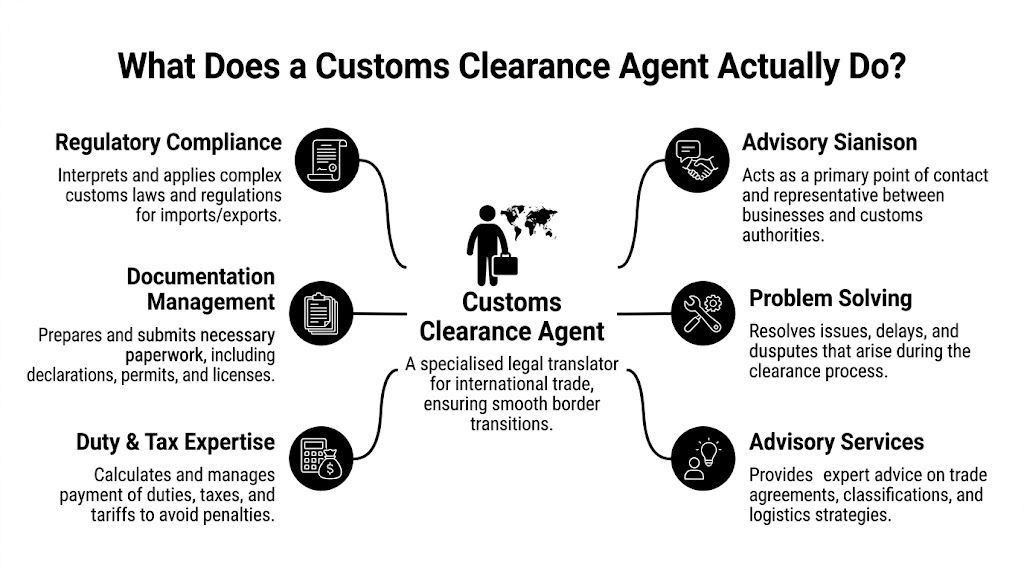
That translation role is more technical than many people assume. The agent doesn’t just “do customs paperwork”. They decide how shipment data is structured, what procedure applies, which supporting records are needed, and how to present the entry so it clears without unnecessary intervention.
Compliance is the first job
At the most basic level, customs clearance agents make sure a shipment is legally presentable to customs authorities. That means checking the product description, origin, value, commodity code, consignee details, incoterms, and any permit or health documentation that may be required.
Three things usually cause trouble:
- Weak product descriptions that say too little for accurate classification
- Wrong origin assumptions where preference claims can’t be supported
- Late document assembly that leaves no time to correct errors before departure
An experienced agent will challenge all three. That can feel inconvenient when a team is in a rush, but it’s far cheaper than fixing a rejected entry after the truck is already in motion.
Trade flow is the second job
Compliance on its own isn’t enough. A customs entry can be legally correct and still operationally poor if it’s filed too late, sent to the wrong place in the workflow, or built without reference to the actual transport plan.
Stronger customs clearance agents add real value. They align customs timing with the movement itself. They understand whether the load is moving as groupage, full truckload, containerised sea freight, or time-critical air cargo. They know when pre-lodgement matters, when supporting documents must be uploaded early, and when a border crossing needs extra sequencing between driver, forwarder, warehouse, and customs team.
A customs process that ignores transport reality tends to create handover failures.
Here’s a practical explainer that complements the point above:
Intermediation is the third job
Agents also act as the working interface between your business and authorities such as HMRC, port systems, and border inspection processes. If customs queries a value, requests supporting evidence, or pauses a declaration, the agent is usually the first person dealing with it.
The best agents don’t just transmit data. They defend the logic behind it when customs asks questions.
That’s why response quality matters as much as filing speed. Anyone can submit data into a system. Fewer people can resolve a classification challenge or explain why a document package supports a claimed procedure.
Agent versus freight forwarder
Businesses often use these terms interchangeably, but they aren’t the same.
A freight forwarder organises movement. A customs clearance agent organises regulatory passage. One manages transport execution. The other manages border compliance. In practice, the roles can overlap, and many logistics businesses provide both. But the distinction matters because a transport booking alone doesn’t solve customs risk.
A truck can be perfectly planned and still fail at the frontier if the declaration work is weak. Equally, a flawless customs entry won’t help if the carrier, depot, or delivery schedule isn’t coordinated. That’s why many importers prefer a model where the customs and transport teams work from the same operational picture rather than passing files between separate companies.
Decoding the Services Customs Agents Offer
A customs entry can look fine right up to the point a shipment is stopped. The filing itself is only the visible part. The essential work sits underneath it in document control, coding logic, border system alignment, and how fast someone can resolve a query without breaking the transport plan.
That matters more with regulated goods. A missed health document or a vague product description does not just create admin. It can trigger storage, rebooking, inspection delays, spoilage, and customer claims. Businesses often learn this after using a standalone agent who can file declarations but has no control over the wider movement.
Document control
Every movement starts with documents, but the issue is not volume. It is whether each document supports the same commercial and regulatory story.
An invoice might use a sales description. The packing list might use an internal SKU label. The declaration might use a broad category. If those do not align, customs has a reason to query identity, value, origin, or admissibility.
Good agents review documents as an operational checkpoint. They look for mismatches in:
- Product identity across invoice, packing list, and declaration
- Origin evidence where preferential duty treatment is being claimed
- Importer, consignee, and EORI details that must match the legal setup of the shipment
- Supporting records for controlled goods, including health, sanitary, veterinary, or product compliance documents
This is basic discipline, but it is where many avoidable problems start.
Declaration preparation on CDS
The UK declaration is a legal statement made through CDS and related border systems. The entry pulls together classification, customs procedure, value, origin, Incoterms, declarant status, and any reliefs or controls that apply.
Software does not fix bad input. If the source data is weak, the declaration can still be accepted and leave the importer exposed later in an audit or post-clearance review.
Capable agents spend time before submission asking awkward but useful questions. What exactly is in the product. Who is the importer of record. Is the origin claim supported. Does the procedure code match the commercial intent. Those questions protect the shipment and the business behind it.
Duty, VAT, and exposure control
Many importers focus on the duty rate. The larger risk usually sits in how that rate was reached.
Duty and import VAT depend on classification, origin, customs value, and procedure. If any of those are wrong, the liability does not disappear because the goods were released. It sits on the importer’s account until HMRC reviews it.
A good agent checks whether the valuation includes the right cost elements, whether preference is supportable, and whether the declared code fits the goods as sold and shipped. That work saves money in some cases. In others, it prevents a larger bill later.
Operational insight: A low filing fee means very little if nobody has tested the assumptions behind the declaration.
Holds, exams, and exception handling
Some shipments clear quickly. Others go into documentary review, port health checks, or physical inspection. At that point, speed depends less on data entry and more on preparation and response quality.
The difference is easy to spot. Strong agents already know which document may be requested, who holds it, and how the hold affects delivery timing, storage, and carrier bookings. Weak agents start chasing after the stop has landed.
For time-sensitive cargo, that delay is expensive. Food ingredients lose shelf life. Retail launches miss dates. Pharmaceutical and healthcare shipments can run into handling restrictions that are far costlier than the original clearance fee.
Specialised clearance for regulated goods
Regulated goods need more than generic customs competence. Agri-food, animal products, plant products, chemicals, healthcare items, and controlled consumer goods often sit under overlapping rules. Customs is only one layer. Border health, licensing, safety controls, and product-specific checks can all apply at the same time.
For agri-food, that can mean getting Export Health Certificate details right, aligning IPAFFS entries with the commercial paperwork, and making sure the goods description is precise enough for both customs and border control purposes. For pharmaceuticals or temperature-sensitive products, delay risk has a direct cost because the condition of the goods matters as much as the release decision.
The operating model is key. A standalone agent may file correctly but still leave gaps between customs, transport, depot handling, and delivery timing. An integrated provider that manages customs alongside warehousing and international freight forwarding services has a better chance of containing the problem because the teams share the same shipment picture.
Advisory support that fixes repeat errors
The strongest agents do more than clear the current load. They identify patterns that keep creating risk and push for permanent fixes.
That usually means work such as:
- Cleaning up product master data so customs descriptions, codes, and units are usable
- Setting document cut-off rules before collection so declarations are not built from partial files
- Separating regulated and non-regulated flows where mixed consignments create avoidable complexity
- Creating lane-specific SOPs for EU-UK, UK-EU, and intercontinental traffic
- Reviewing landed cost assumptions where customs value errors keep distorting margin
Customs support starts to affect supply chain design. The point is not only to get goods over the border today. It is to stop paying for the same mistake every week.
How to Choose a Reliable Customs Agent
A shipment can look fine at booking stage and still fail at clearance because the wrong person asked the wrong question too late. That usually shows up as a hold on value, origin, licensing, commodity code, or product controls. By then, the filing fee is the smallest cost in the chain.
Choosing a customs agent is really about choosing how much operational risk you want to carry yourself.
Start with proof of control, not sales language
A reliable agent should be able to show disciplined customs processes, clear accountability, and experience in the lanes and product types you move. One useful signal is Authorised Economic Operator status. In UK practice, AEO indicates that the business has been assessed against customs compliance and security standards. Official guidance also notes practical benefits such as fewer physical and document-based controls, and priority treatment if a consignment is selected for control.
AEO on its own is not a guarantee of good service. A non-AEO provider can still perform well. But if they do not hold it, ask them to explain what control framework they use instead, how they audit entries, and who owns compliance when Customs challenges a declaration.
Ask how they behave under pressure
The useful questions are not about whether they can submit declarations. Almost any agent can do that. The true test is what happens when the shipment is awkward, incomplete, or under time pressure.
Use questions like these:
- Which lanes do you handle every week? EU groupage, RoRo, deep-sea imports, and regulated airfreight all create different risks.
- Who reviews entries before submission? A processor who only keys data is different from a team that challenges weak descriptions, missing values, or doubtful origin claims.
- Who owns post-entry queries? Ask for the team structure, escalation path, and cut-off times.
- How do you handle regulated goods? Veterinary checks, health certificates, excise movements, dual-use controls, and product compliance all need specific knowledge.
- What happens if documents arrive late or conflict with each other? Good agents have a rulebook. Weak ones improvise.
Specific answers matter. Vague reassurance usually means the hard parts sit with you.
Test the operating model, not just the customs desk
Many importers choose an agent based on filing price and only discover later that customs is disconnected from transport, depot handling, or delivery planning. That gap creates avoidable costs. A declaration may be technically correct while the vehicle still misses its slot, the warehouse misses intake, or the temperature-controlled shipment waits in the wrong place.
That risk gets higher with regulated or sensitive goods. Food, pharmaceuticals, chemicals, and products needing supporting certificates do not tolerate loose coordination well. In those flows, a standalone broker may clear the entry but still leave your team to chase hauliers, inspection sites, warehouses, and document owners.
This is why the wider operating model matters. If customs sits inside a provider that also manages transport and warehousing, issue resolution is usually faster because the teams are working from the same shipment record. If your supply chain already depends on broader international freight forwarding services, check whether customs decisions are tied directly to collection timing, pre-lodgement, arrival messaging, and final delivery.
Look for warning signs early
A dependable customs partner usually shows their habits before the first live job.
| What to test | What good looks like | What should worry you |
|---|---|---|
| Pre-shipment review | They challenge codes, values, origin, Incoterms, and document gaps before collection | They accept whatever file is sent and submit without review |
| Ownership | They name the team or person responsible for your entries and query handling | Responsibility is unclear or hidden behind shared inboxes |
| Regulated cargo handling | They explain inspection steps, supporting documents, and likely failure points | They claim broad capability without giving a process |
| Delay response | They can explain what happens during a hold, who contacts whom, and how they recover delivery timing | They talk only about standard turnaround times |
| Charges | They explain entry fees, amendment fees, storage risk, out-of-hours costs, and liability limits in advance | Extra costs appear only after a shipment stops |
Match the agent to your hardest shipments
Generic customs knowledge is not enough. An agent can be perfectly competent on standard consumer imports and still struggle with mixed loads, SPS goods, temporary admissions, returned goods, or high-frequency road flows with tight cut-offs.
Ask them to walk through your most difficult shipment step by step. Use a real example. A delayed health certificate, a split invoice, a preference claim with weak origin evidence, a trailer arriving before the declaration is accepted. Their answer will tell you whether they only file entries or whether they can protect the movement.
That distinction matters. The hidden cost in customs is rarely the declaration itself. It is the knock-on effect on stock availability, transport planning, customer service, and margin when clearance goes wrong. A reliable agent reduces those costs. An integrated logistics partner can often reduce them further because customs is being managed as part of the whole operation, not as a separate transaction.
Agent or In-House Making the Right Choice
The decision isn’t only about which customs provider to use. It’s about which operating model fits your business. Most companies end up choosing between three routes. They appoint a standalone external agent, build an internal customs function, or work with a logistics provider that has customs built into the wider transport operation.
None of those models is universally right. Each comes with trade-offs in cost, control, scalability, and accountability.
Comparing Customs Clearance Models
| Criterion | Standalone Agent | In-House Team | Integrated Partner (e.g., Multica) |
|---|---|---|---|
| Control over data | Moderate. You supply data, they file it | High. Your team owns the process | High in practice if systems and ops are connected |
| Internal workload | Lower at first, but follow-up can be heavy | High. Recruitment, training, and cover planning all sit with you | Lower because customs and transport coordination are handled together |
| Scalability | Can work well for variable volume, but service quality may vary by lane | Harder when volume spikes or specialist knowledge is needed | Usually stronger for mixed modes and changing volumes |
| Specialist coverage | Depends on the broker’s niche | Depends on your hires | Often broader when customs sits inside multimodal operations |
| Speed of issue resolution | Can slow down if transport and customs are with different firms | Fast internally, if the team has enough authority and expertise | Faster when the same operator can see haulage, docs, and customs status |
| Single point of accountability | Often weak. Broker blames forwarder, forwarder blames broker | Strong internally, but all responsibility stays with you | Stronger if one partner owns both customs and movement coordination |
| Fixed cost burden | Usually lower upfront | Higher, because salaries and systems are yours regardless of volume | More flexible than building a full internal department |
| Best fit | Lower complexity or specialist one-off needs | Large importers with consistent volume and internal compliance maturity | Businesses that want fewer handoffs across customs and logistics |
Where each model works
A standalone agent can make sense if you already have a strong logistics structure and only need declaration support. This model also suits businesses with stable products and straightforward shipping patterns.
An in-house team can work well when customs is central to the business and shipment volume justifies specialist staff. The challenge is coverage. One absent key person can become a bottleneck if knowledge sits with too few people.
An integrated model tends to work best where transport complexity and customs complexity interact every day. That includes groupage, regulated goods, urgent replenishment, and mixed-mode international flows. In those environments, the main gain isn’t only convenience. It’s fewer operational gaps between the declaration, the vehicle, the warehouse, and the final delivery plan.
The practical trade-off
If your shipments are occasional and uncomplicated, full internal capability may be more structure than you need. If your movements are frequent, time-sensitive, or regulated, splitting customs from transport often creates avoidable friction.
The key question is simple. When something changes at short notice, who has both the authority and the information to fix it quickly?
The Customs Clearance Process and Typical Costs
A shipment can look fully ready at 4 p.m. and still miss release by nightfall. The invoice is raised, the truck is booked, and the goods are packed. Then customs queries the commodity code, asks for missing origin support, or spots a value mismatch between the invoice and declaration. The filing fee is rarely what hurts most. The expensive part is what happens around the hold.
How a typical clearance flow works
For a new import or export manager, the easiest way to get control is to view clearance as an operating sequence rather than a single admin task.
Shipment data is assembled
Product descriptions, values, origin, consignee details, Incoterms, and transport references are pulled together.Supporting documents are checked
The customs team confirms that the paperwork supports the intended procedure. Regulated goods often need extra certificates, licence references, or health documents.The declaration is prepared
Goods are entered against the right procedure code, valuation method, and commodity code. At this stage, weak master data starts causing trouble.The entry is submitted at the right point in the journey
Some movements are pre-lodged before arrival. Others are filed on arrival, depending on the route and border process.Customs reviews the declaration
The entry may be accepted immediately, queried, or selected for documentary or physical checks.Goods are released or held
If the shipment is stopped, the next step might be a document correction, an inspection, or proof that should have been ready before departure.Records are retained after clearance
This supports audits, origin claims, post-entry amendments, and any later dispute over duty or classification.
That is the formal process. Operationally, the weak point is usually data quality before filing, not the act of submission itself.
The documents that usually matter most
More paperwork does not make a shipment safer. Consistent paperwork does.
The documents that usually decide whether a shipment clears cleanly are:
- Commercial invoice: The legal and financial basis for the declaration
- Packing list: The physical detail behind quantities, weights, and packaging
- Transport document: The movement reference tied to the journey
- Commodity code support: Product information that explains why a code was chosen
- Origin evidence: Needed if you are claiming preferential duty treatment
- Regulatory certificates: Required for controlled or regulated goods, including many food, chemical, and dual-use shipments
One missing document can stop a load. One inaccurate document can create a larger problem because the goods may move into storage, miss delivery booking windows, or trigger a correction after release.
Check this first: If someone outside your business could not identify the goods from the invoice description, customs may not have enough to work with either.
What the invoice from your customs provider may include
There is no universal customs tariff for service fees. Cost depends on route, cargo type, filing volume, timing, and how often entries need intervention.
A customs invoice often includes:
| Cost area | What it usually covers |
|---|---|
| Entry fee | Preparation and submission of the declaration |
| Disbursement or deferment handling | Administration linked to paying or processing duties and taxes |
| Amendment fee | Corrections after the original filing |
| Out-of-hours or urgent handling | Work outside normal operating windows |
| Inspection or hold support | Extra work during a customs check or intervention |
| Storage and waiting-related charges | Costs caused by delayed release |
For straightforward goods moving on a stable lane, these charges can stay predictable. For regulated products, groupage, or urgent replenishment freight, they can swing quickly because one customs issue often creates costs in several places at once.
Indirect costs often exceed the initial fee
Importers should focus on indirect costs, which often exceed the initial fees.
The standard declaration charge is usually the smallest line on the problem file. The larger exposure sits in demurrage, storage, rework, missed delivery slots, amended transport bookings, duty overpayments from poor classification, and penalties after an avoidable error. Finance teams then inherit a second problem, which is working out why the landed cost no longer matches the original plan.
Regulated goods carry a sharper version of this risk. If a food shipment is selected for inspection, or a chemical product lacks the right supporting record, customs delay quickly becomes an operational delay. Warehouse labour gets rescheduled. Delivery appointments are lost. Shelf-life pressure increases. A standalone agent may file the entry correctly but still have limited control over the warehouse, haulier, or final-mile consequences once the shipment is held.
If you need an early estimate of duties and taxes before booking freight, an import tax calculator for landed cost planning helps frame the likely cost components.
Who pays when something goes wrong
New managers often assume the filing agent absorbs the compliance risk. Usually, that is not how it works.
Even when an agent submits the declaration on your behalf, the importer remains responsible for the underlying accuracy of the product, value, and origin data provided. If the source data was wrong, "the broker filed it" is rarely a complete defence.
In practice, liability usually turns on three questions:
- Who supplied the incorrect information
- Who was expected to question or validate it
- What the service agreement says about amendments, errors, and consequential cost
Read that last point carefully. A low filing fee can look less attractive once you discover that every amendment, customs query, port storage day, and post-clearance correction sits outside the original scope.
Reducing Friction with an Integrated Customs Solution
A shipment can be fully picked, booked, and on its way to the port, then stall because three systems hold three different versions of the same truth. The invoice was revised after the booking. The pallet count changed in the warehouse. The declaration file was built from an older packing list. Customs issues often start there, inside the handoff points between commercial, warehouse, transport, and documentation teams.
An integrated customs solution reduces that exposure because the people filing the declaration are working from the same live shipment record as the transport and operations teams. That matters most when the cost of a mistake is not just an amended entry fee, but a missed delivery slot, extra storage, product spoilage, or a customer escalation.
Where integration removes risk
The practical gain is control.
When customs, warehousing, and transport sit inside one operating model, teams can spot a mismatch before the truck reaches the border. Booking changes, document revisions, and declaration status are visible in one flow instead of being passed around by email. A hold can be escalated through one chain of command, not three separate suppliers.
That changes the risk profile in a few important ways:
- Fewer data breaks: product, value, origin, and shipment details are entered once and updated in one place
- Quicker response to customs queries: operations and customs teams can act on the same issue immediately
- Better coordination for inspections: collection timing, warehouse handling, and supporting records can be aligned earlier
- Less hidden cost: avoidable storage, redelivery, waiting time, and rework are easier to contain
The systems side matters as well. Customs providers need working connections to UK customs platforms and a process for managing rejected messages, missing references, and status updates. Official UK guidance makes clear that non-compliance can lead to delays and financial penalties. In practice, the bigger operational problem is often the knock-on effect across transport planning and customer delivery commitments, especially where goods are time-sensitive or regulated.
Why integration matters more for regulated and time-critical goods
Standard cargo can sometimes tolerate a fragmented setup. Regulated cargo usually cannot.
Food, pharmaceuticals, animal products, chemicals, and urgent replenishment stock all bring tighter document controls and less margin for timing errors. A standalone agent may complete the declaration correctly, but still have limited control over the warehouse cut-off, the haulier's waiting time, the inspection booking, or the document chase that decides whether the load moves today or tomorrow.
That is where integrated providers tend to outperform standalone filing agents. They are not just submitting entries. They are managing the points around the declaration that usually create friction.
Multica Group is one example of that model, combining customs clearance, document support, veterinary inspection handling, multimodal transport, and shipment visibility in the same operation.
When customs, haulage, and document control share the same live shipment picture, more problems are fixed upstream, before they become border delays.
Frequently Asked Questions About Customs Clearance
Do I always need customs clearance agents to import into the UK
Not always. A business can manage customs internally if it has the right expertise, systems access, and operational cover. Many companies still use customs clearance agents because the process is technical, time-sensitive, and easy to get wrong.
Are customs agents and customs brokers the same thing
In everyday use, people often mean the same role. In practice, the exact terminology can vary by market and service model. What matters is whether the provider can legally and operationally handle declarations, supporting compliance work, and customs queries for your goods.
Can one agent handle both standard goods and regulated cargo
Sometimes, but don’t assume it. Standard consumer goods clearance is not the same as handling agri-food, veterinary, or pharmaceutical movements. Ask for specific experience in your cargo type and trade lane.
What is the biggest mistake new import managers make
They treat customs as the final step instead of an input that has to shape the shipment from the start. Most avoidable delays begin earlier, with weak product data, late documents, or assumptions about origin and classification that nobody challenged.
If your team is dealing with recurring border delays, unclear customs costs, or regulated goods that need closer coordination, Multica Group offers a practical next step. The company supports UK and international freight movements with in-house customs clearance, documentation management, veterinary inspection support, multimodal transport, and real-time operational visibility, helping importers and exporters reduce handoff risk across the full shipment journey.