A vehicle is ready to move. The booking looks straightforward on paper. Then the problems start.
The prototype sits too low for a standard ramp. The classic car can't risk open exposure. The agricultural machine still carries contamination risk from prior field use. The customs entry has to match the chassis details exactly. One missed document, one wrong loading method, or one handler who treats it like general freight can turn a controlled move into damage, delay, or a border hold.
That’s where specialist vehicle logistics stops being a transport label and becomes an operating discipline. It combines engineering judgement, border compliance, secure handling, route planning, and tight handover control across road, port, depot, and final delivery.
In the UK, that matters more than many shippers realise. UK ports handled 2.2 million units of RoRo vehicle traffic in 2023, around 15% of total European RoRo volumes, and Southampton alone processed 817,000 units, up 12% on the prior year, according to Grand View Research on UK and European automotive logistics. High volumes don't make specialist moves simple. They make disciplined execution even more important.
Moving More Than Just a Standard Car
A family saloon can often move through a standard automotive process with little adaptation. A non-standard vehicle can't.
The difference starts with the asset itself. A restored classic may have fragile trim, irreplaceable parts, and a value profile that makes even minor cosmetic damage unacceptable. A supercar may have extreme ground clearance issues and battery handling requirements. A forklift, excavator, or specialist farm vehicle may trigger dimensional, weight, contamination, or regulatory issues before it even reaches the port.
Where one-size-fits-all breaks down
Standard vehicle flows are built for repetition. Specialist moves are built for exceptions.
That changes the planning sequence. You don't start with price and find a truck. You start with the vehicle's operating condition, dimensions, loading points, sensitivity, destination rules, and border requirements. Only then do you choose mode, equipment, route, insurance, and timing.
A weak process usually fails in one of these places:
- Loading method mismatch means the vehicle bottoms out, shifts, or suffers underbody damage.
- Poor data capture means the VIN, serial, or customs description doesn't align across booking, export, and import records.
- Inadequate route review leads to avoidable restrictions at bridges, depots, ferry check-in, or delivery sites.
- Wrong border assumption causes the shipment to arrive before the paperwork, inspection slot, or supporting certificates are in place.
Practical rule: If the shipment can't tolerate generic handling, it also can't tolerate generic planning.
What specialist vehicle logistics actually requires
At working level, specialist vehicle logistics means building a move around the vehicle instead of forcing the vehicle into a standard lane.
That usually involves a mix of:
- Technical handling decisions such as ramp angle, lift points, wheel strapping, battery isolation, and whether the vehicle is driven, winched, craned, or skated.
- Regulatory control across customs declarations, temporary admission where relevant, safety filings, and checks tied to regulated or contaminated equipment.
- Security management for high-value cargo, including discreet routing, controlled storage, inspection discipline, and proof-of-condition records at each handover.
- Schedule protection through realistic transit planning rather than optimistic booking assumptions.
The firms that do this well don't treat specialist vehicles as awkward freight. They treat them as high-consequence assets.
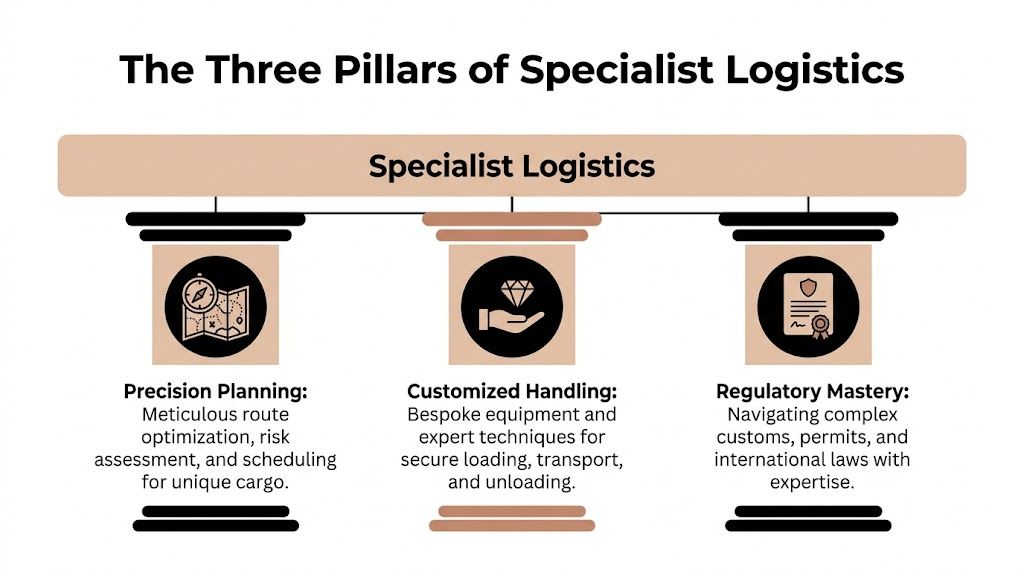
The Three Pillars of Specialist Logistics
Specialist vehicle logistics works when three things line up. The asset, the equipment, and the expertise all have to fit the same plan. If one pillar is weak, the shipment becomes harder to control.
The scale of the market explains why this distinction matters. In 2024, the UK's finished vehicle road transport segment moved 1.8 million vehicles domestically, representing 22% of total UK freight tonnage by value, with a 9.5% year-on-year increase from 2023, according to Fortune Business Insights on the UK automotive logistics market. High-value cargo attracts attention. It also punishes shortcuts.
The asset decides the rules
A concours car, an electric prototype, a terminal tractor, and a self-propelled sprayer may all be called vehicles. Operationally, they behave like completely different cargo classes.
A classic vehicle may need enclosed movement, soft contact points, and strict inspection on trim and paint. A prototype may need confidentiality controls and limits on who can access telematics or battery systems. A machine used in agriculture may need cleaning records and closer attention to regulated border checks if contamination or associated goods are involved.
The first practical question isn't “what's the cheapest mode?” It’s “what can this asset safely tolerate?”
Equipment has to match risk, not habit
The right equipment reduces handling risk before the vehicle ever moves.
That may mean a low-loader for height control, an enclosed transporter for security and weather protection, custom cribbing for unusual wheelbases, or a crane and spreader arrangement for non-running units. Good operators also think about what happens at transfer points. A perfect main leg can still fail if the depot has the wrong ramp geometry or the delivery site can't receive the vehicle safely.
A useful test is whether the provider can explain, in plain language, how they will load and secure your exact unit. If the answer sounds generic, the plan probably is.
| Pillar | What to verify | What goes wrong when ignored |
|---|---|---|
| Asset | Condition, dimensions, drivability, sensitivity, regulatory status | Wrong mode, wrong handling, avoidable damage |
| Equipment | Trailer type, ramps, lifting gear, securement points, depot capability | Unsafe loading, movement in transit, failed delivery |
| Expertise | Route planning, customs skill, inspection discipline, communication | Delays, holds, disputes, poor recovery when things change |
Expertise is the multiplier
Experience matters most when something doesn't go to plan.
Specialist teams know when to reject a loading angle, when to split a multimodal move, when to hold departure because the customs file isn't clean, and when a delivery site needs an alternative vehicle for final access. They also know that model-specific quirks matter. Some vehicles can't be strapped the same way as others. Some machines arrive with attachments that change the centre of gravity. Some EVs require handling steps that a general carrier won't think to ask about.
The strongest specialist operators don't just move vehicles. They remove decision risk for the shipper.
That’s the core framework. The asset sets the constraints. The equipment makes safe execution possible. The expertise keeps the whole chain aligned under pressure.
Choosing Your Transport Mode and Ensuring Securement
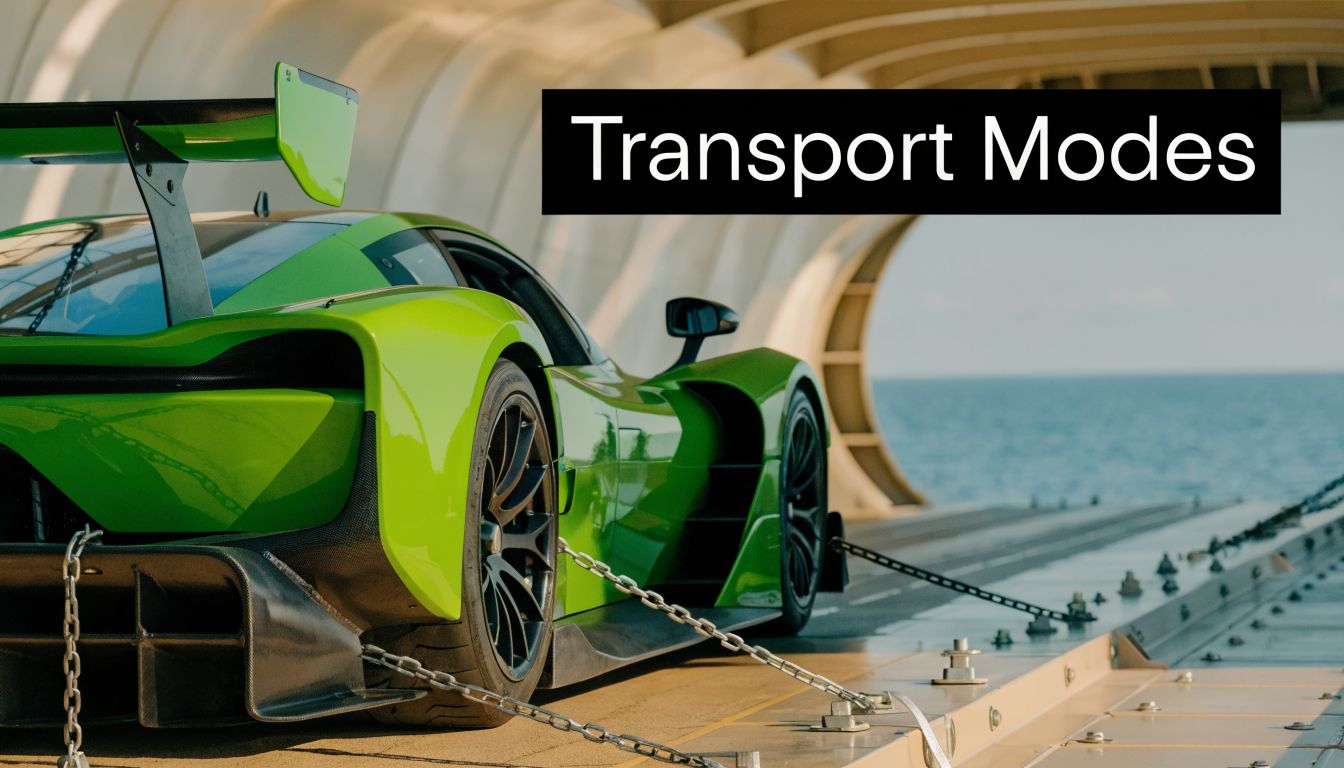
Mode selection isn't just about transit time. It's about whether the vehicle can be moved, protected, inspected, and received without introducing new risk.
For drivable finished vehicles, the UK port network gives RoRo a natural advantage. As noted earlier, UK ports handled large RoRo volumes, which is why the method remains central for many vehicle flows. If you're comparing that option in more detail, this guide to roll-on roll-off shipping is a useful starting point.
RoRo, LoLo, container, or air
Each mode solves a different problem. Trouble starts when shippers choose by habit instead of operational fit.
RoRo for operationally sound drivable units
RoRo works best when the vehicle can be driven safely, the dimensions fit the service, and the port process suits the schedule. It usually simplifies port handling because the unit moves on its own wheels. For finished vehicles, fleet movements, and some plant with compliant dimensions, it's often the cleanest sea option.
Its weaknesses are just as clear. RoRo offers less discretion than enclosed inland transport, and it may not suit non-running units, highly sensitive prototypes, or cargo that needs sealed handling.
LoLo for static, oversized, or awkward units
Lift-on/lift-off is often the better call when the vehicle can't be driven, has unusual geometry, or travels with attachments and ancillary equipment. The lifting plan matters here. Sling angles, lifting points, weight distribution, and landing surface all need review before the job reaches the quay.
A poor handover between forwarder, crane team, and haulier creates damage. The paperwork can be perfect and the lift can still be wrong.
Containerisation for control and discretion
A container can be the right answer when the move needs tighter security, less visibility, or controlled packing with parts and accessories. It also helps when the shipment benefits from a sealed unit through multiple handovers.
Container moves demand disciplined packing. A vehicle inside a box isn't automatically safe. The restraint design, wheel chocks, deck friction, axle loads, and internal clearance all need proper planning.
Air freight for schedule-critical movements
Air is the premium option for prototypes, launch vehicles, motorsport support, and urgent replacement units. It buys speed, but only if the inland legs, handling windows, and export paperwork are ready at the same standard.
Air also magnifies preparation errors. If the documents or handling instructions are weak, expensive capacity doesn't solve the problem.
Securement is where specialists separate themselves
The same strap pattern shouldn't be used for every vehicle.
A low-clearance sports car typically needs careful approach angles, wheel-based restraint, and close attention to spoilers, splitters, and underbody panels. A tractor or heavy machine may require a different restraint strategy because of tyre profile, suspension behaviour, articulation points, or attachments that alter movement during transit.
Ask direct questions before you book:
- How will you load it if the vehicle is non-running, low, wide, or sensitive underneath?
- What exactly touches the vehicle during loading and restraint?
- Do you secure by wheel, axle, or chassis, and why is that right for this unit?
- What happens at transhipment points such as ports, depots, and final-mile transfer locations?
- Who signs the condition report at each handover?
If a provider can't describe the securement method in vehicle-specific terms, they haven't planned the move properly.
A useful visual overview of loading environments and handling pressure points is below.
A practical mode selection check
Use this quick comparison before committing:
| Mode | Best fit | Main strength | Main trade-off |
|---|---|---|---|
| RoRo | Drivable vehicles in regular port flows | Efficient port handling | Less suited to highly sensitive or non-running units |
| LoLo | Heavy, static, oversized, or awkward cargo | Flexibility for difficult units | Lift planning becomes critical |
| Container | High-value, discreet, or accessory-heavy moves | Better control through handovers | Packing and internal restraint must be precise |
| Air | Time-critical prototypes or urgent replacements | Fastest long-haul option | High cost and low tolerance for prep errors |
The wrong mode usually looks cheaper only at booking stage. The right mode costs what the risk profile requires.
Mastering Customs and Regulatory Compliance
Most failed specialist moves don't fail on the road. They fail in the file.
A vehicle can be loaded correctly, secured properly, and routed sensibly, then lose days because the customs data doesn't align, the supporting paperwork is incomplete, or the border process wasn't matched to the cargo's regulatory profile. That’s especially true on EU-UK lanes after Brexit, where specialist vehicles can sit inside broader flows involving regulated goods, used machinery, parts, or equipment that attracts additional scrutiny.
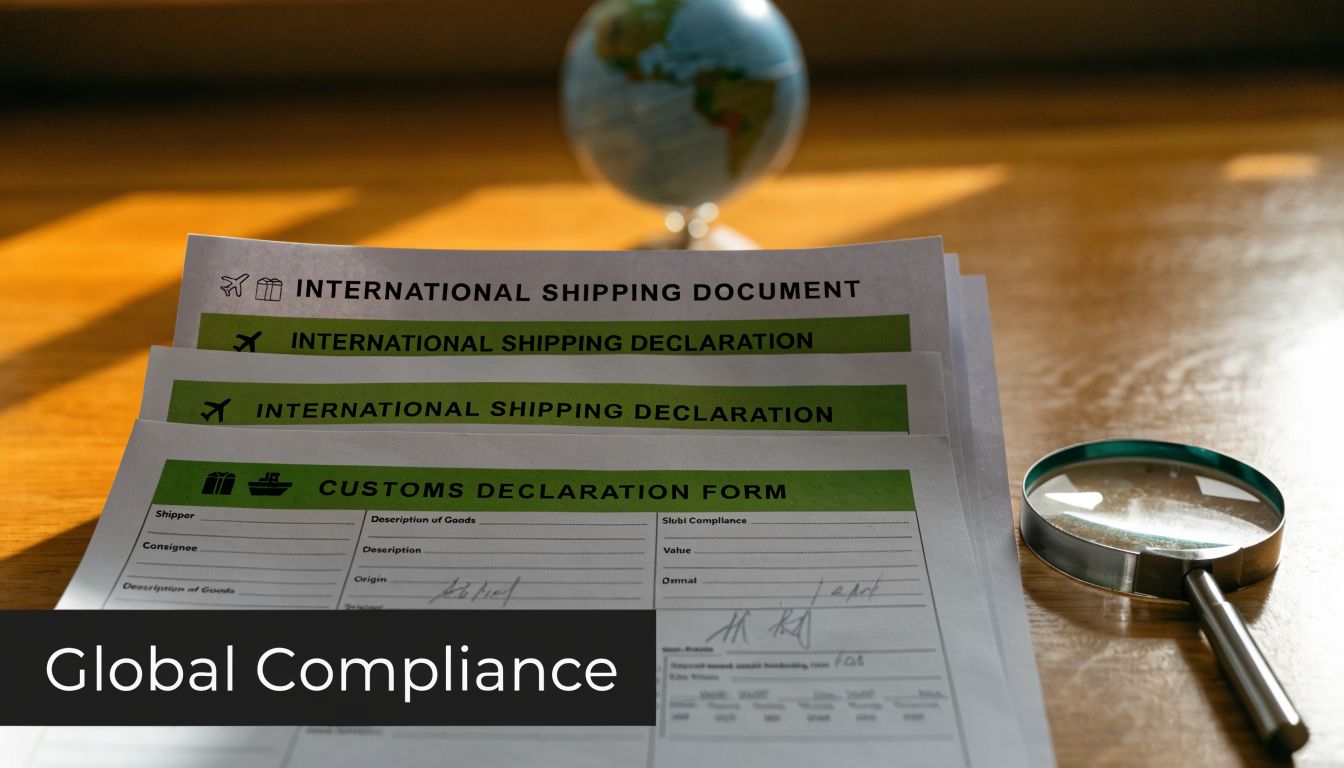
According to analysis covering post-Brexit vehicle and regulated goods delays, UK importers face average customs clearance delays of 2 to 5 days for specialist vehicles carrying regulated goods. The same source notes 15 to 20% higher spoilage rates in associated perishable shipments, that 28% of agri-food consignments required additional checks, and that integrated logistics partners can reduce delays by up to 40% when clearance is better coordinated.
What catches shippers out most often
The recurring issue isn't just missing paperwork. It's paperwork prepared by people who don't understand how the vehicle is moving.
A prototype entering temporarily doesn't need the same customs treatment as a sold production vehicle. A used agricultural machine may need extra attention because cleanliness, prior use, and associated regulated materials can affect inspection exposure. A non-running machine moving with attachments may require more precise commodity description and document alignment than a standard finished car shipment.
The biggest avoidable errors usually fall into four groups:
- Identity errors where VIN, serial number, model, or description differs across transport, customs, and commercial documents.
- Purpose-of-move errors where temporary admission, return, testing, exhibition, or sale status is not declared consistently.
- Timing errors where the vehicle arrives before declarations, supporting records, or inspection bookings are ready.
- Responsibility gaps where nobody clearly owns the customs file once the shipment changes mode or crosses from road to port operations.
A practical EU-UK checklist
For specialist vehicle logistics, compliance discipline starts before collection.
1. Build the document set around the actual movement
Start with the commercial reality. Is the vehicle sold, on test, returning after use, moving for exhibition, or entering for repair? That answer drives the customs structure and supporting records.
Match these core details across every document:
- Vehicle identity including VIN or serial references
- Accurate goods description that reflects the actual asset and its condition
- Declared movement purpose
- Origin and destination details
- Responsible parties for export, import, and customs representation
2. Check whether the vehicle is carrying a regulatory complication
This is common with specialist machinery and mixed consignments. Used equipment may trigger inspection attention because of contamination risk. Accessories, fluids, packaging, and associated regulated goods can pull a vehicle shipment into a more complex border process than the shipper expected.
If BTOM-related checks may apply, don't treat them as a port-side surprise. Build them into the transit plan.
3. Align customs with the transport sequence
Multimodal moves fail when the border plan assumes a direct move, but the transport plan includes cross-docking, port storage, or inland transfer. Every handover point creates another chance for the shipment to get ahead of the file.
Clearance should be planned to the handover sequence, not just to the vessel or truck departure.
4. Decide who controls exceptions
Border issues don't resolve themselves. Someone has to own inspection communication, data correction, and release follow-up. If that responsibility is spread across too many parties, delays stretch.
Prototypes, exhibits, and regulated machinery
These categories deserve extra caution.
Prototypes and exhibition vehicles often need tighter confidentiality, cleaner purpose-of-entry documentation, and stricter control over inspection exposure. Regulated machinery requires realistic planning around cleaning, prior use evidence, and border checks tied to contamination or associated goods.
A practical discipline that works is to hold an internal pre-clearance review before dispatch. Confirm the identity data, movement purpose, document pack, and who answers customs queries once the shipment is live. That review takes less time than recovering a border hold.
Analysing Costs Insurance and Liability
The freight quote is only the visible part of the cost. Specialist vehicle logistics is priced by risk, handling complexity, and exposure across the whole move.
Distance matters, but so do dimensions, weight, drivability, route restrictions, urgency, port handling requirements, permit needs, storage risk, and the number of times the vehicle changes hands. A non-runner usually costs more to move than a drivable unit because the handling plan is more demanding. A discreet move for a prototype may require controls that don't appear on a standard rate sheet. A remote delivery site can turn a simple linehaul into a staged operation with transfer equipment.
What usually pushes the invoice up
The hidden costs aren't really hidden. They're just often left out of the first conversation.
A realistic specialist logistics budget should account for:
- Handling complexity such as winching, craning, skates, enclosed equipment, or custom loading measures
- Route constraints including escort requirements, permits, restricted access, or non-standard final delivery conditions
- Border administration where customs work, inspections, storage, and clearance intervention add cost beyond transport
- Time sensitivity because urgent bookings reduce flexibility and narrow the routing options
- Dwell and recovery risk if the vehicle is delayed at port, depot, or border and needs monitored storage or rescheduling
Carrier liability is not the same as full protection
This is the point many buyers get wrong.
Carrier liability is usually limited by contract and legal framework. It is not the same thing as cover for the full value of a specialist vehicle. If the unit is rare, restored, modified, or commercially sensitive, standard liability often won't reflect the full financial exposure.
All-risk cargo insurance is a different discussion. It should be checked against the actual journey and the actual asset. That means declared value, named movement type, loading and unloading exposure, transhipment points, storage periods, and any exclusions tied to prototypes, used machinery, batteries, accessories, or unattended periods.
For a broader explanation of the distinction, this guide on cargo insurance and what it actually covers is worth reading before you sign off a move.
Don't ask only whether the shipment is insured. Ask what event is covered, on what valuation basis, and during which stage of the journey.
Questions finance and operations should ask together
Insurance decisions are better when operations and finance review them together rather than in sequence.
Use a short control list:
- What is the declared value basis for this specific vehicle?
- Does cover apply door to door, including loading, storage, and transfers?
- Are accessories, attachments, and loose parts included or treated separately?
- What are the exclusions for non-running units, prototypes, used machinery, or high-value classics?
- Who carries the claims burden if damage appears at delivery and multiple handlers were involved?
The cheapest quote often assumes the shipper will absorb more risk. That's not a saving. It's just deferred cost.
Advanced Strategies for Modern Shippers
The most resilient shippers no longer treat specialist vehicle logistics as a sequence of isolated bookings. They run it as a controlled network across road, port, depot, customs, and final delivery.
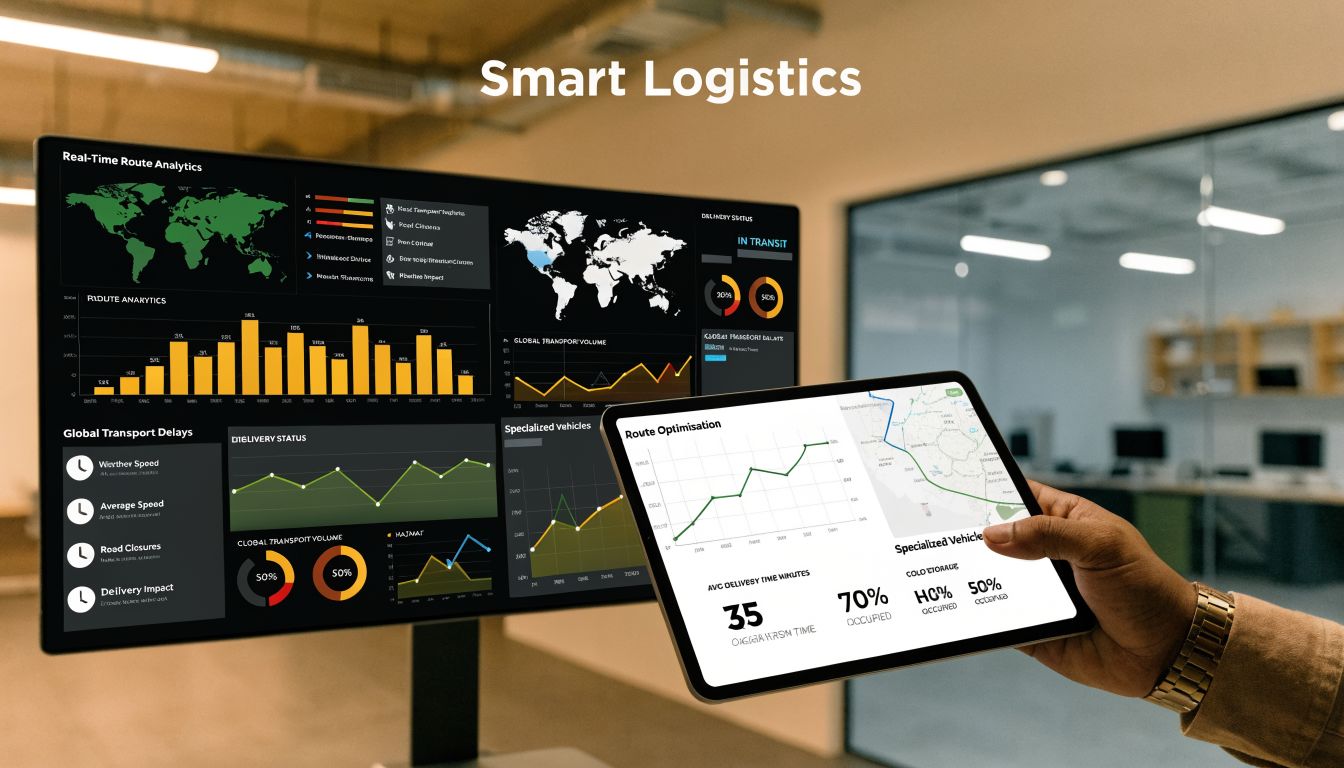
That shift matters because disruption is no longer occasional background noise. According to Automotive Logistics trend coverage on AI, disruption, and low-carbon routes, UK vehicle logistics providers reported a 25% rise in disruptions in 2025, while AI adoption for risk management sat at only 12% among SMEs. The same analysis cites government data from Q1 2026 showing pilot low-carbon multimodal routes cutting emissions by 18%, with 15 to 20% cost savings possible in EU-UK lanes through smarter supplier collaboration.
Multimodal works when one party owns the plan
Road, sea, and air each solve different parts of the problem. The gain comes from combining them deliberately, not from adding extra legs.
A practical multimodal design does three things well:
- Uses road for controlled collection and final delivery where timing, securement, and site access need close management
- Uses sea for cost-efficient trunk movement when the vehicle's handling profile suits port operations
- Uses air selectively for recovery, prototypes, launch support, or schedule-critical replacement units
The key is unified control. If each leg is optimised separately, the whole move usually isn't. Border timing, storage exposure, and transfer risk start to drift. That's why many shippers are reassessing intermodal transport and when it pays off instead of relying on single-mode habits.
Telematics and tracking should drive decisions
Real-time visibility isn't valuable because it looks modern. It's valuable because it lets operators act before a delay turns into a failed delivery or customs problem.
For specialist vehicles, the most useful tracking setup isn't just a map pin. It combines location, event milestones, route deviation alerts, dwell monitoring, and exception handling. If a truck misses a port slot, if a border file isn't released, or if a transfer site overruns its handling window, the control team needs that signal early enough to intervene.
Good telematics also strengthens claims handling and proof-of-process. Time-stamped events, condition images, and handover records make disputes easier to resolve.
Smart tracking is only useful if someone is assigned to act on the alerts.
Where AI helps and where it doesn't
AI isn't a substitute for an experienced operator. It is useful for pattern recognition, disruption forecasting, ETA refinement, and route comparison when the data quality is good.
It helps less when the shipment itself hasn't been defined properly. If dimensions are wrong, the customs status is unclear, or the loading constraints were never captured, no prediction engine will rescue the move. Technology works best after the operational basics are already disciplined.
A sensible modern setup combines:
| Tool | Best use in specialist moves |
|---|---|
| Telematics | Tracking location, dwell, route deviation, and handovers |
| Predictive ETA tools | Flagging likely delays before they hit delivery commitments |
| Digital document workflows | Keeping customs and transport records aligned across parties |
| Exception dashboards | Giving operations one place to manage late, held, or re-routed units |
Climate-smart planning also belongs in the same conversation. Lower-emission routing only works when it preserves handling quality and border reliability. In specialist vehicle logistics, sustainability has to survive contact with reality.
How to Select the Right Logistics Partner
Buying specialist vehicle logistics on price alone is how companies end up paying twice. The first payment is the freight invoice. The second is the cost of delay, damage, rework, customer friction, or a border problem nobody owns.
A suitable logistics partner should be able to explain your move in operational detail before collection. Not in sales language. In actual execution terms. How the unit will load, where it may pause, who handles the customs file, what happens if the vehicle is non-running, and how exceptions are managed at night or at the weekend.
A practical scorecard for partner selection
Use a capability test, not a branding test.
Experience with your vehicle class
A provider may be excellent with finished cars and poor with prototypes, machinery, or high-value classics. Ask what similar units they handle, what loading method they propose, and what the common failure points are for your vehicle type.
Control of customs and documentation
For EU-UK and intercontinental shipments, outsourced paperwork can become a weak link. You want a partner that can manage document flow, answer customs queries quickly, and keep transport and clearance aligned.
Access to the right equipment
Don't stop at “yes, we can move it”. Ask which trailer, which restraint system, what loading equipment, and what fallback plan applies if the first collection method doesn't work.
Visibility and communication discipline
A specialist move should have milestone-based updates, not vague reassurance. You need condition capture, handover records, and a named escalation path when timings slip.
Insurance clarity
A credible operator won't blur the line between liability and insurance. They should tell you what they carry, what they don't, and what you need to arrange separately if the asset value is high or unusual.
Questions worth asking before award
These questions cut through polished presentations fast:
- What is your exact loading plan for this vehicle?
- Who manages customs exceptions if the file is queried after departure?
- What proof of condition do you collect at pickup, transfer, and delivery?
- What happens if the delivery site rejects the vehicle or can't receive the transport unit?
- What risks are excluded from your standard cover?
The right partner reduces uncertainty before the vehicle moves, not after something has gone wrong.
That’s the standard that matters. In specialist vehicle logistics, competence is visible in the questions a provider asks before they give you confidence.
Turning Logistical Complexity into Your Advantage
Specialist vehicle logistics looks complicated because it is. The vehicles are different, the handling is less forgiving, and the border requirements are stricter when the move involves regulated goods, prototypes, machinery, or high-value assets.
But complexity isn't the problem. Uncontrolled complexity is.
The shipments that run well usually share the same traits. The vehicle is defined accurately. The mode matches the handling risk. Securement is planned at unit level. Customs is aligned with the actual handover sequence. Insurance reflects the actual exposure. Someone owns exceptions before they become failures.
That turns logistics from a source of delay into a source of control. Importers protect delivery commitments. Manufacturers protect launch timing and asset condition. Cross-border operators reduce the disruption that comes from paperwork gaps and fragmented handovers.
Handled properly, specialist vehicle logistics doesn't just move an awkward asset from A to B. It protects margin, reputation, and schedule at the same time.
If you're moving high-value, oversized, regulated, or time-critical vehicles across Europe, Asia, or the United States, Multica Group can help you build a practical multimodal solution around the specific constraints of your shipment. From road, sea, and air coordination to in-house customs clearance, documentation support, veterinary inspection handling, warehousing, cross-docking, and live telematics visibility, Multica Group is set up for the kind of specialist moves where generic freight processes fall short.