You have a supplier in China who can make the product at the right price. Samples look good. Margins look workable. Then the shipment itself starts to raise harder questions than the sourcing did.
Should you move it by sea and save money, or use air and protect launch dates? Do you need a full container or a shared load? Which documents matter most at the UK border? And after Brexit, what exactly can go wrong if the customs entry is wrong?
Those are the questions that decide whether shipping china to uk becomes a repeatable supply chain or a series of expensive surprises. The movement from factory to UK warehouse is not just a transport task. It is a chain of commercial decisions about routing, timing, documentation, tax exposure, and risk.
Your Guide to Importing from China to the UK
A first major import usually starts with optimism and then hits operational reality. The factory says the cargo will be ready next week. Your sales team wants delivery dates. Finance wants a landed cost. Your warehouse wants notice before anything turns up. Customs wants documents that match exactly.
That pressure is normal. The China to UK lane is large, active, and commercially important. Bilateral trade between China and the UK peaked at approximately £98.3 billion in 2024, according to this UK trade lane overview. The volume creates opportunity, but it also creates congestion, price swings, and more scrutiny around compliance.
For a new importer, the practical challenge is rarely one single issue. It is the combination of issues arriving at once:
- Transport choice: Sea, air, and rail each solve a different problem.
- Cost control: The freight quote is only one part of your landed cost.
- Customs accuracy: A small mistake in classification or importer details can stop a shipment.
- Operational timing: Stockouts and late launches often start with poor planning at origin.
A good shipment plan is not the cheapest route on paper. It is the route that arrives with the right documents, at the right time, with a landed cost you expected.
The importers who do this well treat freight as a strategic function. They choose the mode around business needs, not habit. They prepare customs early, not after departure. They keep options open so they can switch between sea, rail, and air when market conditions change.
Choosing Your Shipping Method Sea Air and Rail
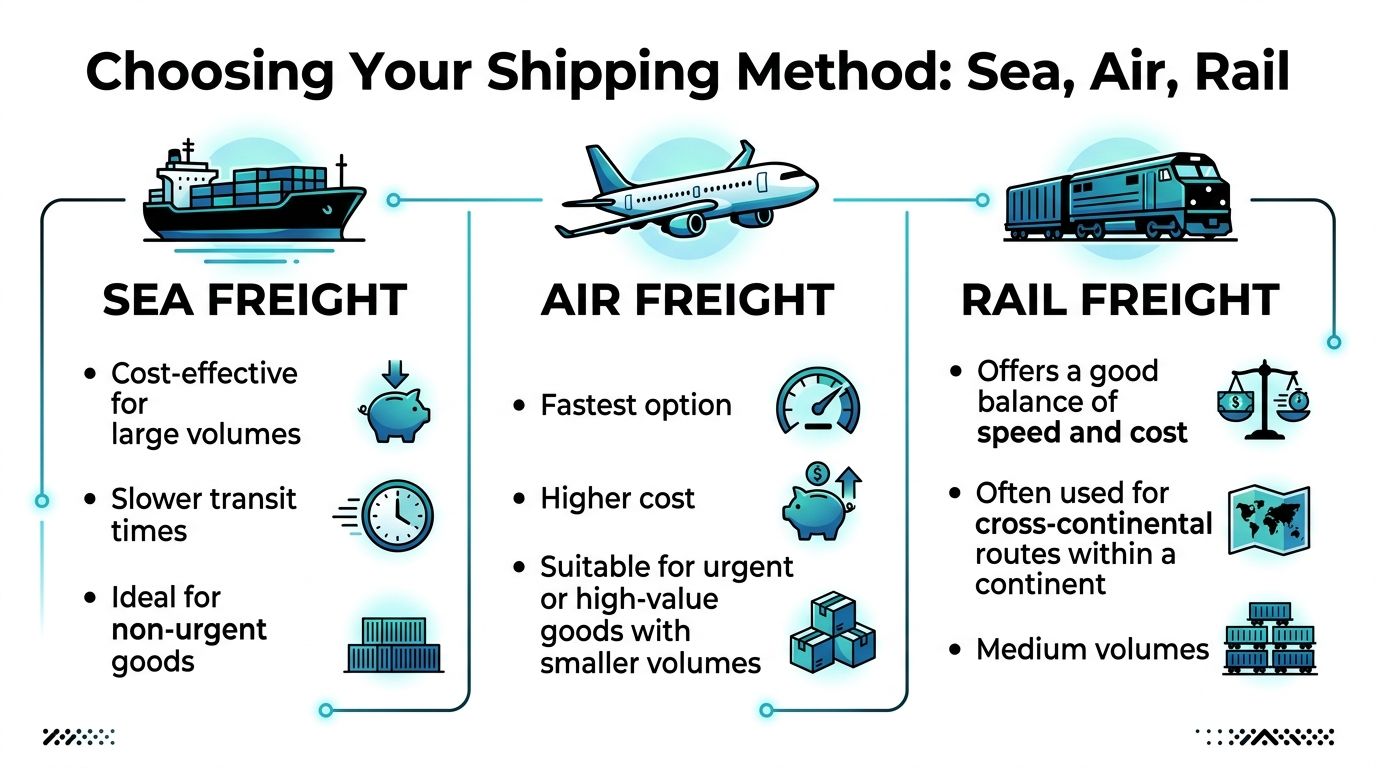
The fastest way to overspend on shipping china to uk is to choose a mode before defining the business priority. Some shipments need the lowest transport cost. Some need the shortest lead time. Some need a mixed plan because the order contains both launch-critical stock and replenishment stock.
Sea freight for volume and cost control
Sea freight remains the default choice for bulk cargo and routine stock replenishment. It usually gives the best unit economics when the goods are not urgent.
According to Sino Shipping’s China to UK lane guide, in April 2026 20GP container rates ranged from $1,769 to $2,162, and typical port-to-port sea transit times ran from 25 to 40 days. That range matters. It means timing and routing assumptions need buffer, especially if your sales plan has tight deadlines.
Sea freight works best when:
- You are moving larger volumes: The more space you use, the easier it is to justify sea.
- Your products are not time-critical: Furniture, consumer goods, components, and replenishment stock often fit this profile.
- You can forecast demand: Sea rewards importers who plan purchase orders earlier.
There are two common sea structures.
FCL, or full container load, usually makes sense when you have enough cargo to use most of the container. It reduces handling points because your goods are loaded, sealed, and moved as one shipment.
LCL, or less than container load, is useful when your order is too small for a full container. You share space with other shippers. This lowers the entry cost for smaller orders, but it often adds extra handling, consolidation, and deconsolidation steps.
Air freight for urgency and launch protection
Air freight is the premium option. You use it when the shipment must move fast, when stockout risk is more expensive than freight, or when the cargo value supports the spend.
The same Sino Shipping guide states that air freight averages $7.70/kg in April 2026, with transit times of 2 to 9 days. That speed changes the planning conversation completely.
Air is usually the right tool when:
- A product launch date cannot move
- You need to replace delayed stock quickly
- The cargo is compact, higher value, or commercially urgent
- You want to split a shipment, moving the first tranche by air and the balance by sea
Express services sit inside this category as well, but they are not the same as standard air cargo. Express gives stronger door-to-door control for small consignments and documents. Standard air cargo is more suitable for structured commercial freight moving through airport handling and customs processes.
If a missed sales window costs more than the freight premium, air is not expensive. It is damage control.
Rail freight for a middle ground
Rail can be a strong compromise between sea and air. It is not the universal answer, but for the right cargo it offers a useful balance between speed and cost.
The Yiwu to London railway gives an 18-day station-to-station alternative, as noted in the same China to UK rail and sea overview. Door-to-door timing is longer once collection, terminal handling, customs, and final delivery are included, but rail still shortens lead time versus sea.
Rail tends to suit:
- Medium-urgency inventory
- Cargo that is too bulky for economical air freight
- Supply chains that need more resilience than a sea-only model
- Importers building a multimodal plan rather than relying on one route
A useful way to think about the three modes is this:
| Mode | Best for | Main trade-off | Typical role |
|---|---|---|---|
| Sea | Large, planned shipments | Slowest transit | Base stock and regular replenishment |
| Air | Urgent or high-value cargo | Highest cost | Launch stock, emergency top-ups |
| Rail | Medium urgency cargo | Route suitability varies | Buffer stock and flexible planning |
What works in practice
The strongest shipping plans rarely rely on one mode all year.
An importer might move the core order by sea, send launch units by air, and keep rail available when sea schedules become too stretched. That kind of design reduces the risk of tying your whole inventory position to one transit profile. If you want a deeper look at combining modes operationally, this overview of multimodality in practice is useful reading.
What does not work is choosing air because planning started too late, or choosing the cheapest sea option without thinking about customs cut-off times, inland delivery, or sales deadlines in the UK.
Calculating the True Cost of Your Shipment
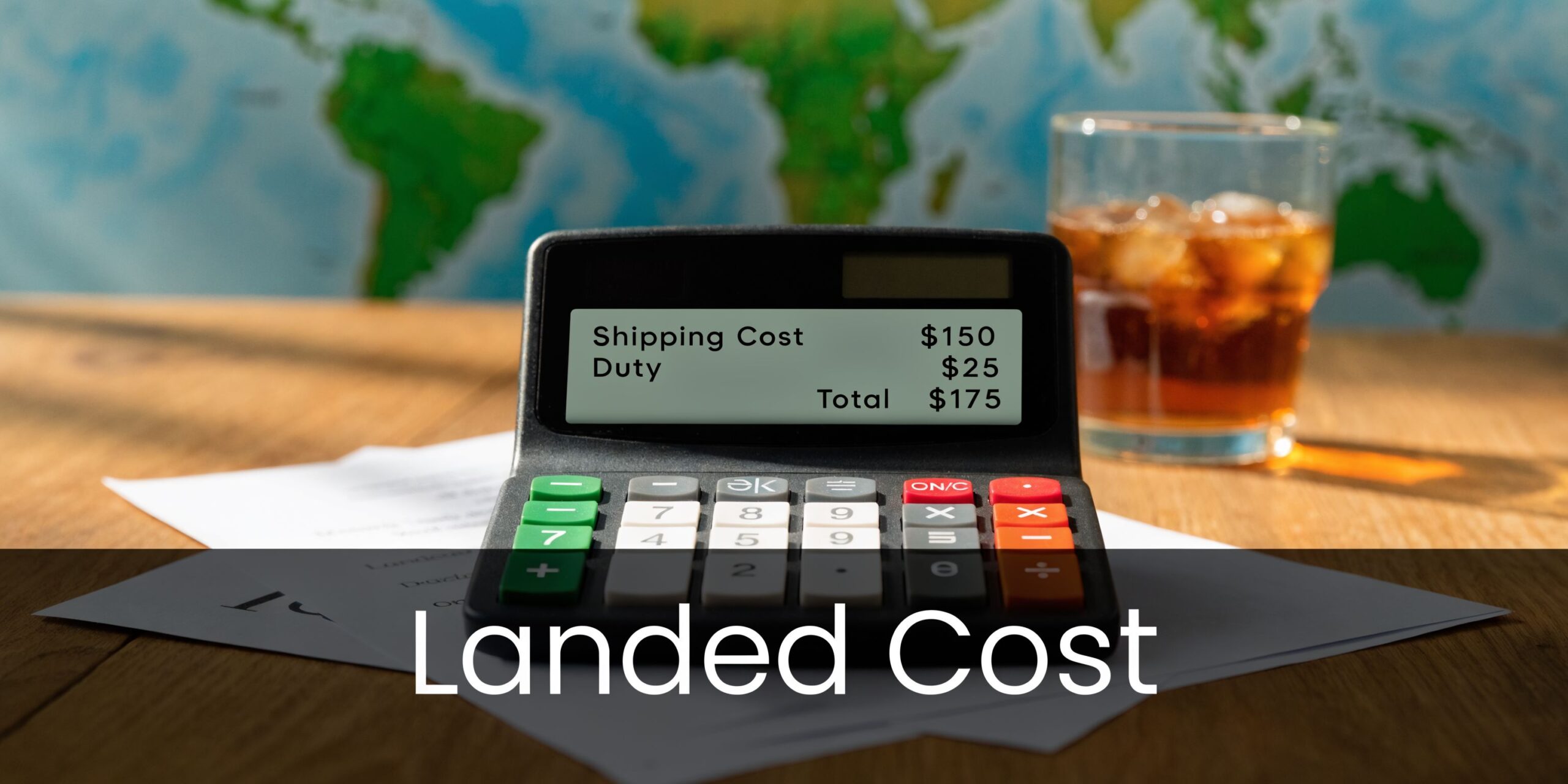
Many first-time importers ask for a freight rate when they need a landed cost model. Those are different things.
The freight rate tells you what it costs to move the cargo. Landed cost tells you what it costs to buy, move, clear, tax, receive, and place that cargo into sellable UK stock. If you miss that distinction, your margin can disappear after the goods have already shipped.
Start with the freight line, then keep going
Importers often focus on the quoted transport charge because it is the most visible figure. It is also only the beginning.
A realistic landed cost review should include:
- Supplier price: The product cost agreed with the factory.
- Origin charges: Collection, export handling, and origin documentation where applicable.
- Main freight: Sea, air, or rail movement.
- Destination charges: Port or airport handling, customs presentation, and delivery-related fees.
- Duties and VAT: These depend on product classification and UK import treatment.
- Customs clearance costs: The administrative cost of submitting the entry and supporting documents.
- Insurance: Especially important for higher value cargo.
- UK inland transport: Delivery from port, terminal, or airport to your warehouse.
Some of those costs are fixed enough to forecast. Others move with the market. That volatility is not theoretical. The China to UK trade lane has seen major cost swings. Bilateral trade reached about £98.3 billion in 2024, and the same market view notes that 40ft container rates surged from a pre-2020 average of $2,500 to over $18,000 in some instances, which is why meticulous cost planning matters on this lane.
The charges importers most often underestimate
The most common budgeting mistake is not one dramatic error. It is a series of smaller omissions.
VAT and duty timing
Even when the rates themselves are understood, the payment timing can strain cash flow. Import VAT and duties do not arrive as abstract accounting entries. They affect when cargo is released and how much working capital you need available.
Destination handling
Importers sometimes compare suppliers or forwarders using only the headline freight line. That can hide destination handling charges that only become visible near arrival.
Customs-related rework
If the commodity code, importer details, invoice values, or document set are inconsistent, the shipment can attract extra admin, storage risk, and delivery disruption. The direct fee is one problem. The delay to stock availability is often the bigger one.
A cheap freight quote can become the most expensive option if it arrives with weak visibility on destination charges and customs handling.
Build your landed cost before booking
For commercial shipments, a simple spreadsheet is enough if the logic is sound. Before you confirm transport, ask these questions in one place:
- What are the goods worth ex works or under the agreed Incoterm?
- Which charges sit at origin and which arrive at destination?
- Who is paying customs clearance fees?
- Have duty and VAT been estimated using the correct product classification?
- Do you need insurance included in the calculation?
- What is the cost of stock arriving late if you choose the slower mode?
That last point is where many landed cost models fail. They count transport cost but not commercial consequence. If sea saves money but causes a stockout, the lower freight bill may still be the wrong decision.
The most reliable importers review landed cost at SKU or order level, then compare it against the delivery window and sales risk. That keeps freight decisions tied to margin, not guesswork.
Navigating UK Customs Documentation and Compliance
Customs is where shipping china to uk stops being a transport job and becomes a compliance job. A container can be loaded correctly, routed correctly, and priced correctly, then still sit still because the importer number is wrong, the commodity code is wrong, or the documents do not match.
Many importers face costly delays at UK ports because of post-Brexit knowledge gaps, including incorrect EORI registration, misclassification under the UK Global Tariff, and failure to use real-time compliance tools, as described in this review of common China to UK customs problems.
The document set that must align
UK customs does not process cargo based on good intentions. It processes what is written and submitted. If the core documents tell different stories, clearance slows down.
The standard commercial set usually includes:
Commercial invoice
This is the financial and declarative backbone of the shipment. It identifies seller, buyer, goods, values, and trading terms.Packing list
This shows how the cargo is physically packed. Customs, warehouses, and delivery teams use it to check counts, weights, and packaging structure.Bill of lading or air waybill
This is the transport document. For sea freight it is usually a bill of lading. For air freight it is an air waybill.Import declaration data
The customs entry draws from the documents above, but it also depends on correct tariff treatment, importer details, and procedural choices.
EORI is basic, but mistakes still happen
A valid EORI number is fundamental for UK importing. Yet this is still one of the areas where businesses trip up, especially when they have traded into Europe before and assume the UK side will work the same way.
Post-Brexit, that assumption is dangerous. UK customs requirements are separate and need to be treated as such. If your EORI setup, importer identity, or representation structure is wrong, the shipment can stall before any debate even starts about duty rates.
What to check before cargo departs
A disciplined importer confirms these points before the goods leave origin:
- Importer identity matches the commercial transaction
- EORI details are valid for the UK process being used
- Commercial invoice describes the goods clearly
- Commodity classification has been reviewed
- The declared values and terms are internally consistent
- Any regulated goods have their extra paperwork ready
That final point matters more than many importers expect. Agri-food, pharmaceuticals, and certain electronics can trigger additional controls, certificates, or inspections. A shipment in a regulated category should never be treated like general cargo just because the transport mode looks standard.
Commodity codes decide more than duty
Classification errors do not just affect tax. They can alter the entire customs treatment of the shipment.
A wrong code can lead to:
- The wrong duty outcome
- Additional review by customs
- Problems with product-specific controls
- Arguments after arrival that could have been solved before departure
This is one reason Incoterms and customs strategy need to line up. If responsibility for transport, insurance, and import formalities is unclear, document quality often suffers. For a practical refresher, this guide to Incoterms 2020 and safer international trade is worth reviewing before you lock supplier terms.
Here is a useful visual explainer on the wider process before documents are finalised:
Real-time compliance is a strategic advantage
The importers who clear reliably do not treat customs as an afterthought handled the day before arrival. They build checks into the shipment timeline.
That means reviewing commercial data before booking, checking document drafts before departure, and watching for mismatch between supplier paperwork and customs entry data. Real-time compliance tools and active document control matter because they catch errors while they are still cheap to fix.
Customs delays often begin long before the vessel arrives. They start when someone accepts a vague invoice description, guesses the tariff code, or assumes the supplier’s paperwork is good enough without review.
What works is early validation. What does not work is trying to repair inconsistent documents while the cargo is already at a UK port and storage risk is building.
Protecting Your Cargo with Proper Packaging and Insurance
Cargo damage is rarely caused by one dramatic event. More often, it comes from preventable weaknesses. A carton softens after moisture exposure. A pallet shifts because it was not secured well enough. An inner pack was suitable for a local courier move but not for international freight with multiple handling points.
That is why packaging and insurance should be treated as part of shipment design, not as optional extras after the booking is confirmed.
Packaging must match the journey
Goods travelling from China to the UK may be packed at the factory, moved to a consolidation point, loaded into a container or aircraft handling system, unloaded at destination, presented for customs processes, and then delivered inland. Every transfer is a risk point.
For sea freight, packaging needs to cope with longer transit, container movement, stacking pressure, and moisture exposure. For air, the transit is shorter, but cargo still faces handling stress, palletisation, and transfer between facilities.
A practical packaging review should cover:
- Outer cartons: Strong enough for stacking and repeated handling.
- Internal protection: Inserts, cushioning, or separators that stop product movement.
- Pallet quality: Stable base, suitable dimensions, and secure wrapping.
- Moisture protection: Important for sea shipments and longer transit conditions.
- Labelling: Clear shipping marks, carton counts, and handling instructions.
If you are planning around container loading, this guide to the dimensions of a 20-foot container helps when checking how cartons, pallets, or mixed cargo will fit.
Insurance fills the gap that packaging cannot
Even well-packed cargo can still be lost, damaged, delayed in a way that creates claims exposure, or affected by handling incidents outside your control.
Some importers assume the carrier will cover everything. That assumption usually does not survive the first serious problem. Carrier liability is limited and rule-based. It is not a substitute for cargo insurance arranged around your commercial exposure.
What proper cover helps with
Insurance can support recovery when the shipment suffers:
- Physical damage in transit
- Loss of cartons or packages
- Handling incidents during loading or unloading
- Events where carrier liability is limited or disputed
The key is to review the policy wording, insured value basis, exclusions, and claims procedure before the shipment departs. Waiting until after damage appears is too late.
If the cargo matters enough to buy, it matters enough to insure properly.
What works and what does not
What works is straightforward. Match packaging to the route, handling profile, and product fragility. Confirm how pallets will be wrapped and secured. Protect against moisture where sea freight is involved. Arrange cargo insurance that reflects the full financial value of the goods.
What does not work is using domestic-grade packaging for an international move, relying on the supplier’s standard carton without checking it, or assuming that a forwarding document equals insurance cover.
The importer pays for weak preparation twice. First in damaged stock, then again in disrupted sales and claim disputes.
Your Step-by-Step Importer Timeline and Checklist
A smooth shipment does not happen because each party is competent in isolation. It happens because actions are sequenced properly. For shipping china to uk, the importer who manages timing well usually avoids the worst surprises even when the market is messy.
Use the timeline below as an operating checklist rather than a theory exercise.
Before production is complete
Stronger shipments are won or lost at this stage. If you wait until cargo is ready, several good options are already gone.
Confirm the trading terms
Make sure the agreed Incoterm is clear and written into the purchase arrangement. You need to know who controls origin collection, export handling, freight booking, insurance, and import formalities.
Review the product data
The description used by your supplier should be commercially accurate and specific enough for customs. Generic wording creates trouble later.
Check importer readiness
Your UK import setup, EORI details, and customs process should be in place before departure planning begins.
Decide the shipment split
If the order has mixed urgency, divide it now. Move urgent units by air or rail and routine stock by sea where appropriate.
When the goods are nearly ready
At this stage, transport and paperwork need to move in parallel.
Booking phase checklist
- Choose the mode deliberately: Sea for planned volume, air for urgency, rail for middle-ground timing.
- Confirm collection details: Factory address, loading date, contact names, and cargo readiness.
- Approve the packaging plan: Especially for fragile, moisture-sensitive, or palletised cargo.
- Request draft documents early: Do not wait until the cargo has departed.
- Review destination delivery needs: Warehouse booking slots, unloading requirements, and receipt procedures.
This is also the right point to finalise your landed cost assumptions. If the shipment mode changes, your working margin may change with it.
At departure
Departure is not the moment to stop paying attention. It is the moment to shift from setup to active control.
Check the final document set
The invoice, packing list, and transport document should align on goods description, quantities, and shipment structure.
Confirm milestones
Know the planned route, transfer points where relevant, and expected arrival window. With sea and rail, keep extra lead time in mind. With air, watch closely for any changes that affect customs preparation at destination.
The best time to fix a customs problem is before arrival data is submitted in the UK.
While the shipment is in transit
This phase is where disciplined importers prepare for arrival instead of merely tracking the cargo.
In-transit control points
Monitor movement updates
If routing changes or delays appear, assess whether warehouse, customer, or stock plans need adjustment.Prepare customs clearance
Do not wait for the vessel to berth or the aircraft to land. Ensure the entry data is ready in advance.Check for document mismatches
If a supplier revises paperwork after departure, make sure all parties are working from the same version.Coordinate final delivery
Port release does not equal warehouse delivery. Inland haulage and unloading arrangements must already be lined up.
On arrival in the UK
Arrival creates the highest concentration of operational pressure. Customs, release, payment, handling, and delivery all converge.
A practical arrival workflow looks like this:
| Stage | What needs to happen | Who should be ready |
|---|---|---|
| Customs entry | Documents and declaration submitted accurately | Importer and customs team |
| Charges settled | Duty, VAT, clearance, and destination costs handled as required | Importer or appointed agent |
| Cargo released | Port, terminal, or airline release completed | Forwarder and destination handling parties |
| Final delivery | Inland transport booked and warehouse ready to receive | Delivery team and consignee |
After delivery
This last part gets ignored too often, especially by first-time importers who feel relieved once the pallets arrive.
Do a short post-shipment review:
- Did the final cost match the budget?
- Were customs documents accepted without issue?
- Did the chosen mode suit the business need?
- Was the packaging sufficient?
- Should the next order use a different mix of sea, air, or rail?
That review is where a one-off import becomes a repeatable operating model. The importers who improve fastest are the ones who document what happened and adjust the next shipment before the same issue repeats.
Frequently Asked Questions About Shipping to the UK
Which Incoterm is usually better for a first-time importer, EXW or FOB
For many first-time importers, FOB is easier to manage than EXW because the supplier handles more of the origin-side process before the goods reach the port of export. EXW can work, but it gives you more responsibility earlier in the chain. The right choice depends on how much control you want and how capable your supplier is at origin.
Can I combine goods from multiple Chinese suppliers into one shipment
Yes, consolidation is often possible. It can be useful when several factories are producing smaller orders and you want one combined movement into the UK. The key is document discipline. Each supplier’s paperwork must still be accurate, and the consolidated shipment must be structured clearly for customs and destination handling.
What should I do if my shipment is held by UK customs
First, find out the exact reason for the hold. Customs delays are often linked to document mismatch, unclear goods descriptions, importer detail problems, or classification questions. Do not guess. Get the shipment record, identify the missing or disputed information, and respond with corrected documents or clarifications quickly.
Is sea freight always cheaper than air freight
For most bulk commercial cargo, sea is usually the lower-cost mode. But “cheaper” only holds if the timing works for your business. If sea creates a stockout, misses a launch, or forces emergency replenishment later, the lower freight line may not be the lower business cost.
When does rail make sense from China to the UK
Rail makes sense when sea is too slow and air is too expensive for the shipment profile. It can be a useful middle option for medium-urgency goods, especially when you want to shorten lead time without paying for full air freight.
Do I need cargo insurance if the goods are packed well
Yes. Good packaging reduces risk. It does not remove it. International cargo still faces handling incidents, loss, and damage scenarios that packaging alone cannot solve.
How early should I prepare customs paperwork
Earlier than most new importers think. Customs readiness should start before the goods leave origin. Waiting until arrival is one of the main reasons avoidable delays happen.
If you are moving goods between China and the UK and want a logistics partner that can coordinate multimodal transport, customs clearance, warehousing, and final delivery with real operational visibility, speak with Multica Group. They support businesses that need practical control across road, sea, air, and regulated trade flows.