Orders are coming in. Revenue looks healthy. Then the cracks show.
A customer wants to know why their parcel has been stuck for days. Your team is chasing a supplier for missing stock, the courier invoice is higher than expected, and a shipment that should have crossed the Channel cleanly is waiting on paperwork. If you sell online in the UK, that combination is no longer unusual. It's the operating environment.
Supply chain management for e-commerce used to mean keeping enough stock on hand and shipping quickly. It now includes customs decisions, warehouse process design, transport mode selection, returns control, and visibility across every handoff. The brands that treat logistics as a strategic function cope far better than the ones that treat it as a back-office task.
The New Reality of E-commerce Logistics
The pressure on e-commerce supply chains isn't coming from one direction. Demand has grown, customer expectations have hardened, and cross-border trade has become more procedural and less forgiving.
In the UK, online retail sales reached £118.9 billion in 2023 and accounted for 27.8% of total retail sales according to Statista's UK e-commerce logistics overview. The same source notes that customs delays post-Brexit increased lead times by up to 25%, and 68% of UK e-commerce firms have had to rethink their supply chains.
That combination matters. More volume exposes weak operations faster. More border friction punishes casual planning.
Growth has made hidden inefficiencies visible
A small delay in replenishment used to be recoverable. Now it can trigger a chain reaction:
- Late inbound stock means overselling on your storefront
- Overselling creates split shipments or refunds
- Split shipments raise fulfilment and carrier costs
- Refunds and delays drive support tickets and erode trust
Most brands don't fail because of one dramatic logistics event. They lose margin through repeated operational leakage.
Practical rule: If your customer service team is constantly answering delivery and stock questions, your supply chain design is already speaking for your brand.
Post-Brexit trade changed the job
For UK sellers moving goods from or into the EU, process discipline now matters far more than it used to. Commodity codes, invoices, declarations, origin details, and product-specific checks all affect whether goods move cleanly or stall.
This is especially important for sellers handling regulated categories, mixed-SKU consignments, or any product that needs extra scrutiny at the border. In those cases, speed doesn't come from pushing carriers harder. It comes from getting the data, documents, and routing right before goods move.
The practical answer isn't to simplify the market reality away. It's to build an operating model that can handle it. That means knowing where inventory should sit, which transport modes suit which products, when to use specialist customs support, and which metrics reveal risk before customers feel it.
The Five Pillars of Your E-commerce Supply Chain
A useful way to think about supply chain management for e-commerce is to follow one product from supplier to shopper, then back again if it gets returned. That journey passes through five connected pillars. If one breaks, the others absorb the damage.
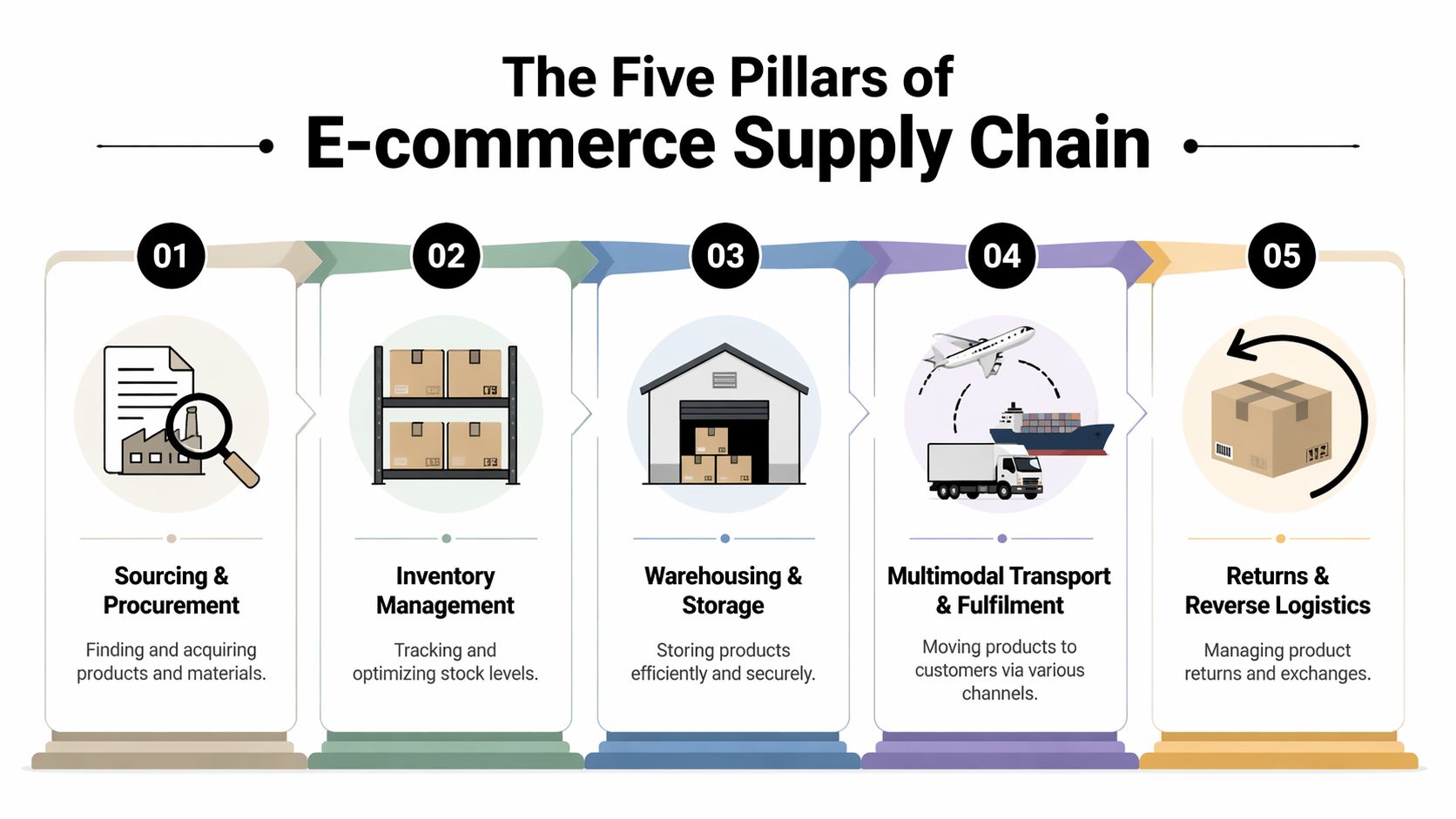
Sourcing and procurement
Everything starts with who supplies you, under what terms, and with how much reliability. Procurement isn't only about unit cost. It includes lead time stability, documentation quality, packaging suitability, minimum order quantities, and the supplier's ability to cope with demand changes.
A cheap supplier becomes expensive when shipments arrive incomplete, labels are wrong, or export paperwork is inconsistent. For cross-border trade, procurement teams also need to ask operational questions early:
- Can the supplier produce the documents your customs process needs
- Are product descriptions detailed enough for declarations
- Does the packaging protect the goods through multiple handling points
- Can the origin point support your preferred transport mode
The wrong answers create problems much later, when the cost of fixing them is higher.
Inventory management
Inventory is where commercial planning meets physical reality. You need enough stock to maintain service, but not so much that cash disappears into slow-moving SKUs.
The aim isn't just “more stock” or “leaner stock”. It's the right stock, in the right location, with clear reorder logic. Fast lines, seasonal lines, promotional lines, and long-tail products shouldn't all be managed the same way.
Some businesses still run this with spreadsheets and manual judgement. That can work for a while. It usually breaks during product expansion, channel growth, or supplier disruption.
Inventory decisions should be tied to supplier reliability and customer promise. A reorder rule that ignores either one is incomplete.
Warehousing and storage
Warehousing is not passive storage. It's the control point where goods are received, checked, stored, picked, packed, labelled, and dispatched.
A well-run warehouse supports speed and accuracy. A poorly run one hides stock, extends pick paths, creates avoidable errors, and slows every downstream process. Slotting, bin discipline, barcode use, receiving standards, and exception handling all matter more than many retailers expect.
For growing brands, warehouse design often lags order growth. They keep the same layout, the same pick logic, and the same manual workarounds long after order volume has changed.
Multimodal transport and fulfilment
Once an order is ready, execution shifts from storage to movement. This pillar includes carrier selection, route choice, parcel injection, pallet transport, customs handoff, and final delivery.
The key point is that not every order should move the same way. Some products suit parcel networks. Some are better consolidated into pallet flows. Some cross-border lanes work better with road and sea combinations than with expensive air options. Fulfilment is about matching service promise, product type, and margin to the right transport design.
Returns and reverse logistics
Returns are where many e-commerce supply chains reveal how disciplined they really are. A weak returns process traps stock, slows refunds, creates manual admin, and prevents resale.
A strong reverse logistics process answers five questions quickly:
- Where does the returned item go
- Who inspects it
- Can it be resold
- How is inventory updated
- What does the return reason tell you about upstream problems
Returns data often exposes issues that merchandising, warehouse, and transport teams miss. Repeated damage points to packaging or handling. Frequent “wrong item” complaints point to picking controls. High “not as expected” rates may point to product data, not logistics.
Optimising Inventory and Warehousing Operations
Most e-commerce operators discover inventory problems too late. They feel them as missed sales, urgent replenishment requests, excess storage, and a returns pile that seems to grow faster than it clears. By then, the issue isn't one bad stock decision. It's a system problem.
The benchmark is clear. Top-performing UK e-tailers maintain less than 5% out-of-stock incidence and achieve 98.7% inventory accuracy, while returns cost the sector £7.2 billion annually and leading 3PLs exceed 99.5% order-picking accuracy, according to Shipium's supply chain analytics summary. Those numbers show why basic stock control isn't enough.
Accuracy matters more than optimism
Many teams trust what the system says without checking whether the physical stock matches the record. That works until discrepancies build up across receiving, put-away, picking, and returns. Then planners start making decisions on false inventory.
Three practices improve control quickly:
- Cycle counting: Count selected stock regularly instead of waiting for a full annual stocktake. This catches drift earlier and causes less disruption.
- Location discipline: Every SKU needs a defined storage rule. If staff can place stock “where there's space”, inventory accuracy decays.
- Returns reconciliation: Returned goods must be inspected and booked correctly. If they sit in quarantine too long or go back into stock without checks, both accuracy and customer experience suffer.
Segment stock by behaviour
Not every SKU deserves the same policy. Fast movers should sit in the easiest pick faces. Volatile items need tighter reorder oversight. Slow movers may need reduced replenishment frequency or a different storage area.
A practical warehouse usually separates stock into groups such as:
| Stock type | Operational approach |
|---|---|
| Fast movers | Store near packing benches and replenish frequently |
| Seasonal lines | Build stock earlier and review exit plans before peak ends |
| Fragile items | Use protective packaging checks and controlled handling points |
| Long-tail SKUs | Store efficiently without giving them prime pick space |
That sounds simple, but many brands mix everything together and then wonder why pick times expand.
The warehouse should shorten decisions
A good warehouse doesn't just hold goods. It removes ambiguity. Staff should know how receipts are checked, where stock goes, how pick exceptions are escalated, and when cross-docking makes more sense than storage.
If your current setup is creaking, it's worth reviewing how specialist warehousing and distribution services handle receiving, storage, picking, and outbound coordination. The point isn't to outsource by default. It's to understand what disciplined process design looks like.
The cheapest warehouse layout is often the one you already have. It can also be the one that costs you the most every day in avoidable labour and errors.
What usually doesn't work
Operators often try to solve inventory issues with more rushing. They expedite inbound deliveries, ask pickers to double-check everything manually, and patch discrepancies case by case. That creates activity, not control.
What works better is boring, repeatable process:
- Clear SKU masters
- Consistent barcode use
- Routine cycle counts
- Defined receiving checks
- Structured returns handling
- Slotting reviews when volume patterns change
Inventory excellence isn't glamorous. It is measurable, procedural, and tightly linked to warehouse execution.
Mastering Multimodal Transport and Order Fulfilment
Transport decisions shape both margin and customer promise. Yet many e-commerce businesses choose a fulfilment model first and only later realise the transport layer doesn't support it. That's backwards.
You need two decisions working together. First, who fulfils the order. Second, how the goods move across each leg of the journey.
Choosing the right fulfilment model
Each model has a place. The mistake is treating one as universally better.
| Model | Works best when | Trade-off |
|---|---|---|
| In-house fulfilment | Order volume is manageable and control matters deeply | Management time rises fast as complexity grows |
| 3PL | You need operational scale, systems, and labour flexibility | You give up some direct control over daily execution |
| Dropshipping | You want to test products without holding stock | Visibility and service consistency depend on suppliers |
In-house fulfilment suits brands with a tight product range, unusual packaging requirements, or very specific customer experience standards. It becomes harder to sustain when SKU counts, channels, and geography expand.
A 3PL makes sense when the business needs predictable process and room to scale. Dropshipping can be useful for range expansion or low-risk testing, but it's weak where delivery control and inventory certainty matter.
Why multimodal often beats default air freight
Air looks attractive because it's straightforward to explain internally. Goods move quickly, and urgency feels like control. But many e-commerce lanes don't need maximum speed on every leg. They need dependable movement at a cost the margin can support.
For EU-UK lanes, road-sea multimodal can deliver 35% cost savings, but 18% of deliveries fail due to poor last-mile integration and visibility gaps, and 72% of London distributors cite those visibility gaps as a primary hurdle, according to The Fulfillment Lab's e-commerce supply chain analysis.
That tells you two things. Multimodal transport can be commercially smart. It also fails when handoffs aren't controlled.
The real problem is integration
A road leg, sea leg, depot handoff, and final-mile delivery can work well together. The trouble usually sits in the joins:
- Tracking data doesn't carry across systems
- Delivery windows aren't updated after delays
- Final-mile partners don't receive accurate instructions
- Customer service teams can't see the same status as operations
When those gaps exist, a cheaper transport plan turns into a service problem.
A practical multimodal setup needs shared visibility, clear milestone tracking, and a carrier or logistics partner that can coordinate mode changes without turning every exception into an email chain. For teams evaluating that model, this guide to combining road, rail and sea transport effectively is a useful reference point.
Speed without visibility creates stress. Slightly slower transport with controlled milestones is usually easier to manage and easier to sell to customers.
What works in practice
For most e-commerce operators, the strongest fulfilment design is mixed rather than pure. Keep premium or urgent orders on faster services. Move replenishment stock and less time-sensitive flows on more economical combinations. Reserve air for products that justify it, not as a default for weak planning.
That approach works especially well when you align three things:
- Customer promise at checkout
- Stock location and pick cut-off
- Transport mode by lane and product type
When those three are disconnected, fulfilment gets expensive fast. When they're aligned, the operation becomes much more stable.
Navigating Cross-Border E-commerce and Compliance
Cross-border trade isn't just a shipping challenge. It's a documentation and compliance discipline that happens to involve transport. Many e-commerce brands underestimate that until goods stop moving.
The post-Brexit reality is particularly sharp for goods moving between the UK and EU, and even more so for regulated or perishable products. UK e-commerce imports of agri-food faced 25% longer clearance times due to new veterinary checks, and 40% of small exporters reported stockouts from non-compliance. 62% of UK online retailers also lack integrated customs tech, according to Locus on e-commerce supply chain management.
Those aren't abstract compliance concerns. They affect whether stock is available to sell.
Border delays usually start before the lorry moves
Teams often blame customs when the root issue is incomplete or inconsistent shipment data. A declaration only moves as cleanly as the paperwork behind it.
At minimum, cross-border e-commerce operations need consistent control over:
- Product descriptions: Generic descriptions create problems. Customs needs clarity.
- Commodity codes: If classification is wrong, duty treatment and clearance can be wrong too.
- Commercial invoices: Values, origin, consignee details, and item information need to align.
- EORI and tax setup: Without the right registration and data, shipments can stall quickly.
- Product-specific requirements: Food, animal-origin products, and some regulated goods may require additional checks or inspection readiness.
Veterinary checks are a separate operational challenge
Perishable and agri-food consignments don't just need standard customs handling. They may also need veterinary or sanitary controls, depending on the product and route. That changes planning completely.
You need to know in advance:
| Compliance area | Why it matters operationally |
|---|---|
| Product classification | Determines what controls apply |
| Supporting certificates | Missing documents can stop release |
| Timing of border arrival | Regulated goods often need tighter coordination |
| Inspection readiness | Delays increase spoilage and stock risk |
| Clearance ownership | Someone must be responsible for document quality and handoff |
That responsibility can't sit vaguely “with the carrier”. Someone needs process ownership.
A provider with in-house customs clearance, documentation handling, and veterinary inspection support can reduce the number of disconnected handoffs. International freight forwarding services are often most useful here when they combine transport execution with compliance coordination rather than treating them as separate jobs.
For a closer look at the operational side of cross-border handling, this video gives helpful context.
Compliance can be a commercial advantage
Brands often treat customs as unavoidable friction. Well-run operators treat it as part of service design.
If your competitors regularly miss delivery windows because paperwork is weak or regulated goods aren't prepared correctly, a compliant and predictable process becomes a differentiator. It protects stock availability, improves planning confidence, and reduces the amount of time your team spends firefighting border issues.
The main shift is organisational. Compliance can't be left to the last hour before dispatch. It needs to be built into product setup, supplier onboarding, and transport planning from the start.
Cross-border reliability isn't created at the border. It's created upstream, when product data, documents, and responsibilities are set correctly.
The Technology and KPIs That Power Modern Supply Chains
Software won't rescue a broken process on its own, but a growing e-commerce operation can't run blind. The practical goal is a single operational picture across stock, orders, transport, and exceptions.
Three systems usually do the heavy lifting.
What each system actually does
A WMS controls warehouse activity. It manages receiving, locations, pick tasks, packing flow, and stock movements. If inventory accuracy is slipping, the warehouse process and the WMS setup are often the first places to look.
A TMS manages transport execution. It helps with route planning, carrier assignment, shipment milestones, and delivery tracking. For cross-border and multimodal flows, it becomes especially useful because handoffs need visibility.
An ERP ties the commercial and operational sides together. It holds product, order, finance, purchasing, and supplier data. If the ERP and operational systems don't align, teams start reconciling by spreadsheet, and that usually means errors are already creeping in.
Good KPI design prevents false confidence
Many dashboards contain too much activity and not enough signal. A practical KPI set should answer four questions:
- Are we shipping accurately
- Are we delivering when promised
- Are we carrying the right amount of stock
- How quickly does cash move through the operation
The table below gives a useful operating dashboard.
Essential e-commerce supply chain KPIs
| KPI | What It Measures | Industry Benchmark (2026) |
|---|---|---|
| Order accuracy rate | Whether customers receive the correct items in the correct quantities | Leading 3PLs exceed 99.5% order-picking accuracy |
| Inventory accuracy | How closely system stock matches physical stock | Top-performing UK e-tailers achieve 98.7% inventory accuracy |
| Out-of-stock incidence | How often customers face unavailable stock | Top-performing UK e-tailers stay below 5% |
| On-time delivery rate | Whether orders arrive within the promised delivery window | UK freight strategy targets 95% on-time e-commerce deliveries by 2025 |
| Returns cost exposure | The financial burden linked to returns across the sector | Returns cost the sector £7.2 billion annually |
| Cash-to-cash cycle time | How long cash is tied up between paying suppliers and receiving customer payment | Optimised UK chains operate at 25 days versus a 75-day industry average |
Read KPIs together, not in isolation
A high dispatch count doesn't mean much if out-of-stocks are rising. Strong delivery performance can hide poor margins if transport spend is inflated. Good inventory accuracy can still coexist with bad replenishment if the stock is accurate but in the wrong place.
The best operators review KPIs in combination and ask operational questions, not just reporting questions. Why did order accuracy dip on one shift? Which lanes generate the most customer queries? Which return reasons map back to warehouse or transport issues?
That habit matters more than fancy dashboards. The point of measurement is intervention.
A Phased Roadmap for Building Your E-commerce Supply Chain
Most businesses don't need a complete supply chain overhaul in one move. They need the next sensible layer of control. The right roadmap depends on stage, order volume, channel complexity, and whether you're trading domestically or across borders.

Phase 1 Foundational setup
At this stage, the priority is consistency. You don't need an elaborate network. You need a process that doesn't collapse every time order volume spikes.
Focus on basics that remove avoidable mistakes:
- Set one stock truth: Choose one system of record for inventory and stop maintaining parallel versions.
- Standardise product data: Keep SKU names, descriptions, dimensions, and handling notes consistent.
- Define carrier rules: Decide which service is used for which order profile instead of choosing ad hoc.
- Create a receiving process: Check inbound goods the same way every time.
- Write a returns workflow: Decide how returned items are assessed and when they go back into available stock.
This phase is often less about software and more about discipline. If the team can't execute the process repeatedly, adding more tools won't help.
Phase 2 Growth and optimisation
Once order volume rises, manual workarounds become expensive. At this point, process design, warehouse flow, and systems integration start to pay off.
Priorities usually include:
| Action | Why it matters |
|---|---|
| Introduce WMS capability | Improves location control, picking, and stock visibility |
| Review warehouse layout | Reduces walking time and pick congestion |
| Segment SKUs | Treat fast, slow, fragile, and seasonal products differently |
| Rework packaging standards | Cuts damage risk and can improve transport efficiency |
| Evaluate 3PL support | Adds operational capacity without immediate facility investment |
This is also the point where many teams should review whether a specialist logistics partner is more sensible than stretching a small in-house operation too far. One option in that category is Multica Group, which provides multimodal transport, warehousing, customs clearance, documentation support, and veterinary inspection coordination for businesses moving goods across the UK, EU, Asia, and the US.
Phase 3 Scaling for international markets
International growth changes the problem. It isn't only about more orders. It's about more handoffs, more compliance exposure, and more cost variation by lane.
A mature setup at this stage usually includes:
- Lane-specific transport strategy: Use different modal combinations for different corridors.
- Customs ownership: Assign responsibility for classification, documentation, and declaration quality.
- Border-ready product setup: Build compliance details into SKU onboarding.
- Distributed stock logic: Place inventory where it supports service and margin, not just where space exists.
- Exception management routines: Decide how delayed, held, or rejected shipments are escalated.
Build for the next stage before peak season forces the change on you. Logistics upgrades made in panic are usually expensive and rarely elegant.
A sensible roadmap is incremental. Fix data. Tighten warehouse control. Improve visibility. Then expand network complexity when the operation can support it.
Frequently Asked Questions
What is the difference between a 3PL and a 4PL
A 3PL executes logistics operations such as warehousing, picking, packing, and transport. A 4PL manages the broader logistics ecosystem, often coordinating multiple providers, systems, and flows on your behalf. If you need physical execution, a 3PL may be enough. If you have several partners, multiple regions, and heavy coordination needs, a 4PL model can make sense.
How should e-commerce businesses handle international returns
Start by deciding where returns should be processed and what level of inspection is needed. International returns become expensive when goods travel back without a clear disposition plan. For some products, local consolidation or controlled disposal is more practical than sending every item back across a border. The key is to define decision rules before returns start arriving.
What is landed cost
Landed cost is the full cost of getting a product to the point where you can sell it. It includes more than purchase price. In practice, businesses should consider freight, duties, taxes where applicable, customs handling, packaging, storage, and fulfilment-related costs. If you don't calculate landed cost properly, you can grow sales while inadvertently shrinking margin.
When should a business use more than one fulfilment centre
Use multiple fulfilment centres when service levels, customer geography, or transport cost justify the complexity. The upside is shorter delivery distances and potentially better resilience. The downside is harder stock balancing and more transfer planning. A second site makes sense when the operational benefit is consistent, not just seasonal.
How can I reduce customs-related delays without building a large in-house team
Start with cleaner product data, better invoice discipline, and clear ownership of declarations and supporting documents. If you regularly move regulated or cross-border goods, work with a partner that can combine transport execution with customs coordination. That reduces fragmented handoffs and makes issue resolution faster.
Which KPI should I watch first if customers are complaining about delivery
Start with on-time delivery, then check order accuracy and exception visibility. A late delivery complaint may be caused by route failure, poor handoff between carriers, delayed dispatch, or bad stock availability upstream. One complaint category can have several operational causes, so don't stop at the surface symptom.
If you're reviewing your supply chain management for e-commerce and need a more reliable cross-border setup, Multica Group can support warehousing, multimodal transport, customs clearance, documentation, and regulated freight flows across Europe, Asia, and the United States.