A container lands. Your customer wants stock next week. Finance wants to know why a large duty and VAT bill is due before a single unit has sold.
That pressure catches a lot of importers at the same point. The goods are physically close, demand looks promising, but cash gets trapped the moment the shipment crosses the border and clears into free circulation. For growing businesses, that timing mismatch can be more painful than the freight cost itself.
That’s where bonded warehousing earns its place. It isn’t just storage. Used properly, it’s a control point for cash flow, customs timing, and market flexibility. If you’ve been asking what is a bonded warehouse, the useful answer isn’t the dictionary version. It’s whether putting stock into bond helps you avoid paying duty too early, reduce exposure on unsold inventory, and keep options open across UK, EU, and US trade lanes.
The Importers Dilemma Unlocking Cash Flow in Your Supply Chain
A common scenario looks like this. A business imports seasonal goods, consumer products, or raw materials in one large shipment because freight economics favour consolidation. The stock arrives, but sales will happen over months, not days.
Customs doesn’t care about your sales cycle. If you clear those goods straight into the domestic market, duty and tax become an immediate issue. That means you’re funding inventory, freight, and border charges before revenue catches up.
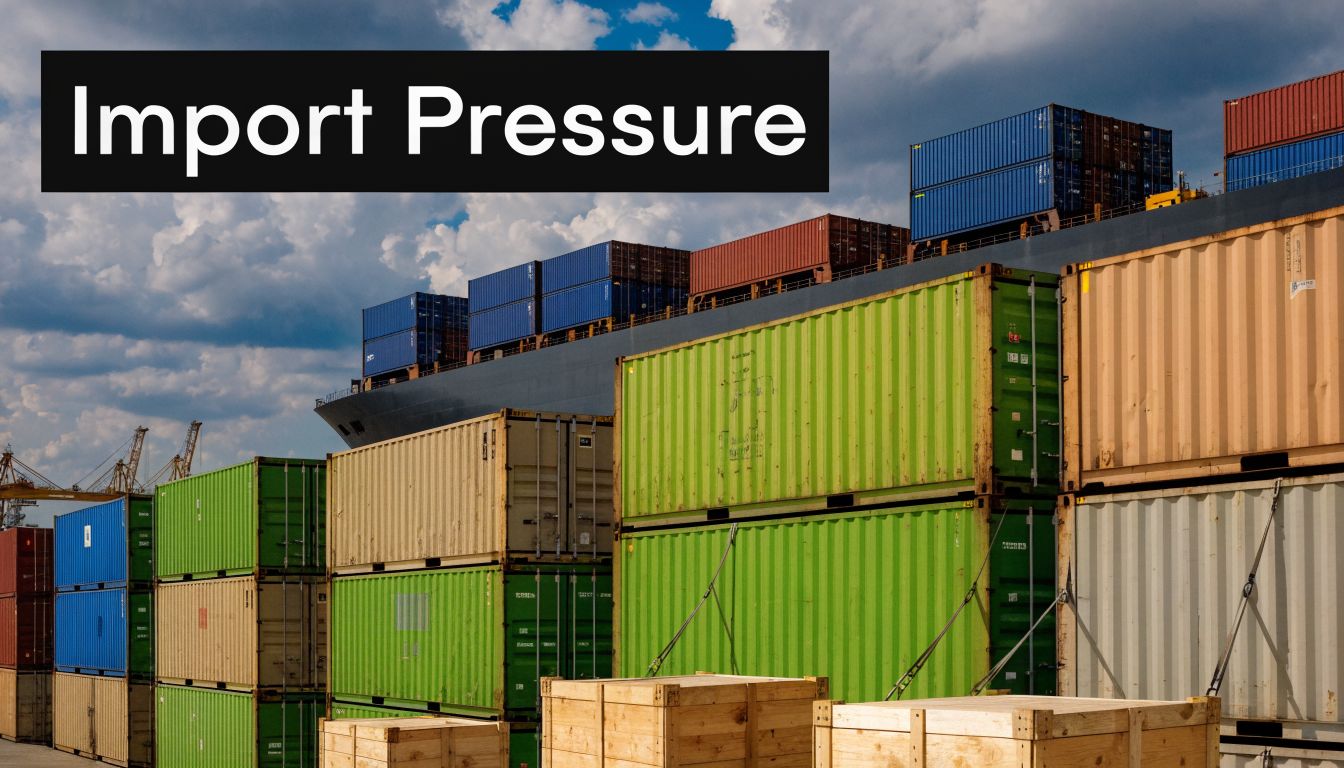
Where the squeeze really happens
The problem usually isn’t a lack of demand. It’s timing.
A smart importer might buy ahead to avoid stockouts, secure better production slots, or protect margin when supply is tight. Then the shipment lands and creates a new issue:
- Cash is tied up early: Duties are due before the stock has generated income.
- Sales may be staggered: You might release goods over weeks or months.
- Forecasts change: Some stock will move fast, some won’t.
- Re-export remains possible: Not everything imported into a country ends up sold there.
A bonded warehouse changes that sequence. Instead of treating import duty as a bill due on arrival, it lets you delay payment until goods leave the bonded facility for domestic use.
Practical rule: If your inventory arrives in bulk but sells in phases, customs timing matters almost as much as purchase price.
Why this is a strategic choice, not a storage choice
Businesses often compare bonded warehousing with standard warehousing as if the only difference is customs paperwork. That misses the point.
The primary comparison is financial and operational. Are you better off paying duties immediately and storing goods normally, or delaying that payment while stock waits under customs control? For some importers, especially those handling higher-duty goods, uncertain demand, or cross-border redistribution, bond can act like a pressure valve in the supply chain.
That’s why bonded warehousing is best understood as a logistics lever. It helps you decide when goods officially enter the market, not just where they sit.
A Simple Analogy for Bonded Warehousing
A bonded warehouse works like a tax-free waiting room for your goods.
That wording is useful because it gets to the commercial decision fast. The stock has arrived in the country and is physically available, but from a customs point of view it is still waiting. Duty is suspended while the goods stay under customs control, which gives the importer time to decide what belongs in the local market and what should move elsewhere.
For UK and US importers, that pause can be worth real money. A business bringing in a full container from the EU, Asia, or North America may sell it over 30, 60, or 90 days rather than all at once. Bond lets the customs bill follow that sales pattern more closely. If part of the stock is later re-exported, the importer may avoid paying domestic duty on that portion at all.
The commercial logic behind the analogy
The practical difference is timing.
Under a standard import process, goods arrive, customs clears them into free circulation, duty is paid, and the inventory goes into normal storage. Under bond, the goods move into an authorised customs-controlled facility first. The tax point is delayed until one of a few clear decisions is made:
- release a portion into the domestic market
- hold the balance until orders firm up
- re-export some or all of the shipment
That matters most when demand is uncertain, product margins are tight, or the shipment may be split across markets. I have seen bond make the most sense where importers buy in container quantities but sell in weekly batches. In that setup, paying all duty on day one often creates a cash flow problem that has nothing to do with actual sales performance.
Who does what
Bonded warehousing only works well when each party knows its role and records stay tight.
| Party | What they do |
|---|---|
| Importer or owner of goods | Chooses bond as the customs route, decides when goods are withdrawn, and directs local sale or re-export |
| Customs authority | Authorises the regime, sets control requirements, and checks traceability and reporting |
| Warehouse operator | Holds the goods under customs control, maintains stock accuracy, and follows approved handling procedures |
| Surety or bond provider | Provides the financial guarantee customs requires under the local regime |
The guarantee point matters, but the exact cost depends on the country, the operator, the importer’s profile, and the value and type of goods. For a 2026 decision, it is better to price the current bond requirement with your customs broker or warehouse operator than rely on older benchmark ranges.
What you can and can’t do inside bond
Importers should treat bond as controlled inventory staging, not general warehouse space.
In practice, bonded facilities are designed for storage and limited handling. That often includes activities such as sorting, relabelling, repacking, or preparing stock for onward shipment, subject to the local rules. More extensive processing, manufacturing, or assembly usually sits under a different customs regime. That distinction matters in post-Brexit EU-UK flows and in US trade, where businesses sometimes choose the wrong setup because they assume bond covers every type of value-added work.
A simple test helps. If the main objective is to delay duty while keeping stock available for release or re-export, bond is usually the right model. If the main objective is to transform the product, assemble components, or run an ongoing production process, another customs structure may fit better.
Bonded stock is inventory with options attached. You choose the market first, and the duty point follows that choice.
How Bonded Warehousing Works Step by Step
Operationally, bonded warehousing is straightforward once the sequence is clear. Problems usually come from getting the sequence wrong, using incomplete documents, or assuming you can treat bonded stock like ordinary stock.
Step 1 through Step 3
The lifecycle starts at arrival.
Goods arrive and are declared
The shipment reaches the port, airport, or inland customs point. Instead of clearing directly into free circulation, the goods are identified for bonded handling.An in-bond movement is arranged
The cargo moves under customs control from the arrival point to the authorised bonded facility. During this phase, the goods are not yet in normal domestic circulation.The goods are received into bond
The warehouse records the cargo into its bonded inventory system. From this point, control and traceability matter. Customs expects the operator and importer to know exactly what is in storage, in what quantity, and under which entry.
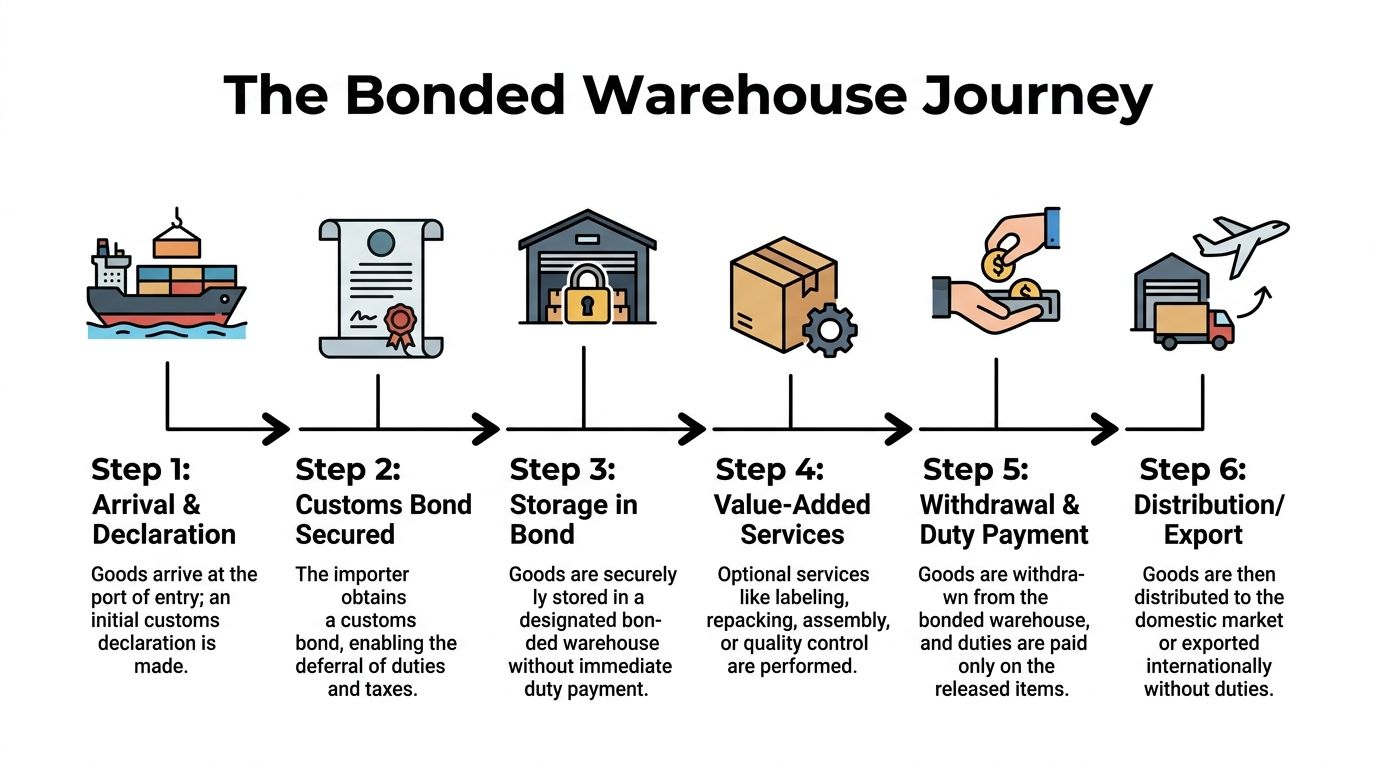
Step 4 through Step 6
Once inventory is inside the facility, the pace slows down and decision quality matters more than transport speed.
What can happen while goods are stored
Depending on the local regime and the warehouse authorisation, goods may be:
- Held securely: This is the default use. Stock waits until demand justifies release.
- Sorted by destination: Useful when one inbound shipment will feed several markets or channels.
- Repacked or relabelled: Minor value-added work is often allowed where customs rules permit.
- Prepared for compliance checks: Especially relevant for regulated or inspected categories.
What doesn’t work is loose inventory discipline. If SKUs are mixed, relabelled without control, or moved without the right entries, the customs risk rises quickly.
Withdrawal for domestic use
When you want to sell the goods in the local market, you withdraw them from the bonded warehouse and complete the required customs process for home use. That’s the moment duty becomes payable.
This is the practical advantage many businesses want. You don’t pay on the full shipment when it lands. You pay when units leave bond for domestic commerce.
That gives you more precise control over:
- release timing
- cash planning
- inventory allocation by market
- response to slower-than-expected demand
Withdrawal for re-export
The second path is re-export.
If goods leave the bonded warehouse for another country rather than the local market, domestic import duties generally don’t arise in the same way because the products were never entered for local consumption. This is one of the strongest use cases for companies using one country as a holding and redistribution point.
If there’s a realistic chance stock will be redirected to another market, bonded storage often beats clearing everything immediately and dealing with the consequences later.
The documents that usually matter
The exact set varies by country and shipment type, but importers should expect a bonded movement to rely on disciplined paperwork, including:
- Customs entry data: The original import details and commodity information.
- Transport records: Evidence of movement from port or airport to the bonded site.
- Bond documentation: The financial guarantee supporting the customs arrangement.
- Warehouse inventory records: A live audit trail of receipts, handling, and withdrawals.
- Release instructions: Clear authorisation showing what is being entered domestically or re-exported.
The practical lesson is simple. Bonded warehousing is forgiving on timing, but not on record-keeping.
Key Benefits and Who Gains the Most
The strongest argument for bonded warehousing is not that it saves everyone money. It doesn’t. The strongest argument is that it gives the right importer better control over when costs are triggered and where stock is finally committed.
That matters enough that the sector itself is growing. The global bonded warehouse market report from Market Intelo states that the market was valued at $32.8 billion in 2024 and is projected to reach $54.3 billion by 2033, with growth linked to cross-border e-commerce and the need for smoother customs clearance. The same report says private bonded warehouses represent over 58% of total market share.
The benefits that matter in practice
Some advantages sound good on paper but don’t change much in operations. These are the ones that usually do.
Cash flow control
This is the headline benefit for a reason. Deferring duty means the payment can track the actual release of goods rather than the arrival of the full shipment.
For a business importing high-value stock in bulk, that can make the difference between flexible working capital and cash that sits inside unsold inventory.
Better market timing
Bond lets you hold imported goods near the market while delaying the customs payment event. That creates room to react to real demand, not just forecasts made weeks earlier.
This is useful when stock is:
- seasonal
- launched in waves
- allocated across channels later
- partly destined for re-export
Reduced commitment risk
Once goods are cleared straight into domestic circulation, your options narrow. Bond preserves optionality.
You can delay a final decision on where inventory belongs. That matters when buyer demand changes, a key account shifts volumes, or one market becomes less attractive than another.
Who tends to benefit most
Not every importer should use bonded warehousing. The best fit tends to be businesses with a clear mismatch between arrival timing and sales timing.
A few strong candidates stand out:
- E-commerce and retail brands: They often import in bulk ahead of campaigns or peak seasons, then release inventory progressively.
- Manufacturers: They may need imported inputs available near production, but not all at once.
- Distributors serving multiple countries: Bond helps when stock may be sold locally or redirected elsewhere.
- Importers of regulated goods: Extra compliance steps can slow release, so bond provides breathing room.
- SMEs avoiding early duty shock: Public bonded facilities are often attractive because they offer access without the capital burden of owning the warehouse structure yourself.
When the model is weaker
A bonded warehouse is less compelling when goods turn over almost immediately, duty exposure is modest, and the added handling or admin outweighs the timing advantage.
If your stock arrives and leaves within days, a direct-clearance model may be cleaner. Speed-focused supply chains often prefer fewer customs touchpoints, not more.
Navigating Compliance Costs and Time Limits
A bonded warehouse makes financial sense only when the duty you defer is worth more than the extra control work you take on.
That is the part many importers miss. They focus on the headline benefit, then get caught by handling fees, inventory controls, and broker time. For a UK business bringing goods from the EU after Brexit, or a US importer staging stock for a phased release, the decision should be made with a simple cash-flow model, not a generic rule of thumb.
As noted by Crane Worldwide on customs bonded warehouses, the return depends on import volumes and duty rates. In practice, I would add one more variable. Stock velocity matters just as much. If goods sit for months, bond can protect working capital. If they clear and sell within days, the admin often cancels out the benefit.

What you need to count
The right comparison is total cost by route. One route is immediate clearance into free circulation. The other is bonded storage with deferred duty and tighter customs control.
A practical review should include:
- Bond fees or guarantees: These vary by market and warehouse setup.
- Storage rates: Bonded space can cost more because the operator carries extra compliance responsibility.
- Handling charges: Receiving, segregation, relabelling, repacking, and staged withdrawals all create labour cost.
- Customs administration: Declarations, broker support, stock reconciliation, and record checks take time.
- Internal management time: Finance, warehouse, and customs data all need to match, or errors become expensive.
A practical decision test
Use four questions before you commit.
| Question | Why it matters |
|---|---|
| How long will stock sit before release? | Duty deferral has more value when inventory turns slowly |
| How high is the duty and import VAT exposure? | Higher tax outlay increases the cash-flow gain from delaying payment |
| Could some stock be re-exported or redirected? | Bond is stronger where final destination is still uncertain |
| Can your systems track stock accurately at SKU level? | Weak inventory control creates customs risk and extra cost |
If you want to estimate the tax effect before choosing a customs route, an import tax calculator for landed cost planning helps frame the decision.
A useful shorthand is this. Bond works like a tax-free waiting room, but waiting rooms still charge rent.
Time limits are generous, but not casual
Bonded storage is controlled storage. It is not indefinite storage.
In the United States, U.S. Customs and Border Protection states that merchandise may remain in a bonded warehouse for up to 5 years from the date of importation. That gives importers room to stage seasonal inventory, hold goods pending allocation, or re-export without entering domestic circulation. It does not justify weak stock discipline or vague release plans.
The same principle applies in the UK. The legal framework may differ, but the operating lesson is the same. If the business cannot say why the goods are in bond, how long they should stay there, and what event triggers release, bond turns from a cash-flow tool into an expensive holding pattern.
Documentation that cannot drift
Customs authorities expect the records and the physical stock to match. Close enough is not enough.
That usually means control over:
- entry data and tariff classification
- goods receipt records
- SKU-level inventory movements
- damage, shortage, or disposal reporting
- withdrawal instructions and proof of final destination
Strong operators set themselves apart. A warehouse system may show available stock, finance may show deferred duty, and the broker may hold the customs entries. If those three records do not reconcile, the business carries audit risk, release delays, and avoidable correction costs.
For UK and US importers alike, the commercial question is simple. Are you using bond to buy time for a clear commercial reason, or are you using it to postpone a decision your team has not made yet? Only the first case usually pays off.
Bonded Warehousing in Practice EU–UK and US Trade Lanes
The value of bond changes depending on the lane. A UK importer dealing with post-Brexit friction is solving a different problem from a US importer using bond to stage inventory for phased domestic release.
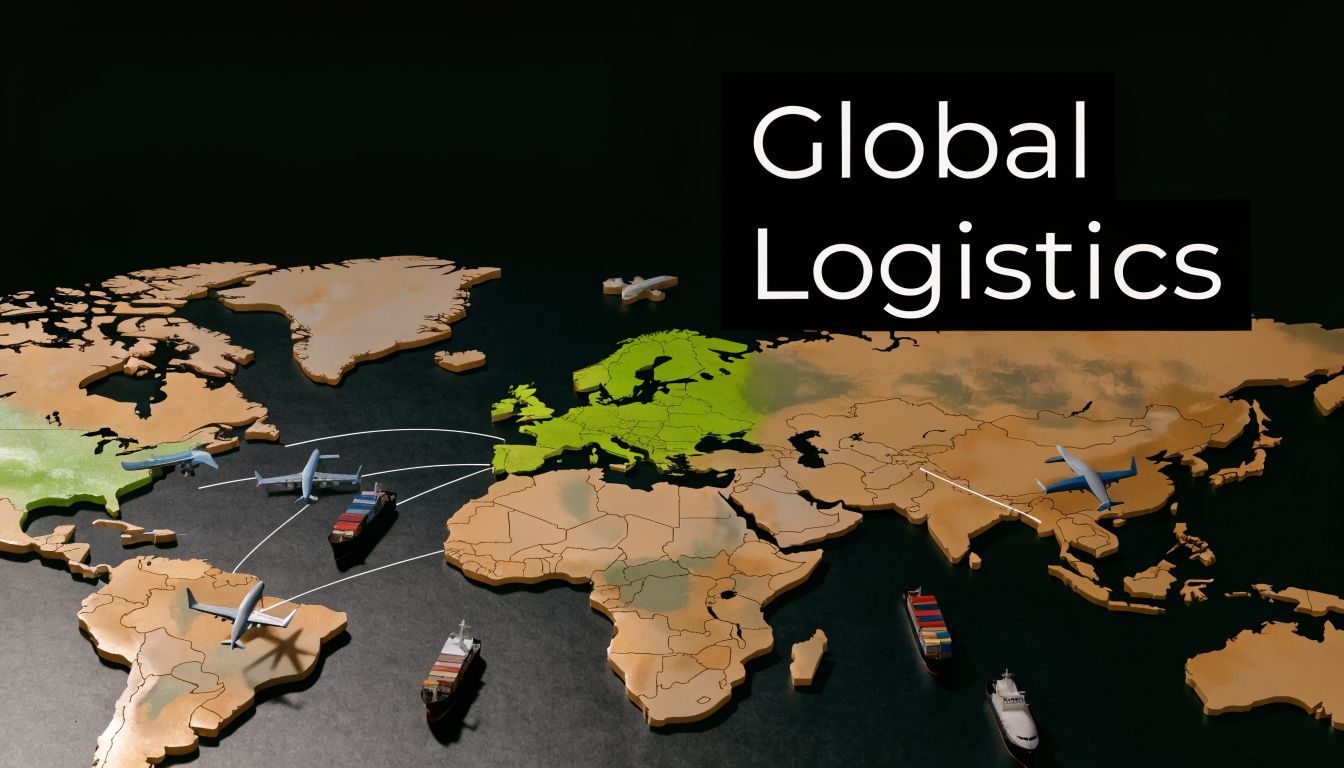
EU to UK after Brexit
For UK businesses, bonded warehousing now plays a more strategic role than it did when EU trade moved with fewer border formalities.
The core issue is not just duty deferral. It’s control. Goods moving from the EU into the UK now sit inside a more complex customs environment, and many generic explanations still gloss over the practical gap between standard import clearance, temporary storage, and bonded handling.
The Cin7 discussion of bonded warehouses and the UK post-Brexit knowledge gap points out that businesses need clearer guidance on how bonded warehouses now bridge EU and UK supply chains, especially around paperwork, timelines, and the separate treatment of EU and non-EU goods under the new regime.
Where bond helps on the UK side
For an importer bringing goods from the EU into the UK, bond can help in several specific situations:
- Arrival before final allocation: Stock reaches the UK, but some may be sold domestically and some redirected.
- Customs paperwork bottlenecks: Bond creates a controlled holding point while entries and documents are finalised.
- Mixed-origin flows: Businesses handling both EU and non-EU stock need cleaner separation and stronger record-keeping.
- Uncertain domestic demand: Releasing in stages can reduce early duty pressure.
The wrong approach is to assume bond solves every border issue. It doesn’t. If the upstream paperwork is wrong, if commodity codes are weak, or if the stock needs immediate free circulation, a bonded model won’t rescue bad customs planning.
For businesses reviewing recent process changes, UK border controls and import procedures provide useful context on the wider control environment around these movements.
How the US use case differs
The US bonded model is mature and very operationally defined. Importers often use it less as a Brexit-style buffer and more as a deliberate finance and distribution tool.
According to the U.S. International Trade Commission trade metrics reference, approximately 293,022 shipments were entered into Foreign Trade Zones or bonded warehouses in recent reporting periods, representing 12.5% of general imports. That tells you bonded and adjacent customs regimes are not niche in US trade. They are part of mainstream import infrastructure.
What US importers usually care about
In US practice, three issues dominate.
First, cash flow. Importers of high-duty or high-value products often don’t want to fund duty on inventory that may sit for months.
Second, distribution timing. Releasing stock in tranches aligns duty payment with actual market movement.
Third, re-export flexibility. Businesses using the US as a regional hub may not want all imported goods to trigger domestic customs cost if some inventory is destined elsewhere.
Here’s a quick comparison.
| Trade lane | Typical bonded priority | Main operational challenge |
|---|---|---|
| EU to UK | Border control, customs timing, post-Brexit flexibility | Managing new paperwork and separating customs statuses |
| Into the US | Duty deferral and staged release | Maintaining strict bonded inventory control and release accuracy |
A short explainer can help if your team needs a visual overview of the mechanics before deciding on process design.
Choosing the right lane strategy
The practical question isn’t whether bonded warehousing is good in the abstract. It’s whether it solves the friction in your actual lane.
For EU to UK trade, bond often acts as a customs buffer. For US trade, it more often acts as a cash and inventory timing tool. In both cases, the businesses that get the best results are the ones that know in advance:
- what portion of stock is likely to be sold locally
- how long inventory will sit
- whether re-export is realistic
- which handling activities are permitted
- who owns customs accuracy inside the organisation
If those answers are vague, bonded warehousing can become expensive complexity. If they’re clear, it becomes a very sharp instrument.
How Multica Group Streamlines Your Bonded Logistics
Bonded warehousing only pays off when the moving parts stay aligned. Customs entries, transport, stock visibility, release timing, and final delivery all need to support the same plan.
That’s why execution matters more than theory. A bonded strategy can look perfect on paper and still fail if the handoff between border clearance, warehousing, and onward transport is fragmented.
What strong execution looks like
In practice, importers need a partner that can support the chain around the bonded facility, not just the building itself.
That usually means:
- In-house customs handling: Fewer handovers, faster issue resolution, and cleaner document control.
- Multimodal transport coordination: Road, sea, and air legs need to connect without breaking customs logic.
- Inventory visibility: You need to know what is in bond, what can be released, and what’s moving next.
- Controlled onward distribution: Domestic delivery and export flows should follow the release plan, not work against it.
Why regulated cargo raises the bar
The need for discipline gets even sharper when the goods are regulated.
Agri-food, pharmaceutical, and other sensitive categories often involve added inspections, handling requirements, and documentary precision. In those cases, the warehouse decision sits inside a wider compliance chain. Border formalities, veterinary processes, and onward transport all have to line up.
Good bonded logistics is rarely about storage alone. It’s about keeping customs status, physical stock, and commercial intent in sync.
Turning a complex option into a usable one
The businesses that succeed with bond usually do three things well:
- They choose bonded warehousing for a specific reason, not because it sounds efficient.
- They define the release logic before the goods arrive.
- They work with operators and forwarders who can manage the whole movement, not just one step.
If you’re comparing providers, it helps to look at broader international freight forwarding services across road, sea, and air rather than treating customs, warehousing, and delivery as separate buying decisions. Bonded logistics works best when those functions are coordinated from the start.
A bonded warehouse can be a tax-free waiting room, a customs buffer, or a release valve for working capital. For the right importer, it’s all three. The hard part isn’t understanding the concept. It’s building a process that uses it well.
If your business is weighing bonded warehousing for EU, UK, or US trade lanes, Multica Group can help you design a practical flow around customs clearance, warehousing, and multimodal transport so duty timing, compliance, and delivery all work together.