A lot of businesses start the manchester to rhodes conversation the same way. The sales team has opened a Greek account, a buyer wants stock on the island, or a seasonal order suddenly becomes urgent. Then the practical questions arrive all at once. Do you push it by air, route it by road and ferry, or build a mixed plan that gives you enough speed without turning margin into freight cost?
That lane looks simple on a map and messy in reality. Rhodes is an island destination. Manchester is a strong origin point, but post-Brexit movement into the EU still depends on clean export data, correct import handling, and realistic planning around handoffs. If the goods are straightforward, the challenge is usually speed versus cost. If they’re regulated, chilled, or time-sensitive, the challenge shifts to control.
Your Manchester to Rhodes Shipping Challenge
A typical problem on this lane starts the same way. The goods are ready in Manchester, the customer in Rhodes wants a firm delivery window, and the original plan assumes Greece will behave like a straightforward mainland drop. Then the practical constraints surface. The shipment needs the right road leg out of the UK, the right entry point into the EU, the right onward connection to an island, and customs data that holds together at every handoff.

From a planning perspective, Manchester to Rhodes is rarely a single-mode job. It is usually a multimodal exercise. Road collection in the North West is the easy part. The hard part is choosing where speed matters, where cost can be protected, and where post-Brexit customs risk can undo an otherwise sensible move.
The cargo usually falls into a few clear profiles. Retail stock needs repeatable replenishment. Industrial parts need timing that supports engineers and shutdown schedules. Food, veterinary, or healthcare consignments need tighter temperature control, document accuracy, and less tolerance for delay. Each profile changes the routing decision.
What makes this trade lane difficult in practice
The pressure points are operational:
- Island delivery planning: Clearing into the EU is only one milestone. Rhodes still needs a booked onward leg, realistic transfer timing, and a consignee ready for delivery or collection.
- Mode fit: Air solves urgency but can destroy margin on routine stock. Road and sea lower cost but add handoffs, cut-off risk, and more points where paperwork must stay consistent.
- Post-Brexit customs alignment: UK export data, commodity codes, invoice detail, origin statements, and Greek import handling must match from the start.
- Cargo-specific controls: Chilled goods, veterinary products, and other regulated shipments need the route, documents, packaging, and timing to work together.
A good plan starts with failure points, not headline transit time.
In our experience, shipments on the Manchester to Rhodes lane usually run into trouble for three practical reasons. The routing was chosen before the cargo profile was understood, customs preparation started too late, or the final island leg was treated as an afterthought. Expert handling matters because this lane rewards coordination, not assumptions.
Choosing Your Core Transport Strategy Air Sea or Road
A poor mode choice usually shows up late. The goods leave Manchester on time, then miss an airline cut-off, sit at a consolidation point, or reach mainland Greece without a realistic island transfer plan. On the Manchester to Rhodes lane, transport strategy is not just a speed-versus-cost decision. It is a multimodal planning exercise that has to account for handoffs, cut-off times, and post-Brexit border handling from the start.
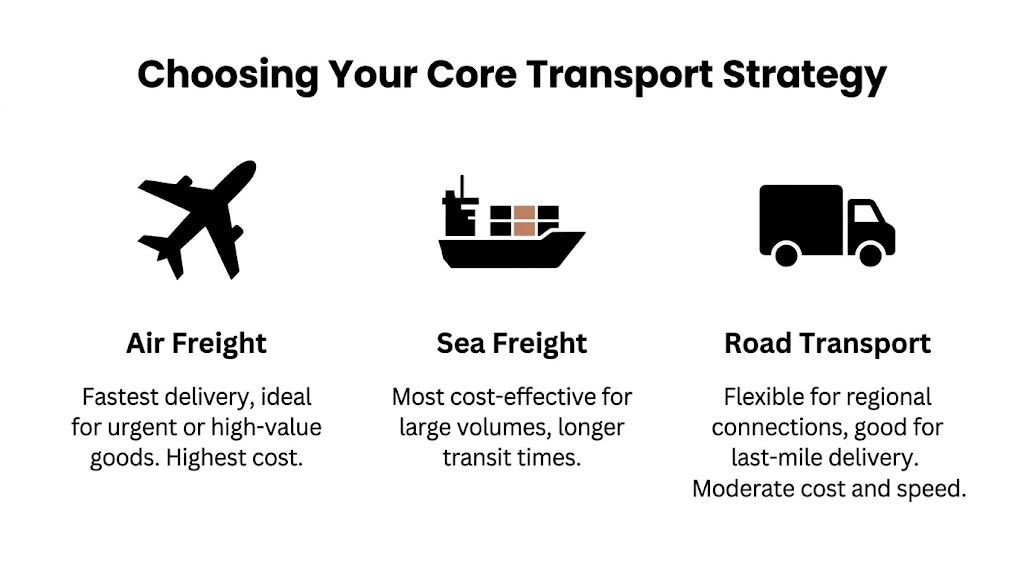
Manchester to Rhodes Freight Options at a Glance
| Mode | Typical Transit Time | Relative Cost | Best For |
|---|---|---|---|
| Air freight with road legs | Fastest option for urgent moves | Highest | Time-critical, high-value, short shelf-life cargo |
| Sea-based multimodal with road legs | Longer but more economical | Lower than air in many cases | Larger consignments, cost-led replenishment |
| Road and ferry combination | Mid-range, depends on routing and handoffs | Moderate and often cost-efficient | Palletised freight, repeat flows, cargo needing flexibility |
When air freight is the right decision
Air works when delay has a direct commercial cost. Typical examples include AOG and engineering spares, launch stock, medical or veterinary products with tight delivery windows, and goods where a missed date causes a stockout or service failure.
For Manchester exporters, air usually starts with road collection to the airport, then a flight plan that still needs careful onward handling into Greece and on to Rhodes. Speed helps, but only if the shipment is ready for that speed. Dimensions, chargeable weight, airline acceptance rules, security status, and document accuracy all need to be confirmed before booking. If any of those points are unresolved, air becomes expensive without being reliably fast.
Air is also less forgiving of late changes. A one-pallet urgent shipment can justify the premium. A routine weekly replenishment usually cannot.
When sea-based multimodal gives better control of cost
Sea-based routing makes sense when the cargo can handle a longer planning window and the rate structure matters more than shaving every day off transit. On this lane, that usually means UK collection by road, port handling, sea freight into Greece or a suitable transhipment point, then an organised final leg to Rhodes.
The key decision is often FCL versus LCL. Full Container Load gives better cargo separation, fewer shared handling points, and more control over loading. Less-than-Container Load lowers cost for smaller volumes, but it adds consolidation and deconsolidation steps. That trade-off is acceptable for durable, non-urgent freight. It is a weaker fit for fragile cargo, short-dated product, or anything likely to be delayed by one missing document in a shared load.
In practice, sea works best for planned replenishment, heavier consignments, and cargo where margin matters as much as transit time.
Where road and ferry often makes the most sense
Road is part of every realistic Manchester to Rhodes plan. The question is how much of the journey it should carry.
A road and ferry setup is often the most balanced option for palletised freight moving on repeat schedules. It gives more routing flexibility than pure air, and it can be simpler to cost and control than an LCL sea move with multiple warehouse touches. Shippers often default to direct flights, overlooking a practical sea and road alternative that fits regular B2B flows better.
LTL and FTL matter here. Less Than Truckload suits smaller consignments that can move on a shared schedule. Full Truckload suits dedicated moves, tighter delivery windows, and cargo that benefits from less handling. If the consignee in Rhodes has a fixed intake window, or the goods are sensitive to repeated loading and unloading, paying for dedicated space can save more than it costs.
How to choose the right setup for this lane
The decision usually comes down to four practical questions:
- What does delay cost? If a late arrival stops production or breaches a customer commitment, air may be justified.
- How much handling can the cargo tolerate? Fragile, regulated, or high-value goods usually need fewer transfer points.
- Is the shipment repeatable or exceptional? Repeat flows often benefit from road and ferry or sea-based planning. One-off emergencies often go by air.
- Is the final Rhodes leg fixed and booked? A good trunk route still fails if island delivery is left open.
We usually advise clients to build the Manchester to Rhodes lane around the normal shipment profile, then use air only for true exceptions. That keeps transport spend under control without exposing routine loads to avoidable delay. It also fits the current UK-EU operating reality, where border preparation and routing discipline matter as much as the main carriage mode. For a closer look at the regulatory changes shaping those decisions, see our guide to how the 2025 UK-EU transport rule changes will affect routing and planning.
What works and what does not
What works:
- Air for genuine urgency: Best for shipments where the commercial cost of delay is higher than the freight premium.
- Road and ferry for repeat pallet flows: Often the strongest balance of cost, control, and flexibility.
- Sea-based multimodal for planned volume: A good fit for replenishment stock and larger consignments with predictable demand.
What does not work:
- Using air because planning started late: That shifts an internal scheduling problem into a high-cost freight decision.
- Putting sensitive cargo into shared routings without checking handling points: Extra touches increase risk.
- Booking the main leg before confirming the Rhodes transfer: Island freight needs the onward leg planned from the outset.
Navigating Post-Brexit Customs and Documentation
A typical failure on the Manchester to Rhodes lane looks like this. The trailer leaves on time, the ferry space is booked, and the consignee expects delivery into Rhodes within the agreed window. Then the paperwork is checked and the shipment stops because the invoice description is too vague, the importer details do not match, or nobody fixed who would handle Greek clearance.

Post-Brexit shipping to Rhodes needs more than a standard UK to EU export file. It needs a document flow built around the actual route. That means matching the Manchester collection, the main leg by road, sea, or air, the EU entry point, and the island transfer to one consistent set of data. If one stage is planned in isolation, customs queries usually appear at the handover.
The practical rule is simple. Treat UK export and Greek import as two separate clearance events linked by one controlled shipment record.
Separate UK export from EU import
On the UK side, the exporter must present the goods correctly for export. On the Greek side, the importer of record, or its customs representative, must clear the goods into the EU and release them for onward movement to Rhodes. Businesses often blur those roles, especially when sales, warehousing, and transport are handled by different teams. That is where avoidable delay starts.
UK export side
The UK file needs to match the loaded freight exactly. In practice, that usually includes:
- Exporter EORI details: The legal exporter must be identified correctly.
- Commercial invoice: Seller, buyer, goods description, values, currency, and Incoterm must be accurate.
- Packing list: Carton count, pallet count, marks, dimensions, and weights must match the physical load.
- Export declaration data: Commodity information and shipment references must align with the handover plan.
Description quality matters more than many shippers expect.
“Parts,” “samples,” or “food items” will often trigger questions. A specific description gives the broker and customs officer a clear basis for classification and clearance. It also reduces the risk of rework after departure, which is expensive on an island route because missed cut-offs can affect both the main leg and the Rhodes connection.
Greek and EU import side
Greek import clearance is not a formality added at the end. It has to be prepared before collection in Manchester, especially if the shipment is entering the EU at one point and completing delivery through another. For Rhodes traffic, that matters because the final island leg only works if import release, delivery authority, and local handling instructions are already in place.
Confirm these points before the freight moves:
- Who is the importer of record
- Who pays duty and VAT under the agreed Incoterm
- Whether the goods need supporting certificates, licences, or controls
- Which broker or representative will file the import entry
- How the goods will be released for the Rhodes onward leg
If those answers arrive after departure, the load is already at risk.
Build one working document set
The best customs files are not large. They are consistent.
At Multica Group, we look for one master shipment record that controls the commercial invoice, packing list, booking data, customs references, and consignee details across every mode used on the lane. That matters even more on Manchester to Rhodes moves because multimodal routings create more handoff points. Every mismatch between documents and booking data creates another opportunity for a stop, query, or missed transfer.
A practical workflow looks like this:
- Check the commercial file first: Product descriptions, values, consignee details, origin data, and Incoterm must match the sale.
- Match the transport file second: Pallet count, gross weight, dimensions, and marks must match the booked equipment and routing.
- Confirm import readiness before collection: The Greek broker or importer should have the document pack before the load leaves Manchester.
- Lock the references before departure: Last-minute edits to consignee data, values, or carton counts often create declaration errors.
Teams still adjusting to the current rules should keep up with the 2025 UK-EU transport rule changes affecting routing and customs planning.
Clean paperwork does not guarantee release on the exact minute planned. It does remove the errors that usually cause avoidable holds.
A short explainer can help teams who don't deal with customs every day:
What usually goes wrong
The recurring problems on this lane are rarely obscure legal points. They are coordination errors between sales, warehouse, forwarder, broker, and consignee.
| Problem | What it causes | Better approach |
|---|---|---|
| Invoice and packing list do not match | Customs queries, rework, and possible hold at export or import | Issue both documents from one checked shipment record |
| Importer details are incomplete or unclear | No workable import clearance path on arrival | Confirm importer responsibility and broker details before booking |
| Goods descriptions are too vague | Classification questions and document amendments | Use specific commercial descriptions that match the product |
| Documents are sent after the freight has moved | Reactive clearance and missed connections to Rhodes | Pre-send the full file to the broker and consignee before departure |
| Incoterms are agreed commercially but not operationally | Confusion over duty, VAT, delivery, and release responsibility | Align the sales term with the actual transport and clearance plan |
The first shipment on this route often exposes weak internal process. Repeated shipments should not. Once the document pack, clearance roles, and handoff points are fixed, Manchester to Rhodes becomes a controlled lane instead of a recurring customs problem.
Shipping Perishables and Veterinary Goods
A chilled veterinary consignment can leave Manchester in good order and still fail before it reaches Rhodes. The failure point is usually not the long-distance leg. It is a break in temperature control during transhipment, a missing health document, or an arrival booked into the wrong inspection flow.

This trade lane needs tighter control than standard UK to EU freight. Rhodes is an island destination, so perishable and veterinary goods often involve a road leg out of Manchester, then an air or sea connection, then final delivery under time pressure. Every handoff adds exposure. If the shipment only works on paper, it is already at risk.
Protect the product before you protect the schedule
For chilled food, frozen product, ingredients of animal origin, and temperature-sensitive healthcare goods, equipment choice comes first. A generic trailer with extra wrap is not a cold-chain plan. The vehicle, packaging, and monitoring method must match the actual temperature band and the length of each leg, including waiting time at depots, ports, or airport sheds.
Air can reduce transit time, but it also introduces extra handling and stricter cut-off discipline. Sea can be more stable for larger reefer loads, but the transit is longer and contingency options are narrower if a connection slips. Road to a continental hub, then air or sea onward, is often the right Manchester to Rhodes solution, but only if the temperature setpoint, dwell-time tolerance, and handover points are agreed in advance.
For life sciences and veterinary products, nominal refrigeration is not enough. The shipper should define the acceptable range in writing, specify how readings will be recorded, and make clear who acts if there is an excursion.
Veterinary and SPS control has to be built into the plan
Goods of animal origin and other SPS-controlled products need more than the standard commercial file. They may require export health documentation, pre-notification, and presentation at the correct EU border inspection point before they can move freely onward to Rhodes. That work has to start before booking is confirmed, because certificate timing, product coding, and inspection routing affect the transport plan itself.
A practical reference is this guide to veterinary, sanitary and phytosanitary controls for UK goods entering the EU via the French border. Even where the final routing to Greece differs, the operating discipline is the same. Product status first. Correct health paperwork next. Border control preparation before departure.
One mistake causes most avoidable failures here. Teams classify the shipment as general freight, then try to add veterinary compliance later. By that stage, the booking, routing, and consignee preparation may already be wrong.
A working process for Manchester to Rhodes controlled cargo
The strongest setups use a fixed pre-departure check, especially for repeat shipments:
Confirm commodity status early
Check whether the goods are food, feed, animal-origin, pharmaceutical, or mixed cargo. Do this before space is booked.Align the mode with the risk
Choose air, sea, road, or a multimodal combination based on shelf life, inspection exposure, volume, and what happens if one leg misses its connection.Secure the health and supporting documents
Export Health Certificates or equivalent supporting documents need to match the goods, the consignee, and the route.Set the cold-chain controls
Define temperature range, packaging standard, data logging, and escalation instructions for delays or out-of-range readings.Prepare the arrival side
The importer, broker, and receiving facility must be ready for inspection-facing cargo before dispatch leaves Manchester.
This is where experienced handling matters in practical terms. A forwarder who understands this lane will question the routing, certificate timing, airport or port cut-off, and final island handoff before the goods move. That prevents the common failure of sending compliant cargo on a route that cannot keep it compliant.
For perishables and veterinary goods, the primary task is to preserve condition and admissibility at the same time. On Manchester to Rhodes, you need both.
Executing the Shipment Insurance Tracking and Packaging
Once the route and documents are in place, the shipment still has to survive practical challenges. Forklifts clip pallets. labels get damaged. airport handling changes at short notice. consignee delivery windows move. Execution is where decent planning either holds up or starts to unravel.
Package for movement, not for storage
A pallet that's stable in a warehouse may fail during a multimodal journey. Manchester to Rhodes often means several handling points, especially if you're combining road with air or sea. Packaging has to reflect that.
Use a pallet footprint that fits the actual cargo. Overhang creates avoidable crush risk. Weak top cartons invite stacking damage. In mixed loads, poor pallet build quality is one of the easiest ways to turn a routine shipment into a claims file.
A practical pallet standard usually includes:
- Stable base build: Heavy items low, lighter items high
- Consistent carton edges: Keep the stack square and secure
- Protective wrap and strapping: Use both when the cargo needs restraint, not just stretch film alone
- Readable labelling: Marks should stay visible after wrapping
Insurance needs a deliberate choice
Carrier liability and cargo insurance are not the same thing. Too many shippers assume the carrier automatically covers the full value of the goods. That assumption usually gets tested at the worst possible time.
If the cargo has meaningful value, narrow replacement windows, or customer-sensitive consequences, review cover before dispatch. The right level depends on the goods, the route, and the commercial impact of loss or damage. A useful starting point is Multica's practical guide to insurance for cargo.
The question isn't whether something can go wrong. It's whether the financial exposure is acceptable if it does.
Tracking is an operational tool, not a nice extra
Visibility matters on this lane because handoffs matter. Road collection, terminal delivery, customs status, airline uplift, port transfer, and island final delivery all create moments where customers ask the same question: where is it now?
That becomes even more important when a shipment depends on passenger-flight capacity or timed air connections. Data from the past year shows that 46% of the 9 weekly nonstop flights from Manchester to Rhodes experienced delays, with an average delay of 123 minutes, according to the Manchester to Rhodes flight route data. If you're moving time-critical freight, that kind of disruption can break a downstream plan very quickly.
What good tracking should tell you
| Tracking view | Why it matters |
|---|---|
| Collection confirmed | Proves the shipment is physically in motion |
| Terminal or gateway status | Helps teams manage cut-off and handover risk |
| Customs milestone | Shows whether the shipment is moving cleanly through border stages |
| Updated ETA | Lets the consignee plan labour, storage, or onward delivery |
The key point is simple. Tracking isn't there to make the shipper feel informed. It's there to support decisions before a delay becomes a service failure.
How Multica Group Streamlines Your Manchester to Rhodes Freight
A typical failure on the Manchester to Rhodes lane starts the same way. Goods are collected in Manchester on time, but the booking was made mode-first instead of shipment-first. The cargo reaches a gateway, a document query appears, the island leg has not been aligned with the mainland arrival, and the consignee in Rhodes is left waiting without a firm delivery window.
That is what happens when road, air, sea, customs, and final delivery are handled as separate tasks instead of one transport plan.
Multica Group reduces that risk by controlling the route as a single job. On this lane, that means matching the cargo to the right core mode, building in the Greek island leg from the start, and keeping customs decisions tied to the physical movement rather than chasing paperwork after the freight is already in transit.
What a good operator controls on this lane
For Manchester to Rhodes, the operator needs control over more than collection and linehaul. The essential work sits in the joins between each stage.
A practical setup should cover:
- Collection in Manchester with the right vehicle and loading plan
- Mode selection based on urgency, product type, and delivery constraints
- Customs document checks before departure, not after a hold
- Handover control between UK export, EU transit or import, and the Rhodes final leg
- One point of contact for status, exception handling, and consignee coordination
Multica Group fits that model because it works across road, air, and sea, while also handling customs support, warehousing, cross-docking, and distribution. For this trade lane, that matters more than broad EU coverage claims. Rhodes is an island destination, so a plan that stops at "arrives in Greece" is incomplete.
Why multimodal planning works better than a fixed-mode habit
Some shipments do need air. Many do not.
A planner should test the commercial need first. If the cargo has a short shelf life, a shutdown risk, or a fixed installation date, air can be the right decision. If the shipment is cost-sensitive, less time-critical, or large enough for road and ferry to make sense, a mixed road-sea plan often gives a better result. The value is not only in transit cost. It is in having a route that can be adjusted without rebuilding the whole file when space, cut-off times, or island connections change.
That flexibility is especially useful post-Brexit. A Manchester to Rhodes move is no longer a simple UK to EU handoff. It is a sequence of linked decisions across origin loading, export preparation, main carriage, Greek entry, and island delivery. If one part is planned in isolation, the delay usually appears at the next handoff.
What expert handling changes in day-to-day operations
Experienced teams ask better questions early.
They check whether the consignee can receive on the planned day. They confirm whether the goods can move groupage or need a dedicated leg. They verify who acts as importer of record before the truck is booked or the air shipment is tendered. They look at packaging with the route in mind, not only the warehouse environment, because the freight may move through depots, ports, airline handling points, and ferry connections before it reaches Rhodes.
That changes outcomes. Problems are caught while there is still time to reroute, rebook, or correct paperwork. The shipper does not have to chase separate hauliers, brokers, and local agents for answers because one team is already managing the full chain.
On this lane, that is the difference between a shipment that merely leaves Manchester and one that arrives in Rhodes as planned.
Frequently Asked Questions
How does a lorry shipment reach Rhodes if the destination is an island
A lorry move to Rhodes is a multimodal job from the start. Collection begins in Manchester, the freight moves by road to the main export leg, enters Greece through the agreed gateway, then transfers onto the island connection for final delivery in Rhodes. The mistake is treating the Greek mainland arrival as the finish line. On this lane, the ferry leg, local handling window, and delivery booking on Rhodes need to be planned before the truck is even loaded in Manchester.
Should I choose air freight for every urgent manchester to rhodes shipment
Choose air when the business case supports it. That usually means stock-out risk, high-value goods, short shelf life, or a fixed delivery deadline that road and sea cannot meet.
I regularly see shipments labelled urgent because the internal release was late. In those cases, air can solve the immediate problem, but it also raises cost sharply and may still leave customs or island delivery as the bottleneck. A mixed plan often works better on this trade lane. For example, road to the airport, air to the nearest workable entry point, then controlled onward delivery into Rhodes.
How do I handle volumetric weight for air shipments
Use packed dimensions, not product dimensions from a sales file. Airfreight is usually rated on chargeable weight, so a light but bulky shipment can cost more than expected.
Apply the IATA volumetric formula, L x W x H / 5000, before you ask for the final rate. That check is simple, but it prevents a common pricing dispute. The figure must come from the freight as presented for export, including pallets, outer cartons, and any overhang.
What does DAP mean for this route
DAP can work well on Manchester to Rhodes if both parties define responsibilities clearly before booking. The seller arranges transport to the named place of delivery. The buyer usually handles import duties, taxes, and customs clearance unless the contract says otherwise.
Problems appear when the consignee on Rhodes is not ready to act as importer, or when the delivery point is described too loosely. "Rhodes" is not specific enough for an operational file. Use the exact delivery address, confirm who handles Greek import formalities, and make sure the handover point matches the commercial agreement.
What about returns or reverse logistics from Rhodes back to Manchester
Treat returns as a new shipment with a customs history attached. The reason for return matters. Rejected goods, repair items, warranty replacements, and unsold stock can each require different paperwork and different customs treatment.
Cargo condition matters too. If packaging has been opened, labels are missing, or temperature control failed on the outbound move, the return may need repacking, inspection, or revised commodity information before it can travel. The fastest way to create delay is to describe it as "returning goods" without stating why they are coming back and who is filing the customs entry.
Why is Greater Manchester such a strong logistics origin point for this lane
Greater Manchester works well as an origin because it combines manufacturing, warehousing, motorway access, and reliable links into UK ports and airports. That gives planners options. If one leg becomes tight on time or cost, the routing can be changed without redesigning the whole shipment.
That flexibility matters on a Manchester to Rhodes move. The lane often needs a practical mix of road, air, and sea, plus customs handling that fits post-Brexit rules rather than old UK to EU assumptions.
If you're planning a manchester to rhodes shipment and want a workable route rather than a generic quote, Multica Group can assess the cargo, choose the right mode mix, and coordinate the customs and onward delivery pieces that usually decide whether the move runs smoothly.