A supplier says the shipment is “expedited”. Your team relaxes for a moment. Then the goods miss the delivery window anyway, because the truck moved fast but the paperwork didn’t, or because customs clearance sat outside the transport plan, or because a regulated load reached the border before the compliance file was ready.
That’s the problem with most explanations of what is expedited shipping. They treat it as a faster service level. In practice, businesses don’t buy speed for its own sake. They buy a result. They need stock on the shelf before demand peaks, a replacement component at a plant before a line stops, or a compliant pharmaceutical shipment cleared and delivered within a usable window.
In UK trade, that difference matters more than ever. Consumer expectations keep pushing delivery times down. A 2023 Statista survey found that 44% of UK online shoppers are willing to wait no more than two days for delivery, helping drive a 15% year-on-year rise in express parcel volumes according to Inbound Logistics’ summary of the UK express market. The same source notes the global express market is projected to reach $484.38 billion by 2030.
For importers, exporters, and manufacturers, expedited shipping is no longer a niche add-on. It’s a practical tool for controlling risk.
Introduction When Fast Is Not Fast Enough
A common scenario looks like this. A shipment leaves on time, the carrier books a priority movement, and everyone expects a smooth arrival. Then a customs query, missing commodity detail, or poorly timed inspection turns a premium shipment into an expensive delay.
That’s why the simplest definition of expedited shipping isn’t enough.
Expedited shipping is a premium logistics service designed to shorten transit time and tighten delivery certainty. But in real operations, especially on UK-EU and intercontinental lanes, it only works when transport, customs, documentation, and handling all move to the same urgent timetable.
A fast truck on a standard admin process isn’t expedited. A next-flight-out booking with incomplete import paperwork isn’t expedited either. Those are fast transport legs inside a slow supply chain.
Practical rule: If only the vehicle is moving faster, you haven’t bought an expedited outcome. You’ve bought a premium transport segment.
That distinction matters most when the cost of being late is larger than the freight premium. Manufacturers use expedited services to protect production continuity. Retailers use them to hit launch dates. Agri-food and pharmaceutical shippers use them to preserve compliance windows, product integrity, and commercial value.
What works is simple to describe, even if it takes discipline to execute. You identify the deadline, remove avoidable handoffs, prioritise handling, prepare border and compliance work in parallel, and choose the mode that protects the delivery window rather than the quoted transit alone.
Beyond Speed The Core Principles of Expedited Shipping
Many people hear “expedited” and think “faster truck” or “faster plane”. That’s only part of it. The better way to think about it is a VIP pass for freight. Your cargo gets moved through the network with higher priority, fewer obstacles, and a clearer commitment on timing.

Priority handling comes first
The first principle is priority handling. Expedited freight is scanned, loaded, routed, and monitored ahead of standard consignments.
For UK road transport, this isn’t abstract. Priority handling protocols can reduce transit times by 40% to 60% compared with standard ground services, with expedited road services achieving next-business-day delivery for consignments up to 30kg within mainland UK, as outlined in this expedited shipment guide focused on UK operations. The same source explains why: immediate scanning on receipt, front-of-queue loading, and sorting facility dwell times kept to under 2 hours instead of 12 to 24 hours.
That operational difference is what you’re paying for.
Fewer touchpoints reduce risk
The second principle is reduced touchpoints. Every extra depot, transfer, unload, relabel, and waiting period creates another chance for delay, damage, or administrative mismatch.
For cross-border and regulated freight, fewer touchpoints often matter more than raw linehaul speed. A direct movement with fewer handovers is easier to control, easier to monitor, and less likely to break a temperature chain or miss an inspection window.
The same UK road benchmark notes that integrating cross-docking hubs can reduce touchpoints by 50% and correlate with a 25% lower damage incidence, with 0.8% versus a 1.1% industry average. That matters when the load cannot tolerate rough handling, relabelling mistakes, or uncertain dwell time.
Certainty is the ultimate product
The third principle is timeline certainty. Clients don’t usually need a shipment to be “fast-ish”. They need it by a specific time because another business process depends on it.
That’s why good expedited services are built around a delivery window, not a vague estimate. The same UK road data shows 92% on-time performance for expedited LTL loads under 2 tonnes versus 78% for standard LTL, based on Department for Transport data referenced in the source above. On a domestic lane, benchmark ETAs such as 8 to 16 hours from London to Manchester versus 24 to 48 hours standard show how that certainty translates into planning.
The value of expedited shipping is predictability. Speed is how providers achieve it.
If you remember one thing, remember this. Expedited shipping is a service design, not just a transport mode. It combines priority handling, fewer touchpoints, and tighter execution to produce a more reliable arrival window.
Your Expedited Toolkit Air Road and Charter Options
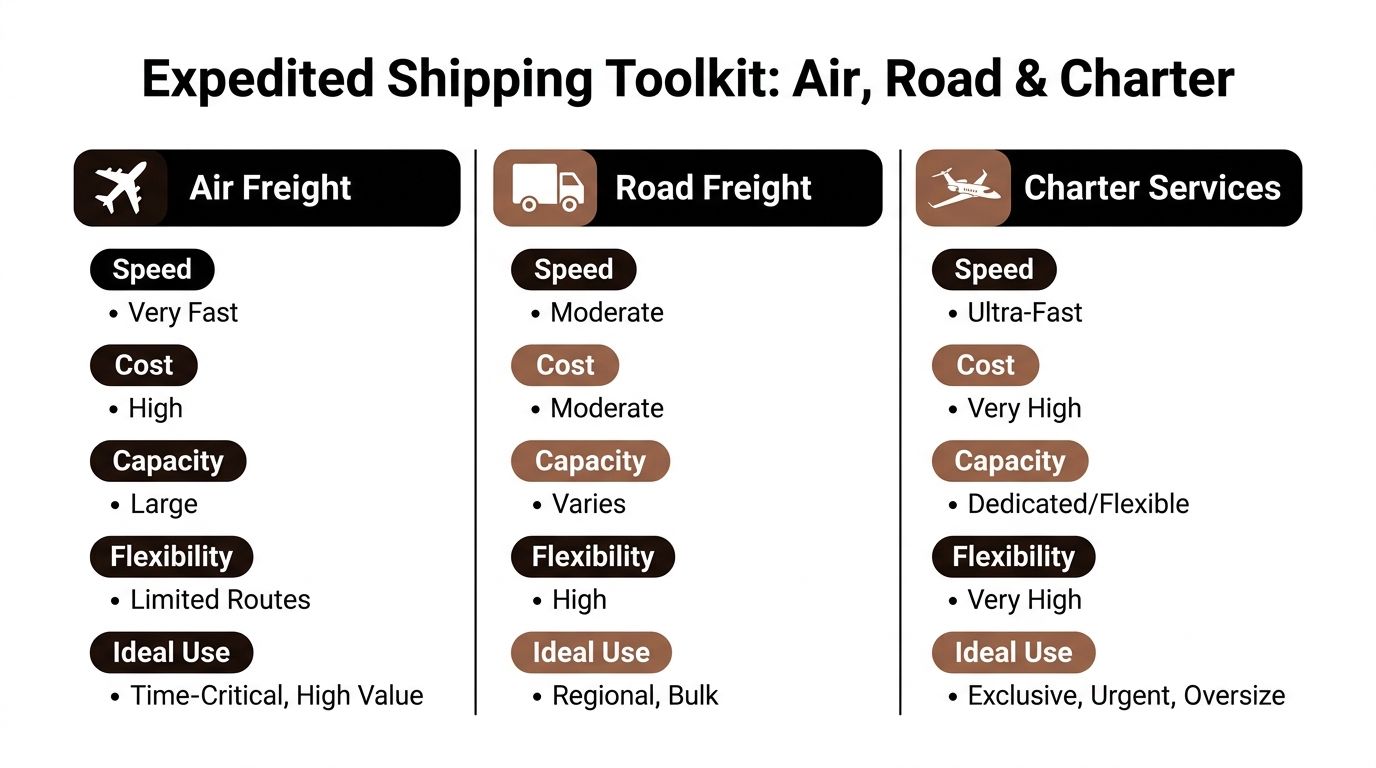
There isn’t one expedited product. There are several, and each solves a different problem. The mistake is choosing a mode because it sounds fast instead of choosing it because it matches the deadline, cargo profile, route, and compliance burden.
Express air freight
If the cargo is high value, highly urgent, or crossing continents, express air freight is usually the first option to assess.
For shipments into the UK, expedited air services deliver to major airports in 1 to 3 business days from EU, Asia, and US origins, with customs clearance averaging 4 to 6 hours via AEO-certified pathways compared with 24 to 72 hours for standard air cargo, according to this air-focused expedited shipping guide. The same source says the total door-to-door transit reduction is typically 50% to 70%, and cites 96% compliance for expedited pharma and life sciences shipments under GDP standards.
That combination makes air freight strong for:
- Pharmaceutical shipments where product condition and documentation timing must line up.
- High-value electronics or components where stockouts cost more than freight.
- Retail launch stock that has to hit a selling window, not just “arrive soon”.
The weakness is cost. Air solves time, but not every budget can absorb it.
Priority road freight
Within the UK and across near-European lanes, priority road freight often gives the best balance between urgency and spend.
It works well when:
- The route is short or regional
- The shipment is palletised or too bulky for economical air
- Collection and delivery flexibility matter
- The consignee needs a narrow slot rather than airport handling
Road is particularly useful for LTL and FTL replenishment, spare parts, retail deliveries, and urgent movements where loading directly onto a vehicle saves time that would otherwise be lost in terminal handling.
For many businesses, this is the practical middle ground. It’s faster than standard groupage, simpler than air, and easier to adapt when delivery points or collection times shift during the day.
Charter and dedicated emergency options
Then there’s the specialist end of the toolkit. Charter services and fully dedicated emergency movements are for jobs where shared capacity won’t do.
These tend to fit:
- Oversized or awkward freight
- Exclusive-use movements
- Very high-value or highly sensitive loads
- Rescue shipments where the commercial cost of delay is extreme
Charter isn’t a routine answer. It’s a controlled intervention. If a plant stoppage, a medical supply issue, or a missed vessel connection creates a severe deadline, a dedicated option may be the cleanest way to restore control.
Comparison of expedited shipping methods
| Method | Typical Transit Time (EU-UK) | Cost Level (vs Standard) | Best For |
|---|---|---|---|
| Express air freight | Usually the fastest option for cross-border urgent freight | High | Intercontinental urgent cargo, high-value goods, regulated shipments |
| Priority road freight | Fast for regional and European lanes, often suitable for next-day or tightly timed delivery windows | Moderate to high | Pallets, urgent LTL or FTL, factory replenishment, retail distribution |
| Charter or dedicated emergency service | Fastest when exclusive capacity is needed | Very high | Rescue loads, oversized cargo, exclusive-use urgent freight |
How to choose the right mode
A quick way to decide is to ask four questions:
What is the deadline?
Is the target a date, a booked slot, an inspection window, or a production restart?What happens if the shipment is late?
If the answer is spoiled stock, a missed launch, or line downtime, the premium may be justified.What is the cargo really sensitive to?
Weight, value, temperature, handling, and customs complexity each push the choice in a different direction.Where is the actual bottleneck?
If the route is fast but the border process is fragile, spending more on air may not fix the problem.
A good expedited decision starts with the deadline and works backwards. A bad one starts with the fastest quoted transit and hopes the rest will sort itself out.
When to Pull the Expedited Trigger
Most businesses shouldn’t use expedited shipping by default. It’s a targeted tool. The right time to use it is when the cost of delay is larger than the freight premium and when the shipment can still be controlled end to end.
Production downtime is the clearest trigger
If a missing component can stop a line, the freight cost becomes secondary very quickly.
A manufacturer waiting on a replacement part doesn’t care whether standard service is cheaper on paper. The comparison is between the premium freight spend and the cost of idle labour, missed output, disrupted downstream schedules, and customer penalties.
That’s why urgent industrial moves are often decided in minutes, not days. The shipment isn’t buying transport. It’s buying continuity.
Retail deadlines and launch dates justify urgency
Retail and e-commerce teams face a different pressure. Their deadlines aren’t mechanical. They’re commercial.
If launch stock misses a sales event, the lost value can’t always be recovered later. The same is true when a fast-selling item runs out and demand is still active. In those moments, expedited freight becomes a margin-protection decision.
Use it when:
- A promotion or launch date is fixed
- A key SKU is out of stock unexpectedly
- Replacement inventory can still arrive in time to protect revenue
- The shipment value outweighs the premium cost
Regulated goods need a different test
For perishables, food products, pharmaceuticals, and other regulated shipments, the trigger isn’t only urgency. It’s whether speed protects compliance.
In the UK, food exports to the EU face post-Brexit SPS checks, and the value of expedited shipping depends on whether shipments are pre-notified and whether documents are prepared in parallel with transport, as explained in this article on expedited shipping for time-sensitive shipments. The same source makes the key point clearly: for regulated cargo, the value is measured in faster regulatory clearance, not just faster carrier transit time.
That changes the decision process.
A chilled food shipment is not “safe” because the truck is fast. It’s safe if:
- The transport timing matches inspection windows
- Pre-notification is completed correctly
- The compliance file is ready before arrival
- The route avoids unnecessary dwell time
Pharmaceutical cargo works the same way. A narrow delivery window only matters if the chain of custody, temperature control, and import documentation hold together under pressure.
A practical ROI test
Before approving expedited freight, ask:
- What is the cost of being late?
- Can a faster mode still meet the true deadline once compliance steps are included?
- Is this a one-off rescue or a recurring planning issue?
- Would partial expedition solve the problem better than expediting the whole shipment?
Sometimes the answer is yes. Sometimes the better answer is to change stock policy, supplier lead times, or customs workflow.
Expedited shipping works best when it solves a defined business risk, not when it covers for a process that keeps failing in the same place.
Navigating the Hidden Costs and Customs Complexities
Many expedited shipments go wrong. The carrier performs exactly as booked, yet the goods still arrive late because the border process wasn’t built into the plan.

For UK importers and exporters, that’s the hidden cost of expedited freight. You can pay a premium for priority transport and still lose the delivery window if declarations, commodity data, supporting documents, or inspection requirements are not aligned.
A useful example comes from a UK business shipping from Poland. An expedited ground movement might reach the UK in 2 days, but customs delays can add 3 to 5 days, making the premium difficult to justify, as discussed in this analysis of the hidden complexity behind expedited shipping benefits.
Fast transport doesn’t equal fast delivery
That sounds obvious, but many teams still buy on the quoted transit alone.
The problem usually shows up in one of four places:
Customs entry issues
Incorrect values, missing tariff detail, or mismatched commercial documents trigger avoidable intervention.Inspection timing
Regulated products may arrive before the inspection window or before supporting documents have been accepted.Duty and Incoterms confusion
If the commercial terms are unclear, the operational team can end up unsure who is responsible for customs charges, paperwork, or delivery obligations. A strong refresher on Incoterms 2020 and safe international trade helps prevent that kind of expensive ambiguity.Disconnected providers
One company handles transport, another handles brokerage, and nobody owns the full deadline.
If no one is coordinating transport and compliance together, your expedited booking is exposed before the vehicle even departs.
Premium freight can hide a poor process
Businesses often treat expedited shipping as a way to “buy back time”. Sometimes that works. Sometimes it masks a planning failure and adds cost on top.
If the same lane keeps needing emergency bookings because paperwork is prepared too late, the issue isn’t the carrier. It’s the workflow.
This short video captures the basic customs challenge well before you commit another urgent cross-border movement:
What fixes the problem
The practical answer is to redefine expedited shipping as an orchestrated end-to-end service.
That means:
- Booking transport only after the customs path is confirmed
- Preparing declarations and supporting files in parallel with collection
- Matching route design to inspection and delivery windows
- Making one party responsible for deadline ownership
When that happens, the premium is easier to defend because it protects a real outcome. When it doesn’t, “expedited” often becomes an expensive way to reach the next bottleneck sooner.
Integrating Services with Multimodal Expedited Solutions
The most reliable expedited plans rarely depend on one mode alone. They combine modes to protect the deadline at the lowest sensible cost.
That’s the practical shift from buying “fast freight” to designing a fast flow.
The route should flex around the bottleneck
A shipment from Asia doesn’t always need full air express from origin to consignee. Sometimes the better answer is a staged solution. Use a slower leg where time allows, then accelerate the critical segment where delay would hurt.
Examples include:
- Ocean plus air when the initial move can travel economically but the final approach to market needs speed
- LCL plus priority road when cargo doesn’t justify full-container urgency but the inland leg must hit a fixed delivery window
- Air inbound plus dedicated final mile when airport arrival is only half the deadline and consignee timing is strict
This is why multimodal planning matters. It gives operators room to spend urgency where urgency has value.
Handover quality decides the result
Multimodal expedition only works if the handovers are controlled tightly.
Each transfer point needs:
- Clear ownership
- Live visibility
- Aligned documentation
- A realistic cut-off and contingency plan
If one leg is fast but the next provider receives incomplete instructions, the whole design loses its value. Strong multimodal planning is less about mode variety and more about removing friction between modes.
A useful reference point is this overview of intermodal transport, when it pays off, and why businesses should consider it. The core lesson is simple. Intermodal success depends on planning the connections, not just choosing the components.
The best expedited solutions don’t always use the fastest single mode. They use the best sequence of modes for the actual deadline.
Visibility matters more in mixed-mode moves
In a standard shipment, a delay update is often just inconvenient. In an expedited multimodal move, a delay update is operationally useful only if it comes early enough to change something.
That’s why visibility has to support action. If a road leg slips, can warehouse labour be retimed? If an inbound flight lands later than planned, can the customs file still clear in sequence? If a final-mile slot is missed, is there an alternative route or delivery point?
Those are the questions that separate a multimodal expedited plan from a collection of premium bookings.
How Multica Group Operationalises Your Urgent Shipments
Urgent freight needs more than a booking desk. It needs control across transport, paperwork, routing, and delivery execution. That’s where an integrated operator has an advantage.

Multica Group is built around that operational model. It combines road, sea, and air with in-house customs clearance, documentation management, support for veterinary inspections, warehousing, cross-docking, and final distribution. For urgent shipments, that matters because the delivery window depends on the whole chain, not one movement.
Parallel customs and transport planning
The first practical advantage is that customs and transport can be prepared together.
That reduces the classic risk in expedited shipping. A carrier moves quickly, but the border file lags behind. By managing documentation in parallel with the physical move, an operator can reduce dead time between arrival, clearance, and final release.
For importers of regulated goods, that’s one of the biggest differences between a “fast service” and a controlled urgent shipment.
Owned fleet and live visibility improve response
Multica also runs a modern, fully owned truck fleet supported by advanced telematics. In urgent work, that changes how problems are handled.
A brokered-only model can struggle when collection times move, consignee availability changes, or a border crossing needs an immediate reroute. A controlled fleet with live tracking gives the operations team more room to adapt while the shipment is still in motion.
That matters for:
- Factory-critical replenishment
- Retail delivery windows
- Cross-dock handoffs
- Temperature-sensitive road segments
Value-added services save time after the linehaul
A lot of delay happens after the main transit leg. Goods arrive in-country, then lose hours in rehandling, storage queues, or disorganised onward distribution.
Cross-docking, warehousing, order picking, labelling, and distribution become part of the expedited answer, not an extra service bolted on at the end. If those steps are coordinated from the start, the shipment can keep moving instead of waiting for the next team to catch up.
For clients comparing premium options, that broader control is often what determines whether the spend is justified.
The economics only work when the stakes are real
Expedited shipping is typically 2 to 3 times pricier than standard services, according to this guide to expedited shipping trade-offs. That same source notes that, for pharma, expedited air freight can cut transit from Asia to the UK from 7 to 10 days to 48 hours, preserving 95% of temperature-sensitive payloads, while the UK pharma import market involved is valued at £22 billion annually.
Those figures explain why urgent logistics can be commercially rational. The premium is high, but the cost of delay, spoilage, non-compliance, or stock failure can be higher.
Teams that need a provider to manage those moving parts can review Multica’s broader approach to international freight forwarding services, especially where urgent movements sit inside a larger cross-border supply chain.
Conclusion Building Resilience with Strategic Speed
Expedited shipping is easy to misunderstand because the label sounds simple. In practice, it isn’t just faster transport. It’s a higher-control service built to hit a usable delivery window.
That’s the key idea to hold onto. If the shipment moves quickly but waits on customs, misses a veterinary inspection slot, or stalls in the final mile, it wasn’t expedited in the way your business needed. Real expedition is an outcome. The vehicle matters, but so do the documents, the handovers, the route design, and the operator’s ability to adjust when something shifts mid-move.
For some jobs, the answer will be express air. For others, priority road will do the work more efficiently. In a number of cases, the smartest choice is multimodal. Use a lower-cost leg where the timeline allows it, then accelerate only the critical segment. That’s how experienced logistics teams protect margins while still defending service levels.
The commercial test is straightforward. Use expedited shipping when lateness costs more than urgency. That might mean avoiding production downtime, protecting a retail launch, preserving product condition, or maintaining compliance on a regulated shipment. If the premium only buys speed on one segment and leaves the rest of the chain unmanaged, it’s money poorly spent.
For UK importers and exporters, especially those moving between the UK and EU or handling regulated goods, the strongest expedited strategy is coordinated from origin to final delivery. It joins transport and compliance into one timeline and gives one team responsibility for the result.
That’s what turns expedited shipping from a costly reaction into a resilience tool.
If you’re moving time-critical freight and need an expedited solution that covers transport, customs, documentation, and final delivery as one managed flow, speak with Multica Group. The team can help you design an urgent UK, EU, or intercontinental shipment plan that protects delivery windows instead of just promising a faster journey.